Cattle Fencing Material Taxonomy: Wire, Mesh, and Post Selection
Compare high-tensile, barbed, and woven wire cattle fencing materials. Learn post spacing, gauge specs, and cost per linear foot for optimal containment.
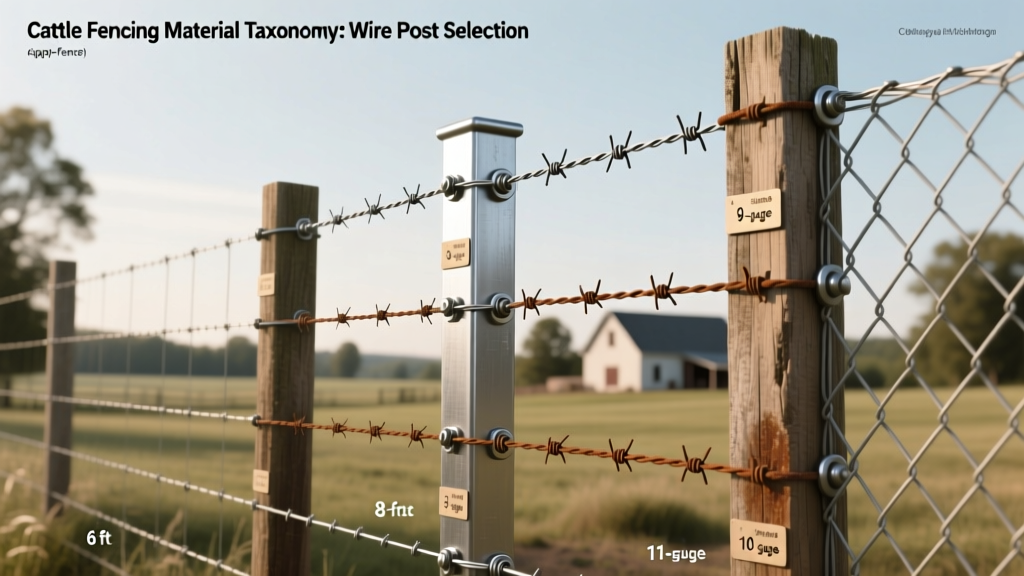
The Core Taxonomy of Cattle Fencing Materials
Selecting the correct cattle fencing requires moving beyond generic "farm fence" categories and understanding the structural taxonomy of wire and post systems. Containment efficacy depends on matching the physical barrier to the herd's behavioral patterns, terrain, and budget. The three primary material classes for cattle containment are woven wire (field fence), high-tensile smooth wire, and barbed wire. Each operates on a fundamentally different mechanical and psychological principle.
Woven Wire: The Physical Barrier
Woven wire, often referred to as field fence or net wire, provides a physical barrier that prevents calves from wandering through and stops predators from entering. The industry standard designation for cattle is typically a 1047 or 1147 style (10 or 11 horizontal wires, 47 inches high). When selecting woven wire, the critical distinction is between hinge-joint and fixed-knot construction.
- Hinge-Joint: The vertical and horizontal wires are wrapped around each other. If a post breaks or the fence is impacted, the joint can slide, causing the fence to lose vertical rigidity and sag. It is cheaper but less durable under high stress.
- Fixed-Knot: The vertical wires are locked to the horizontal wires with a separate piece of wire wrapped tightly around the intersection. This maintains vertical spacing and structural integrity even if a post fails or a 1,200-pound animal pushes against it. Fixed-knot is mandatory for high-tensile woven applications.
High-Tensile Smooth Wire: The Psychological and Elastic Barrier
High-tensile wire relies on psychological deterrence and elasticity. Typically installed in 5 to 7 strands, it requires the cattle to be trained to respect the boundary (often by introducing a temporary electrified polywire inside the perimeter for two weeks). High-tensile wire is manufactured from high-carbon steel, allowing it to be pulled to 150–200 pounds of tension without snapping. Its primary advantage is memory; if a tree falls on it or an animal pushes through, the wire will stretch and return to its original shape once the pressure is released.
Barbed Wire: The Deterrence Multiplier
Barbed wire is rarely used as a standalone primary fence for modern rotational grazing due to the risk of hide damage and injury, but it remains a staple for boundary lines. Standard cattle barbed wire features two points per barb, spaced 4 to 5 inches apart. It is typically installed in 4 to 5 strands. According to Penn State Extension, barbed wire is most effective when combined with a smooth bottom wire to prevent calves from rolling under the lowest barb.
Material Selection Decision Matrix
Choose Fixed-Knot Woven Wire if: You are managing cow-calf pairs, operating near highways, or dealing with high predator pressure (coyotes/dogs). Expect to pay a premium for material and installation labor.
Choose High-Tensile Smooth Wire if: You are managing adult steers or cows in large rotational grazing paddocks, have uneven or rocky terrain, and want to minimize material costs while maximizing fence lifespan.
Choose Barbed Wire if: You are establishing long, straight property boundaries with adult cattle, need to minimize maintenance on brush-heavy lines, and are not concerned with predator ingress.
Post Material Selection and Spacing Metrics
The wire is only as strong as the posts anchoring it. Post selection dictates the tension capacity of the entire cattle fencing system. The standard taxonomy divides posts into line posts, corner posts, and brace posts.
| Post Type | Material Specs | Max Spacing (High-Tensile) | Estimated Cost (2026) |
|---|---|---|---|
| Steel T-Post | 1.33 lb/ft, 7 ft length, studded | 16 to 20 feet | $7.50 - $9.00 each |
| Treated Wood Line Post | 3 to 4-inch diameter, CCA treated | 20 to 25 feet | $12.00 - $18.00 each |
| Wood Corner/End Post | 5 to 6-inch diameter, 8 ft length | N/A (Corners only) | $28.00 - $45.00 each |
| Fiberglass Composite | 1.25-inch solid rod, UV stabilized | 10 to 12 feet (woven only) | $8.00 - $11.00 each |
For high-tensile wire systems, Texas A&M AgriLife Extension recommends using 1.33 lb/ft T-posts rather than the lighter 1.25 lb/ft variants. The heavier post resists bending under the 150+ pounds of lateral tension exerted by the wire. Furthermore, T-posts must be equipped with plastic or metal post clips that allow the wire to slide freely; crimping the wire directly to a T-post will cause the wire to snap under thermal contraction in winter.
Wire Gauge and Tensile Strength Specifications
Understanding wire gauge and tensile class is non-negotiable for cattle fencing. The lower the gauge number, the thicker the wire. However, thickness alone does not dictate breaking strength; the carbon content and galvanization class are equally critical.
The 12.5-Gauge Standard
For high-tensile cattle fencing, 12.5-gauge wire is the industry baseline. This wire typically boasts a minimum tensile strength of 200,000 PSI (pounds per square inch) and a breaking strength of approximately 1,800 pounds. It must be Class 3 galvanized (zinc-coated), which provides roughly 0.80 ounces of zinc per square foot. Class 1 galvanization will rust through within 7 to 10 years in humid climates, whereas Class 3 extends the functional lifespan to 30+ years.
Corner Bracing Mechanics
The terminal ends of a high-tensile fence bear the cumulative tension of the entire run. A standard diagonal brace is insufficient for modern high-tensile loads. You must construct an H-brace. According to guidelines from the Noble Research Institute, a proper H-brace utilizes a 5-inch vertical corner post set 3.5 feet into the ground, a 4-inch horizontal brace post, and a 2.5-inch diagonal brace. The assembly is cinched together using #9 galvanized brace wire, twisted with a fencing plier until the wood fibers compress, creating a rigid, self-supporting anchor that will not pull out of the ground under 1,000+ pounds of cumulative wire tension.
Cost Breakdown and Installation Variables
Material costs for cattle fencing fluctuate based on steel commodity prices and regional timber availability. The following estimates reflect 2026 market averages for materials only, excluding heavy equipment rental and labor.
2026 Material Cost Per Linear Foot (Estimates)
- 5-Strand High-Tensile Smooth Wire: $0.85 – $1.20 / linear foot
- 4-Strand Barbed Wire: $1.10 – $1.50 / linear foot
- 1047 Hinge-Joint Woven Wire: $1.90 – $2.40 / linear foot
- 1147 Fixed-Knot High-Tensile Woven: $2.80 – $3.60 / linear foot
Note: Adding electrification (solar energizer, polytape, and grounding rods) adds an initial capital cost of $400–$800 per energizer unit, but reduces long-term maintenance by 40% by preventing animals from pushing on the physical wire.
Common Failure Modes and Edge Cases
Even premium materials fail if the installation ignores environmental and behavioral edge cases. Anticipating these failure modes during the material selection phase prevents costly rebuilds.
"The most common failure in high-tensile cattle fencing is not the wire breaking, but the corner posts pulling inward. This is almost always caused by setting the corner post too shallow or failing to use an H-brace configuration. A 4-inch post set only 2 feet deep will lean within six months under the tension of five high-tensile strands."
Thermal Expansion and Contraction
Steel wire expands in summer heat and contracts in winter cold. A 1,000-foot run of 12.5-gauge wire can change length by several inches across seasonal temperature swings. If high-tensile wire is pulled to its absolute maximum tension on a 95°F August day, the thermal contraction in January will increase the tension beyond the wire's yield point, causing it to snap or pull the corner posts out of alignment. Always tension high-tensile wire to roughly 70% of its rated capacity (around 150 lbs of tension) using a calibrated tension gauge, leaving room for winter contraction.
Grounding and Vegetation Shorts
If you opt to electrify your cattle fencing to improve containment psychology, the energizer's ground system is more critical than the hot wire itself. In dry, rocky, or sandy soils, standard copper-clad ground rods fail to complete the circuit. In these edge cases, you must install a ground-wire return system, running alternating hot and ground wires on the fence itself, ensuring the animal completes the circuit the moment its nose touches the wire, regardless of soil moisture.