Cost to Replace a Fence: Trex Seclusions vs. Horizons 2026 Guide
Compare the true cost to replace a fence using Trex Seclusions vs. Trex Horizons. Get 2026 pricing, installation specs, and material breakdowns.
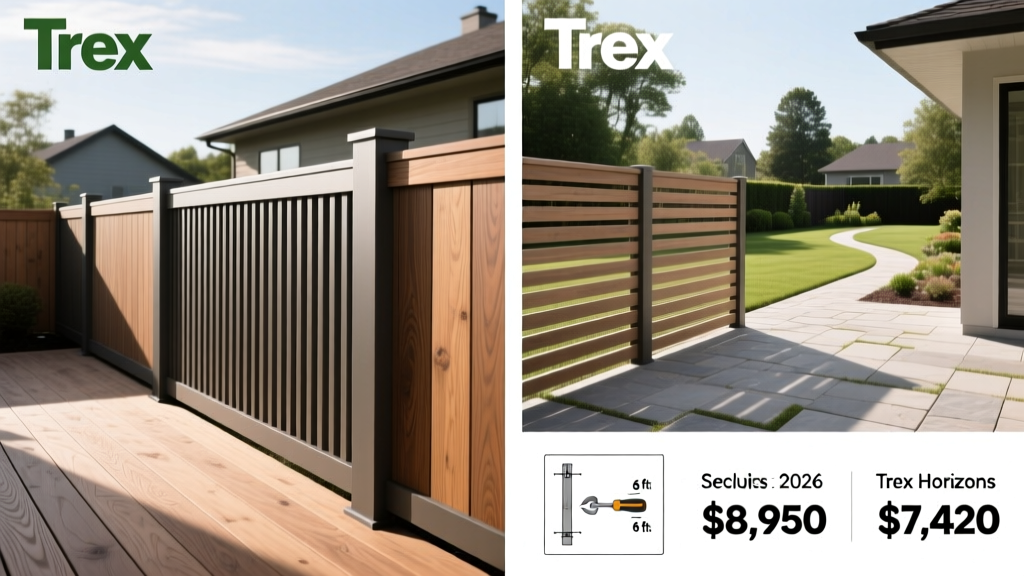
The Premium Composite Shift: Beyond Basic Wood Replacement
When calculating the total cost to replace a fence, homeowners increasingly bypass traditional pressure-treated pine in favor of engineered composite systems. Wood fencing requires annual sealing, warps under UV exposure, and typically fails at the ground line within 12 to 15 years. Composite fencing, manufactured from a blend of recycled high-density polyethylene (HDPE) and reclaimed wood fibers, pushes that lifespan past 25 years with near-zero maintenance.
However, the composite market is dominated by specific product lines that dictate your final budget. Trex Fencing, manufactured under license by Barrette Outdoor Living, offers two distinct architectural systems: Trex Seclusions (vertical privacy) and Trex Horizons (horizontal modern). Understanding the structural and material differences between these two lines is critical for accurate project estimating in 2026.
Brand Line 1: Trex Seclusions (Vertical Privacy System)
Trex Seclusions is the flagship vertical privacy line, designed to mimic the look of traditional board-on-board or tongue-and-groove wood fencing while utilizing a fully interlocking composite profile.
Material Specifications & Structural Integrity
- Picket Profile: 5.5-inch wide interlocking tongue-and-groove pickets. This eliminates the visible gaps that occur in wood fencing as boards shrink and warp over time.
- Post Architecture: The system utilizes a structural 5x5 pressure-treated wood or galvanized steel inner post, sleeved by a 6x6 composite post cover. This dual-layer approach provides the structural load-bearing capacity required to withstand 90-mph wind loads while maintaining a massive, premium aesthetic.
- Rail Reinforcement: The top and bottom composite rails feature an internal extruded aluminum channel. This prevents the composite material from sagging over the 8-foot span between posts, a common failure mode in unreinforced vinyl or early-generation composite fences.
- Color Options: Woodland Brown, Saddle, and Winchester Grey. All colors feature a co-extruded outer cap layer that resists UV fading and moisture absorption.
Brand Line 2: Trex Horizons (Horizontal Modern System)
Introduced to capture the modern architectural trend, Trex Horizons utilizes horizontal composite boards with intentional semi-privacy gaps (typically 1/4-inch to 1/2-inch). While visually striking, horizontal fencing introduces unique engineering challenges that directly impact the cost to replace a fence.
The Steel-Reinforcement Requirement
Composite materials are heavier than wood and possess a higher coefficient of thermal expansion. When installed horizontally across an 8-foot span, composite boards are highly susceptible to gravitational sagging and thermal bowing. To counteract this, the Horizons system requires heavy-duty steel post inserts and specialized steel rail brackets. The horizontal boards are not routed through the posts; instead, they are face-mounted using hidden steel clip systems. This hardware-intensive installation method increases both material costs and labor time by approximately 20% to 30% compared to the Seclusions line.
2026 Cost Matrix: Seclusions vs. Horizons (150 Linear Feet)
The following matrix breaks down the estimated cost to replace a fence for a standard 150-linear-foot backyard perimeter, assuming flat terrain and standard 6-foot height requirements.
| Cost Category | Trex Seclusions (Vertical) | Trex Horizons (Horizontal) |
|---|---|---|
| Demolition & Haul-Away (Old Wood) | $1,125 - $1,500 | $1,125 - $1,500 |
| Composite Materials (Panels, Rails, Caps) | $5,250 - $6,750 ($35-$45/LF) | $6,750 - $8,250 ($45-$55/LF) |
| Posts, Sleeves & Internal Hardware | $1,800 - $2,400 | $2,500 - $3,200 (Steel inserts) |
| Concrete & Footing Materials | $450 - $600 | $450 - $600 |
| Professional Installation Labor | $3,750 - $5,250 ($25-$35/LF) | $5,250 - $6,750 ($35-$45/LF) |
| Total Estimated Project Cost | $12,375 - $16,500 | $16,075 - $20,300 |
Note: Pricing reflects 2026 national averages for premium composite systems. Regional labor variances and supply chain fluctuations can shift totals by ±10%.
Hidden Replacement Variables: Demolition and Footing Extraction
Contractor estimates frequently omit the true cost of site preparation. If you are replacing an existing fence, the old concrete footings present a major variable.
Expert Warning: The Concrete Footing Trap
Never assume a contractor will extract old concrete footings as part of standard "demolition." Pulling a 120-pound concrete bell-footer from clay-heavy soil requires a mechanical post puller, a hydraulic jack, or manual excavation with a digging bar. If left in the ground, the new composite posts must be offset, which can violate property line setbacks. Budget an additional $25 to $45 per post for complete concrete extraction and hole re-augering.
Furthermore, replacing a fence on sloped terrain requires "stepping" or "racking" the panels. Trex Seclusions can be stepped by cutting the pickets at an angle and using custom composite angle-cutters, adding roughly $8 to $12 per linear foot in labor. Trex Horizons, due to its rigid horizontal geometry and steel bracketry, is significantly more difficult to step and is generally recommended only for flat or mildly graded terrain.
Installation Framework: Routed Posts vs. Bracket Systems
The methodology your installer uses will dictate the long-term structural integrity of the fence. According to guidelines from Barrette Outdoor Living, the parent manufacturer, proper post-routing is non-negotiable for the Seclusions line.
Seclusions: The Routed Post Method
For Seclusions, the 6x6 composite sleeves are pre-routed at the factory or on-site using a specialized plunge router. The top and bottom rails slide directly into these routed holes. This creates a seamless, hardware-free connection point that prevents water intrusion into the post cavity. Critical Edge Case: If the inner structural post is wood, it must be elevated 1/2 inch above the final grade using a galvanized post standoff. If the wood post sits directly in the concrete footing, capillary action will draw moisture up into the wood, causing it to rot and expand, which will eventually crack the composite sleeve from the inside out.
Horizons: The Steel Bracket Method
Horizons relies on surface-mounted steel brackets. The composite posts are solid or heavily reinforced, and the horizontal rails are attached via hidden cleats. While this allows for easier on-site adjustments, it introduces dozens of stainless steel screws into the composite material. Installers must use exact torque settings on their impact drivers; over-torquing will strip the composite threads, while under-torquing will result in rattling rails during high-wind events.
Frequently Asked Questions
Does the cost to replace a fence with composite include a warranty?
Yes. Both Trex Seclusions and Horizons are backed by a 25-year limited residential warranty against fading, staining, and structural failure. However, this warranty is strictly voided if the fence is installed in direct contact with soil or standing water. Proper gravel drainage at the base of the post is mandatory.
Can I install Trex Fencing on an existing concrete wall?
Which line offers better wind resistance?
Trex Seclusions offers superior wind resistance. The solid, interlocking tongue-and-groove vertical profile acts as a continuous windbreak, but the routed rail system distributes sheer force evenly across the heavy 6x6 posts. Horizons, with its intentional horizontal gaps, allows some wind to pass through, reducing lateral sheer pressure, but the bracket connections are more vulnerable to extreme uplift forces during severe storms.