Hog Panel Fence Specifications & Load Ratings Guide
Explore technical specifications, load ratings, and galvanization classes for hog panel fences to ensure structural integrity and longevity.
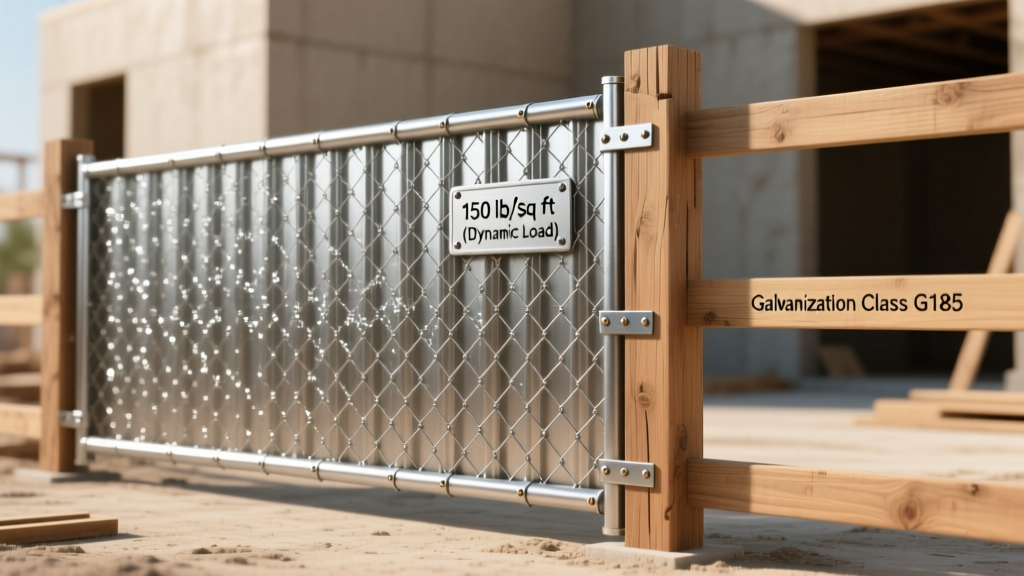
Defining the Hog Panel: Dimensions and Wire Geometry
Unlike woven field fences that rely on continuous wire wrapping, a true hog panel fence utilizes a rigid, resistance-welded grid structure. This rigidity provides exceptional impact resistance against rooting animals and heavy livestock leaning. Standard commercial hog panels measure exactly 16 feet in length and 50 to 52 inches in height. The most critical specification is the grid aperture: true hog panels feature a 4-inch by 4-inch square grid, which prevents piglets and small predators from passing through, whereas 6-inch by 6-inch grids are technically classified as cattle or utility panels.
The wire thickness is almost universally 4-gauge (0.2253 inches or 5.72 mm in diameter). This specific gauge offers the optimal balance between panel flexibility for uneven terrain and the structural stiffness required to resist deformation under lateral loads. A standard 4-gauge, 4x4-inch grid panel weighs approximately 34 to 36 pounds, providing a substantial mass that dampens kinetic energy from animal impacts.
Material Science: Tensile Strength and Yield Ratings
The performance of a hog panel under stress is dictated by its carbon content and drawing process. Manufacturers produce panels in two primary metallurgical grades:
- Low-Carbon Steel (Standard): Yield strength typically ranges from 45,000 to 55,000 psi. These panels are more malleable, allowing them to conform to rolling terrain without permanent deformation. However, they will permanently bend if subjected to concentrated point loads exceeding 250 lbs.
- High-Carbon Steel (High-Tensile): Yield strength ranges from 80,000 to 100,000+ psi. High-tensile hog panels resist bending and return to their original shape after severe impact. They are strictly required for high-density containment or areas with heavy predator pressure, though they are more difficult to cut and shape on-site.
Corrosion Resistance: Galvanization Classes Explained
The longevity of a hog panel fence is entirely dependent on its zinc coating. The ASTM A641 Standard governs zinc-coated carbon steel wire, classifying coatings by weight. Selecting the wrong class for your climate is the most common procurement error in agricultural fencing.
| Galvanization Class | Zinc Coating Weight | Coating Thickness | Expected Lifespan (Humid) | Best Application |
|---|---|---|---|---|
| Class 1 (Commercial) | 0.28 oz/sq ft | ~0.45 mils | 5 - 8 Years | Temporary corrals, arid climates, indoor use |
| Class 3 (Heavy) | 0.80 oz/sq ft | ~1.28 mils | 15 - 20+ Years | Permanent perimeter fencing, high humidity, coastal zones |
| Class 3 + PVC | 0.80 oz/sq ft + 12 mil PVC | ~13.0 mils total | 25 - 30+ Years | Highly corrosive soils, equestrian facilities, premium estates |
During the resistance welding process, the extreme heat vaporizes the zinc at the intersection points. High-quality manufacturers apply a secondary zinc-rich paint or electro-galvanize the panels post-welding to seal these vulnerable nodes. Always inspect the weld intersections for dark, uncoated spots before purchase.
Structural Load Capacity and Post Spacing Matrix
A hog panel acts as a semi-rigid membrane. While the 4x4 grid allows approximately 75% wind passage, the sheer surface area of a 16-foot panel can generate significant lateral wind load. Furthermore, rooting hogs apply concentrated upward and outward forces at the bottom 12 inches of the fence.
Line Post Spacing Requirements
Post spacing must be calibrated to the specific animal load and terrain. Referencing guidelines from the Beef Magazine Fencing Guide and agricultural engineering standards, use the following matrix:
- High-Density Hog Containment: 8-foot post spacing. Required to prevent panels from bowing outward when animals lean or root against the base.
- Cattle and Equine Perimeter: 16-foot post spacing (one post per panel). Acceptable only if the panel is securely fastened at the top, middle, and bottom, and the terrain is flat.
- Uneven/Rolling Terrain: 8-foot post spacing. The panel must be stepped or contoured, requiring closer post intervals to manage torsional stress.
Corner Bracing and Anchor Specifications
Hog panels do not carry structural tension like high-tensile smooth wire; they are load-bearing barriers. Therefore, corner posts do not require massive inline tension bracing, but they must resist the leverage of the rigid panels pushing against them during high winds or animal crowding.
"The most frequent failure in welded wire fencing is not the wire itself, but the corner post pulling inward due to improper brace geometry. An H-brace must utilize an 8-foot horizontal post and a 45-degree diagonal, set a minimum of 36 inches into undisturbed soil."
For 50-inch hog panels, the horizontal brace post should be placed at 34 inches above grade (roughly two-thirds the height of the fence). Use 6-inch diameter treated wood posts for corners and gate ends, and standard 1.25 lb/ft steel T-posts (minimum 6.5 feet total length, driven 18 inches deep) for line posts.
Fastener Shear Strength and Attachment Protocols
Attaching a rigid 35-pound panel to a post requires fasteners that can handle both shear and pull-out forces. Never use standard fencing staples on steel posts, and never use light-gauge aluminum clips on wood posts.
- Wood Post Attachment: Use 12-gauge (0.105 inch) hot-dipped galvanized fence staples, minimum 1.5 inches in length. Drive them at alternating angles to lock the wire. Place one staple at every horizontal wire intersection along the post (typically 12 to 13 staples per 16-foot panel).
- Steel T-Post Attachment: Use 9-gauge (0.148 inch) galvanized T-post clips. These heavy-duty clips wrap around the T-post stud and twist around the panel wire. Standard 11-gauge clips will deform and pop off under the torsional stress of a hog panel.
Common Failure Modes and Edge Cases
Understanding how hog panel fences fail allows for proactive mitigation during the design phase.
In regions with deep frost lines, if line posts heave upward during the freeze-thaw cycle while the rigid 16-foot panel remains anchored to adjacent stable posts, the panel will buckle outward. Always set line posts below the local frost line, or use a slip-sleeve on the panel ends to allow for vertical micro-movement during spring thaws.
Another critical edge case is galvanic corrosion. If you attach galvanized hog panels to pressure-treated wood posts using standard steel fasteners, the copper in the wood treatment (like ACQ or MCQ) will rapidly corrode the fasteners. Always use hot-dipped galvanized or stainless steel fasteners when attaching panels to modern pressure-treated lumber.
Procurement Checklist for 2026
When sourcing hog panels for a permanent installation, verify the following specifications on the manufacturer's tag or invoice:
- Wire diameter explicitly stated as 4-gauge (0.225").
- Galvanization rated as Class 3 (minimum 0.80 oz/sq ft).
- Weld intersections treated with secondary zinc coating.
- Panel weight no less than 32 lbs (indicates true gauge thickness without excessive manufacturing tolerances).
By strictly adhering to these metallurgical and structural specifications, a hog panel fence will provide a maintenance-free, highly secure barrier capable of withstanding decades of environmental and biological stress.