Plastic Fencing Lifespan: Durability Analysis & Failure Modes
Analyze plastic fencing durability, UV degradation, thermal expansion, and true lifespan of PVC and HDPE materials to avoid premature failure.
Material Composition: Why Not All Plastic Fences Are Equal
The term "plastic fencing" is a commercial misnomer that groups vastly different polymers under a single umbrella. Evaluating the durability and true lifespan of these systems requires dissecting the specific resin chemistry, extrusion method, and additive packages used in manufacturing. A fence marketed as "vinyl" may fail in five years if extruded with the wrong impact modifiers, while a properly formulated system will outlast pressure-treated timber by decades.
Cellular PVC vs. Solid HDPE vs. Recycled Plastic Lumber (RPL)
Understanding the baseline mechanical properties of the three primary plastics used in fencing is the first step in lifespan analysis. According to standards maintained by ASTM Committee F14 on Fences, structural requirements vary wildly based on the polymer base.
| Material Type | Modulus of Elasticity (psi) | Thermal Expansion (in/in/°F) | Primary Failure Mode | Expected Lifespan |
|---|---|---|---|---|
| Rigid Cellular PVC | 350,000 - 400,000 | ~3.0 x 10^-5 | UV Chalking / Brittle Fracture | 30 - 50+ Years |
| Solid HDPE | 110,000 - 150,000 | ~10.0 x 10^-5 | Creep (Sagging) / Buckling | 20 - 40 Years |
| Recycled Plastic Lumber | 80,000 - 120,000 | ~12.0 x 10^-5 | Heavy Sagging / Warping | 15 - 30 Years |
The Chemistry of Degradation: UV Stabilization and Chalking
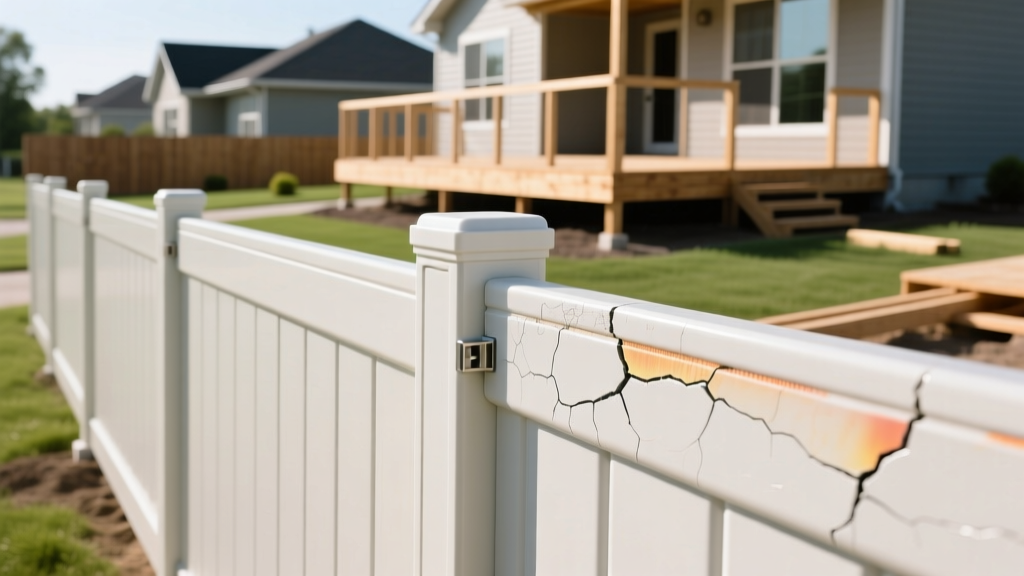
The most common aesthetic failure in plastic fencing is "chalking"—a powdery white residue that forms on the surface as the polymer matrix breaks down under ultraviolet radiation. This is not merely a cosmetic issue; chalking indicates that the UV inhibitors have been depleted, exposing the underlying polymer chain to photo-oxidative degradation, which rapidly destroys impact resistance.
The Titanium Dioxide (TiO2) Mandate
To prevent UV degradation, manufacturers must incorporate Titanium Dioxide (TiO2) into the resin. However, the crystalline structure of the TiO2 dictates the fence's lifespan. Rutile TiO2 absorbs UV light and dissipates it as harmless heat. Anatase TiO2, a cheaper alternative, acts as a photocatalyst that actually accelerates the breakdown of the PVC polymer when exposed to sunlight.
For a plastic fence to achieve a 30-year lifespan without severe chalking, the extrusion formula must contain a minimum of 8 to 10 parts per hundred resin (phr) of Rutile TiO2. Budget manufacturers often drop this to 4 phr or substitute Anatase to cut costs, resulting in severe chalking and embrittlement within 3 to 5 years in high-sun environments like the American Southwest or Florida.
Thermal Expansion: The Hidden Killer of Plastic Fences
Plastic polymers expand and contract significantly more than wood or metal. If a fencing system is installed without accounting for the Coefficient of Linear Thermal Expansion (CLTE), the resulting thermal stress will cause rails to buckle, posts to crack, and brackets to shear.
"A 100°F seasonal temperature swing will cause a 6-foot HDPE rail to expand by nearly 0.75 inches. If the installer pins both ends tightly during a cold winter morning, that rail will violently bow or snap the post brackets by mid-July."
— Field Engineering Guidelines for Polymeric Fencing Systems
Installation Gap Matrix
To prevent thermal buckling, installers must leave specific expansion gaps at the end of every rail and picket. Use the following matrix based on the installation temperature relative to the region's historical high:
- PVC (CLTE 3.0 x 10^-5): Leave 1/8" gap per 10 feet of continuous rail if installed at 50°F.
- HDPE (CLTE 10.0 x 10^-5): Leave 3/8" gap per 10 feet of continuous rail if installed at 50°F.
- RPL (CLTE 12.0 x 10^-5): Leave 1/2" gap per 10 feet. (Refer to the USDA Forest Products Lab guidelines on RPL for specific span limitations).
Cold Weather Impact Resistance and Brittle Fracture
While plastic fences do not rot, they are susceptible to brittle fracture in sub-freezing temperatures if the correct impact modifiers are not compounded into the resin. Rigid PVC is naturally brittle. To meet the impact requirements of AAMA 603 standards for rigid PVC profiles, manufacturers must add impact modifiers.
CPE vs. Acrylic Impact Modifiers
Chlorinated Polyethylene (CPE) is a common, low-cost impact modifier. It works well in moderate climates but loses its elastomeric properties below 20°F (-6°C). A CPE-modified PVC fence struck by a snowblower or a rogue baseball in January will shatter like glass. For installations in northern climates, specify PVC fencing that utilizes Acrylic Impact Modifiers (such as Paraloid). Acrylic modifiers maintain their ductility and energy-absorption capabilities down to -20°F (-29°C), preventing catastrophic brittle fractures during winter impacts.
Real-World Failure Diagnostics
When assessing an existing plastic fence or evaluating a warranty claim, use this diagnostic framework to identify the root cause of failure:
| Symptom | Root Cause | Corrective Action / Prevention |
|---|---|---|
| Heavy white chalky residue on surface | Insufficient Rutile TiO2 or use of Anatase TiO2. | Cannot be reversed. Replace with co-extruded PVC featuring a high-TiO2 cap layer. |
| Horizontal rails bowing downward (creep) | HDPE/RPL material spanning too far without support; low modulus of elasticity. | Reduce post spacing to 6' centers or install internal aluminum rail stiffeners. |
| Rails buckling and popping out of brackets | Thermal expansion; installed too tightly in cold weather without expansion gaps. | Detach brackets, trim 1/4" from rail ends to create expansion gaps, and re-secure. |
| Shattering upon minor impact in winter | Use of CPE impact modifiers instead of acrylic; thin wall extrusion. | Replace shattered sections with acrylic-modified, thick-walled PVC profiles. |
Lifespan ROI: Cost Per Year of Service
When analyzing durability, the initial material cost is less relevant than the amortized cost over the system's functional lifespan. While plastic fencing requires a higher upfront capital expenditure than pressure-treated pine, the elimination of maintenance (staining, sealing, rot-replacement) drastically alters the long-term ROI.
| Fencing Material | Installed Cost (per lin. ft.) | Annual Maintenance Cost | Expected Lifespan | Amortized Cost / Year |
|---|---|---|---|---|
| Pressure-Treated Pine | $25 - $35 | $2.50 (stain/seal every 2 yrs) | 15 Years | $3.66 - $4.83 |
| Cellular PVC (Premium) | $45 - $65 | $0.15 (occasional washing) | 40 Years | $1.16 - $1.66 |
| Solid HDPE (Reinforced) | $55 - $75 | $0.10 (occasional washing) | 35 Years | $1.60 - $2.17 |
Actionable Procurement Specifications
To ensure you are purchasing a plastic fencing system that will actually achieve its advertised lifespan, require the manufacturer or supplier to provide a technical data sheet (TDS) verifying the following specifications before signing a contract:
- ASTM F964 Compliance: The PVC profiles must meet or exceed the physical property requirements of ASTM F964 for rigid PVC fencing.
- Co-Extrusion Technology: Specify a dual-layer co-extruded profile. The inner core should be made of recycled or cellular PVC for structural mass and cost-efficiency, while the outer cap layer (minimum 0.015" thick) must contain the concentrated UV inhibitors (10+ phr Rutile TiO2) and acrylic impact modifiers.
- Notched Izod Impact Testing: The TDS should show an Izod impact resistance (ASTM D256) of at least 1.5 ft-lbs/in of notch at 73°F, and crucially, no less than 0.8 ft-lbs/in at 32°F to ensure cold-weather durability.
- Deflection Limits: For horizontal rails, the manufacturer must guarantee a maximum deflection of L/240 (where L is the span length) under a uniform load of 50 lbs, ensuring the fence will not visibly sag over time.
By shifting the evaluation criteria from aesthetic preference to polymer chemistry and mechanical engineering, property owners and contractors can specify plastic fencing systems that deliver true, multi-decade durability without succumbing to the premature failure modes that plague poorly formulated alternatives.