Engineered Wood vs Solid Hardwood: Scenario Matching Guide
Discover exactly when to install engineered wood versus solid hardwood. Match your flooring to specific rooms, subfloors, and climate conditions.
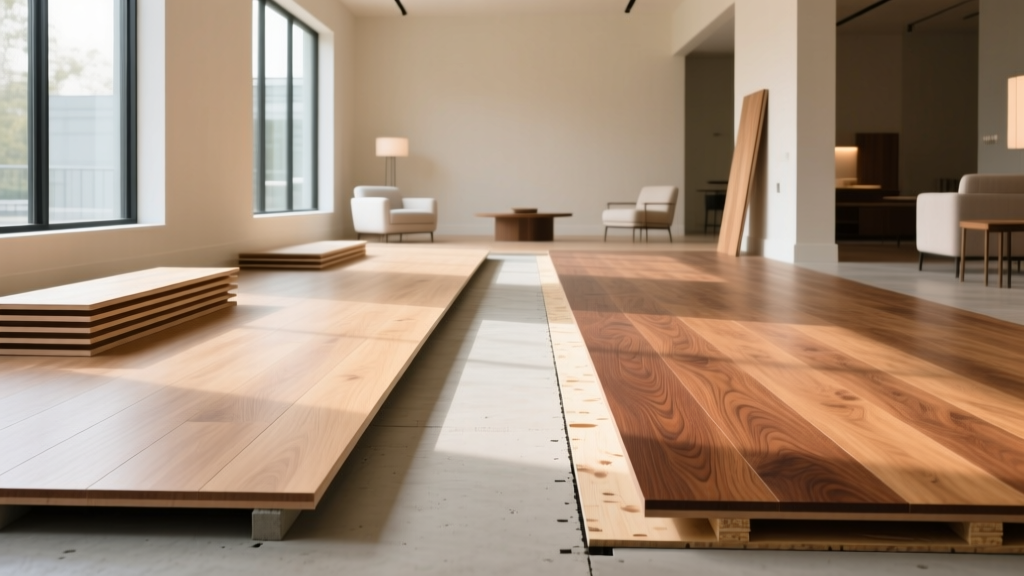
The Core Difference: Dimensional Stability
The debate between solid hardwood and engineered wood often centers on aesthetics, but the true differentiator is dimensional stability. Solid hardwood is milled from a single, continuous piece of timber, typically 3/4-inch thick. Because wood is hygroscopic, solid planks expand and contract significantly across the grain in response to ambient humidity fluctuations. This makes solid hardwood highly susceptible to cupping, gapping, and crowning when installed in environments with moisture volatility.
Engineered wood solves this structural vulnerability through cross-lamination. A top veneer of genuine hardwood (ranging from 1.5mm to 6mm thick) is bonded to a core of 5-ply to 11-ply Baltic birch or high-density fiberboard (HDF). The core layers are stacked with their wood grains running perpendicular to one another. This cross-grain construction restricts lateral movement, making engineered wood up to 75% more dimensionally stable than solid hardwood. According to the National Wood Flooring Association (NWFA), this structural advantage fundamentally dictates where each product can and cannot be installed.
Scenario Matrix: Where Each Flooring Wins
Choosing between the two materials requires matching the flooring's physical properties to the specific environmental demands of the room. Use this decision matrix to determine the optimal fit for your project.
| Installation Scenario | Solid Hardwood | Engineered Wood | Optimal Choice |
|---|---|---|---|
| Below-Grade (Basements) | High risk of cupping/mold | Stable with proper vapor barrier | Engineered Wood |
| Over Radiant Heating | Prone to severe gapping | Stable (max 85°F surface temp) | Engineered Wood |
| Concrete Subfloors | Cannot be nailed; requires sleepers | Can be glued directly or floated | Engineered Wood |
| Wide Planks (>5 inches) | High expansion/contraction risk | Minimal lateral movement | Engineered Wood |
| Nail-Down over Plywood | Excellent holding power | Good, but requires specific cleats | Solid Hardwood |
| Historic Home Restoration | Authentic, matches original milling | Often visually discernible on edges | Solid Hardwood |
Deep Dive: High-Moisture and Below-Grade Applications
Basements, kitchens, and half-baths present unique moisture challenges. Solid hardwood is strictly prohibited for below-grade installations by virtually all manufacturers due to the high probability of moisture wicking from the concrete foundation. Engineered wood, however, can be installed below grade, provided strict moisture mitigation protocols are followed.
Before installing engineered wood over a concrete slab, you must conduct a Moisture Vapor Emission Rate (MVER) test using a calcium chloride kit. If the slab emits more than 3 lbs of moisture per 1,000 square feet over 24 hours, a topical moisture barrier is mandatory. Modern silane-terminated polymer adhesives (such as Bona Silane or Bostik GreenForce) act as both a bonding agent and a Class I vapor retarder, streamlining the installation process. Furthermore, maintaining indoor relative humidity between 35% and 55% is critical; the Environmental Protection Agency (EPA) notes that proper humidity control not only preserves flooring but also mitigates indoor air quality issues related to mold and VOC off-gassing.
Do not assume engineered wood requires less acclimation time than solid hardwood. While the core is stable, the top veneer still reacts to ambient conditions. Unbox the planks and let them acclimate in the installation room for a minimum of 48 to 72 hours, ensuring the HVAC system is running at normal living temperatures.
Deep Dive: Radiant Heat and Concrete Subfloors
Radiant floor heating systems are increasingly standard in modern residential builds, but they create a hostile environment for solid hardwood. The concentrated, localized heat drives moisture out of the wood rapidly, leading to irreversible checking (splitting along the grain) and severe gapping between boards.
Engineered wood is the only viable wood option for radiant heat, but specific parameters must be met:
- Maximum Surface Temperature: The floor surface must never exceed 85°F (29°C). Use a floor thermostat with a high-limit sensor.
- Installation Method: Floating or full-spread glue-down installations are required. Never nail or staple engineered wood over radiant tubing, as this risks puncturing the hydronic lines or electrical mats.
- Wood Species Selection: Avoid species with high dimensional movement coefficients, such as hickory or maple. Opt for quarter-sawn white oak or walnut, which exhibit superior thermal stability.
The Refinishing Reality: Wear Layer Math
The most common argument for solid hardwood is its longevity; a 3/4-inch plank can be sanded and refinished 6 to 10 times over its lifespan. However, modern engineered wood has largely closed this gap, provided you select the correct wear layer thickness.
Every time a floor is sanded, approximately 1mm of material is removed. Therefore, the refinishing potential of engineered wood is a simple mathematical equation based on the veneer thickness:
1.5mm to 2mm Wear Layer: Cannot be sanded. Can only be screened and recoated. (Lifespan: 20-30 years).
3mm to 4mm Wear Layer: Can be fully sanded 1 to 2 times. (Lifespan: 40-50 years).
5mm to 6mm Wear Layer: Can be fully sanded 3 to 5 times. (Lifespan: 60+ years, rivaling solid hardwood).
When sourcing engineered wood for high-traffic areas, insist on a minimum 4mm wear layer. Brands like Kahrs and Shaw offer premium lines with 5.4mm veneers that provide the same multi-generational lifespan as solid lumber, without the structural vulnerabilities.
Cost, Installation, and ROI Breakdown
While engineered wood was once viewed as a budget alternative, premium engineered products now frequently exceed the cost of solid hardwood due to the complex manufacturing process of the cross-laminated core.
| Cost Factor | Solid Hardwood (3/4") | Premium Engineered Wood (5/8") |
|---|---|---|
| Material Cost (per sq. ft.) | $5.00 - $9.00 | $6.50 - $13.00 |
| Installation (Nail/Staple) | $4.00 - $6.00 | $4.00 - $6.00 |
| Installation (Glue-Down) | N/A (Rarely done) | $5.50 - $8.50 |
| Subfloor Prep (Concrete) | $3.00+ (Requires sleepers) | $1.50 - $3.00 (Leveling/Primer) |
| Resale Value ROI | High (Traditional buyer preference) | High (Appraisals treat both equally) |
From an ROI perspective, real estate appraisers do not differentiate between high-quality engineered wood and solid hardwood; both are classified as "hardwood flooring" on the appraisal report. However, engineered wood often yields a better net ROI in homes with concrete slab foundations, as it eliminates the need for expensive sleeper subfloor systems required for solid hardwood.
Expert Verdict: The 80/20 Rule for Modern Homes
For 80% of modern residential applications—particularly those involving concrete subfloors, radiant heating, open-concept kitchens, or wide-plank aesthetics—engineered wood is the superior technical choice. It provides the authentic visual and tactile experience of solid timber while neutralizing the moisture and thermal risks that cause solid floors to fail.
Reserve solid hardwood for the remaining 20% of scenarios: historic restorations, nail-down installations over traditional plywood joist systems, and environments where the absolute lowest initial material cost is the primary driver. When purchasing engineered wood, prioritize products certified by the Forest Stewardship Council (FSC) to ensure the veneer and core materials are sourced from responsibly managed forests, and always verify the wear layer thickness before signing a purchase order.