Cost to Keep a Floor Warm: Radiant Heating Calculator 2026
Calculate the exact 2026 costs to keep your floor warm with radiant heating. Compare electric vs. hydronic systems, materials, and BTU needs.
The Core Cost Matrix: Electric Mats vs. Hydronic PEX
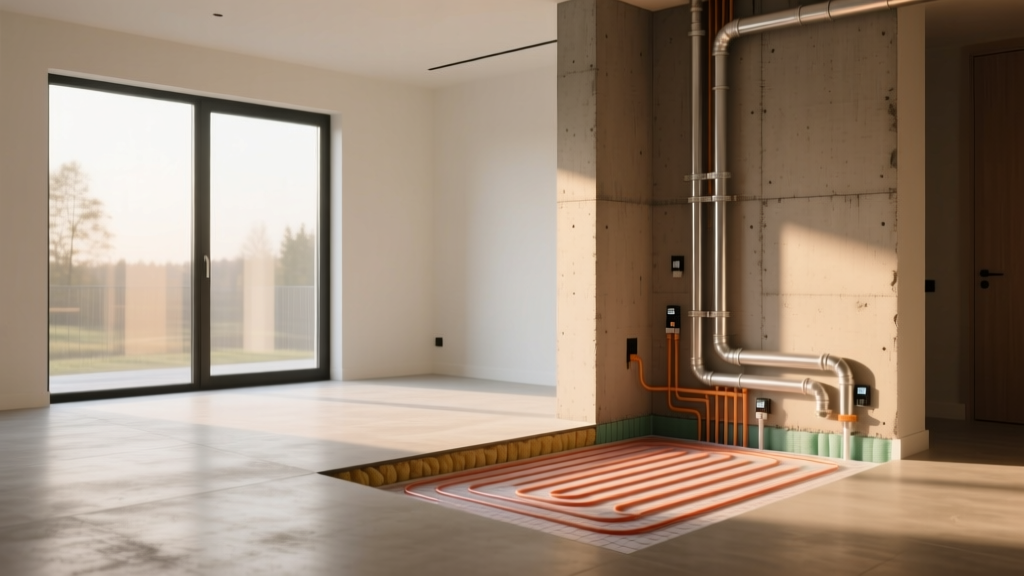
Deciding how to keep a floor warm efficiently requires matching the heating technology to the project scope. Electric radiant mats are optimal for single-room retrofits and bathroom upgrades, while hydronic PEX tubing systems are the standard for whole-home new construction or deep gut renovations. The financial threshold where hydronic becomes more cost-effective than electric typically crosses at 400 square feet of heated area.
| Metric | Electric Radiant Mats | Hydronic PEX Tubing |
|---|---|---|
| Material Cost (per sq. ft.) | $8.00 - $14.00 | $4.50 - $9.00 (tubing & manifolds only) |
| Installed Cost (per sq. ft.) | $14.00 - $22.00 | $18.00 - $32.00 (includes boiler & labor) |
| System Thickness | 1/8' to 3/16' (ultra-thin) | 1/2' to 5/8' (requires sleeper or pour) |
| Best Application | Bathrooms, kitchens, single-room retrofits | Whole-home, basements, slab-on-grade |
| Heat-Up Time | 30 - 60 minutes | 4 - 12 hours (high thermal mass) |
Electric Mat Quantity Calculator: Wattage & Amperage
To accurately estimate material requirements for an electric system, you must calculate the exact wattage and resulting amperage to ensure your electrical panel can handle the load. Most residential electric floor warming systems operate on a 120V or 240V circuit.
- Calculate Heated Square Footage: Measure the total walkable area. Subtract 4 to 6 inches from all walls, cabinets, and permanent fixtures (like toilets and tubs). Multiply the remaining length by width. For a 100 sq. ft. bathroom, expect roughly 80 sq. ft. of heated area.
- Determine Wattage Requirement: Standard floor warming requires 12 watts per square foot. High-heat-loss areas (sunrooms, rooms over unheated garages) require 15 watts per square foot. Formula: Heated Sq. Ft. × 12W = Total Watts. (80 sq. ft. × 12W = 960 Watts).
- Calculate Amperage Draw: Divide total watts by the system voltage. Formula: Watts ÷ Voltage = Amps. For a 960W system on a 120V circuit, the draw is exactly 8 Amps. The National Electrical Code (NEC) mandates that continuous loads cannot exceed 80% of a breaker's capacity. Therefore, an 8 Amp load requires a dedicated 15 Amp circuit (15A × 0.80 = 12A max continuous).
- Select the Thermostat: Most standard floor warming thermostats max out at 15 Amps. If your calculation exceeds 12 Amps (continuous), you must either switch to a 240V system (which halves the amperage draw) or install a power module/relay to split the load across two circuits.
Hydronic System Sizing: PEX Spacing & Boiler BTU
Keeping a floor warm via hydronics requires precise thermal engineering. The cost of the PEX tubing itself is minimal (roughly $0.60 to $1.10 per linear foot for oxygen-barrier PEX-a). The primary cost drivers are the boiler sizing, manifold configuration, and tubing spacing.
Tube Spacing & Thermal Output
Tubing spacing dictates the uniformity of the heat and the total linear footage required. Use this framework to calculate your PEX requirements:
- 6-Inch Spacing: Yields ~1.8 linear feet per sq. ft. Used for high-heat-loss areas, exterior walls, or snow-melt applications. Delivers up to 45 BTU/sq. ft.
- 9-Inch Spacing: Yields ~1.3 linear feet per sq. ft. The residential standard for living spaces and bathrooms. Delivers ~30 BTU/sq. ft.
- 12-Inch Spacing: Yields ~1.0 linear feet per sq. ft. Used for low-heat-loss areas, bedrooms, or supplementary warming. Delivers ~20 BTU/sq. ft.
Boiler Sizing Calculation
Do not rely on rule-of-thumb boiler sizing. An oversized boiler will short-cycle, destroying efficiency and the heat exchanger. Calculate the exact heat loss using the ASHRAE Manual J equivalent method. As a baseline for 2026 well-insulated builds (R-20 walls, R-40 ceilings, triple-pane windows), plan for 15 to 20 BTU per square foot of floor area. For older, drafty homes, this jumps to 35 to 50 BTU per square foot.
Real-World Material Pricing (2026 Market Rates)
When sourcing materials, brand selection heavily influences the final invoice. According to technical specifications from Schluter Systems, integrated uncoupling and heating membranes command a premium but eliminate the need for a separate backer board.
- Schluter-DITRA-HEAT Membrane: ~$2.25 per sq. ft. (membrane only).
- Schluter-DITRA-HEAT-E-HK Heating Cable: ~$7.50 to $9.00 per sq. ft. of heated area.
- Nuheat Signature Pre-Wired Mats: ~$9.50 to $11.00 per sq. ft. (includes integrated mesh).
- Watts RadiantHeat ProDeso Mats: ~$8.00 per sq. ft. (low-profile, 1/8' thickness).
- Uponor PEX-a Tubing (1/2 inch): ~$0.85 per linear foot.
- Stainless Steel Manifolds (4-port): $280 - $450 depending on flow meter integration.
Subfloor Preparation & Hidden Installation Costs
The most frequent cause of budget overruns in radiant floor warming projects is inadequate subfloor prep. Radiant systems, particularly electric mats embedded in thinset, require a perfectly flat substrate. The Tile Council of North America (TCNA) mandates flatness tolerances of 1/8 inch over 10 feet for large-format tile.
Additional hidden costs to factor into your estimator:
- GFCI Protection: The NEC requires Class A Ground Fault Circuit Interrupter (GFCI) protection for all floor warming systems. If your smart thermostat does not have built-in GFCI (like the Nuheat Signature does), you must install a GFCI breaker ($45 - $75) in the main panel.
- Floor Temperature Sensors: Always install the secondary floor sensor probe, even if the thermostat relies on ambient air temperature. The floor probe acts as a high-limit safety switch, preventing the floor from exceeding 85°F (29°C), which can damage engineered hardwood and degrade thinset adhesives.
- Insulation (R-Value): The U.S. Department of Energy explicitly notes that without proper subfloor insulation, up to 30% of downward heat loss occurs in floor warming systems. For joist cavities, budget $1.50 per sq. ft. for foil-faced polyiso rigid foam boards to reflect heat upward.
Operating Cost Projections & Energy ROI
To calculate the ongoing cost to keep a floor warm, use the local kilowatt-hour (kWh) rate. With the 2026 national average electricity rate hovering around $0.16 per kWh, the operating cost for electric mats is highly predictable.
Scenario: An 80 sq. ft. heated bathroom floor running at 12W/sq. ft. (960W total, or 0.96 kW). If the thermostat cycles the system on for 4 hours per day during winter months:
0.96 kW × 4 hours = 3.84 kWh per day.
3.84 kWh × $0.16 = $0.61 per day, or roughly $18.30 per month.
Hydronic systems powered by high-efficiency condensing gas boilers (95%+ AFUE) or geothermal heat pumps will yield significantly lower operating costs per square foot, often dropping the monthly operational expense by 40% to 60% compared to electric resistance heating. However, the 10-to-15-year ROI timeline on hydronic systems means they are only financially justifiable for whole-home installations exceeding 800 square feet.