Waterproofing Basement Walls From Inside: Top Brand Guide
Compare top brands for waterproofing basement walls from inside. Discover Drylok, RadonSeal, and Xypex product specs, costs, and application tips.
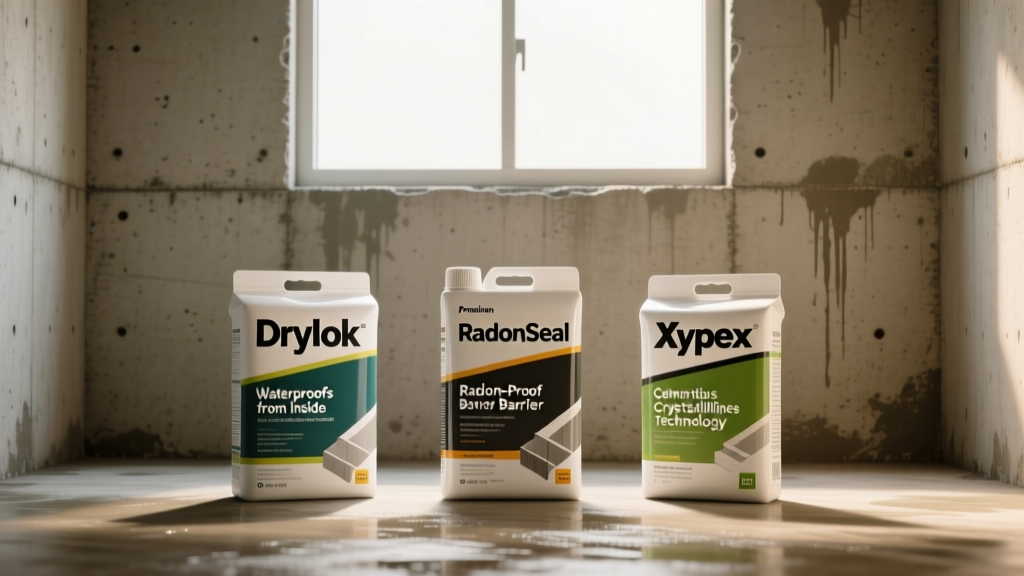
The Physics of Interior Basement Waterproofing
When exterior excavation is financially or logistically impossible, waterproofing basement walls from inside becomes the default strategy for moisture management. However, interior waterproofing is fundamentally different from exterior membrane systems. Instead of stopping water before it touches the concrete, interior systems must manage water that has already penetrated the substrate, or rely on immense bond strength to resist hydrostatic pressure pushing from the outside in.
According to the Building Science Corporation, applying a non-breathable waterproof coating to the interior of a basement wall can trap water inside the concrete matrix. If the hydrostatic pressure exceeds the coating's tensile bond strength, the coating will blister, delaminate, and spall the concrete face. Always match the product chemistry to your specific water intrusion profile.
Selecting the right brand requires understanding the chemical mechanisms at play. Below, we dissect three dominant product lines in the interior waterproofing market, analyzing their chemical compositions, hydrostatic limits, and real-world application costs for 2026.
RadonSeal: Deep-Penetrating Silicate Sealers
Product Focus: RadonSeal Plus
RadonSeal does not form a surface film; it is a penetrating sodium silicate sealer designed for porous concrete and cinder block. When applied to bare masonry, the low-viscosity liquid is drawn into the capillaries via capillary action. It reacts with the free lime (calcium hydroxide) naturally present in cured concrete to form a calcium silicate hydrate (C-S-H) gel. This gel permanently clogs the microscopic pores, densifying the concrete from the inside out.
- Chemistry: Alkaline sodium silicate solution.
- Penetration Depth: Up to 4 inches into standard concrete.
- Hydrostatic Limit: Not rated for active, pooling hydrostatic pressure. It stops capillary seepage and dampness, but will not hold back a structural leak.
- Cost: Approximately $245 per 5-gallon pail, covering 500 to 750 square feet (two coats). Roughly $0.40 to $0.50 per square foot.
- Best Use Case: Damp, weeping basement walls with no active streams, or as a primer to stop efflorescence before applying a secondary coating.
UGL Drylok: Cementitious & Acrylic Surface Barriers
Product Focus: Drylok Extreme Masonry Waterproofer
Drylok Extreme is arguably the most recognized consumer-grade interior waterproofer. It is a hybrid blend of Portland cement, graded silica sand, and acrylic polymers. Unlike pure silicate sealers, Drylok forms a thick, rigid, and slightly flexible physical barrier on the surface of the wall. The acrylic polymers provide the necessary flexibility to bridge micro-cracks, while the cementitious base ensures a strong mechanical bond to masonry substrates.
- Chemistry: Portland cement, silica aggregate, and acrylic copolymer emulsion.
- Application Thickness: Requires a thick application (roughly 1/16 inch per coat) using a stiff nylon or tampico fiber brush. Rollers are generally ineffective for the first coat.
- Hydrostatic Limit: Independently tested to withstand 15 PSI of hydrostatic pressure (equivalent to a 33-foot head of water).
- Cost: Approximately $48 per gallon in 2026. Coverage is 75 to 100 square feet per gallon. Total material cost averages $0.55 to $0.75 per square foot.
- Best Use Case: Walls with moderate seepage and hairline cracks (under 1/16 inch) where a physical, paintable barrier is desired.
Xypex: Crystalline Waterproofing Systems
Product Focus: Xypex Concentrate
Xypex represents the commercial and industrial tier of interior waterproofing. It is a crystalline waterproofing system that utilizes a proprietary blend of cement, specially graded silica sand, and active catalytic chemicals. When mixed with water and applied to a damp concrete surface, the chemicals trigger a catalytic reaction that generates non-soluble crystalline formations deep within the concrete's capillary tracts. These crystals grow and self-seal micro-cracks (up to 1/64 inch) even years after the initial application.
- Chemistry: Catalytic crystalline silicate complex.
- Curing Requirement: Requires the substrate to be kept continuously damp for 48 to 72 hours post-application to facilitate crystal growth.
- Hydrostatic Limit: Withstands extreme hydrostatic heads; frequently specified for subterranean vaults and elevator pits.
- Cost: Approximately $195 per 50 lb pail. Coverage is 100 to 125 square feet per pail (two coats). Material cost is roughly $1.60 to $1.95 per square foot.
- Best Use Case: High-hydrostatic environments, structural concrete walls, and areas where long-term self-sealing of future micro-cracks is critical.
Comparative Matrix: Cost, PSI Rating, and Longevity
| Brand / Product | System Type | Hydrostatic PSI Limit | Est. Cost / Sq Ft | Expected Lifespan |
|---|---|---|---|---|
| RadonSeal Plus | Penetrating Silicate | 0 PSI (Capillary only) | $0.40 - $0.50 | Lifetime of concrete |
| Drylok Extreme | Cementitious / Acrylic | 15 PSI | $0.55 - $0.75 | 10 - 15 Years |
| Xypex Concentrate | Crystalline Slurry | > 30 PSI | $1.60 - $1.95 | Lifetime of concrete |
Step-by-Step: Prepping the Substrate for Interior Application
According to the Environmental Protection Agency (EPA), controlling moisture is the primary defense against indoor mold growth. However, 90% of interior waterproofing failures are not due to product defects, but inadequate substrate preparation. Any coating applied over efflorescence, paint, or dust will fail under hydrostatic load.
- Remove Existing Coatings: Interior sealers must bond directly to bare masonry. Use a mechanical grinder with a diamond cup wheel or a chemical stripper to remove old paint, Drylok, or drywall mud.
- Eliminate Efflorescence: White, powdery mineral deposits will push off any new coating. While muriatic acid is traditional, it leaves chloride residues that can corrode internal rebar. Use a phosphoric acid-based masonry cleaner (e.g., Sure Klean 600) to dissolve salts without damaging the concrete matrix.
- Route and Patch Active Leaks: Coatings cannot stop flowing water. Use a chisel to route active cracks into an inverted 'V' shape (wider at the back than the front). Pack the void with a rapid-setting hydraulic cement (e.g., Quikrete Hydraulic Water-Stop Cement), which cures in 3 to 5 minutes even against active flow.
- Address the Cove Joint: The seam where the floor meets the wall is the most common point of failure. Do not seal the cove joint with rigid hydraulic cement, as structural settling will crack it. Instead, use a flexible polyurethane sealant or a specialized cove-joint drainage channel system.
When Interior Waterproofing Fails: Edge Cases
Even premium products like Xypex and Drylok will fail if deployed in the wrong scenario. Recognizing these edge cases prevents thousands of dollars in wasted materials and subsequent remediation costs.
- The 'Mud Puddle' Effect: If the exterior grading slopes toward the foundation and downspouts dump water directly against the wall, the hydrostatic pressure will eventually exceed the 15 PSI limit of products like Drylok. Interior coatings cannot compensate for catastrophic exterior drainage failures.
- Structural Cracking: If a basement wall has horizontal stair-step cracks wider than 1/4 inch, this indicates active lateral soil pressure or foundation settlement. Waterproofing materials are not structural repair compounds. Carbon fiber strapping or steel I-beam reinforcement must precede any waterproofing application.
- Applying Over Painted Block: Silicate sealers like RadonSeal require direct contact with the concrete's capillaries. If the block was previously painted, the sealer will simply puddle on the surface, dry into a brittle glaze, and flake off within weeks.
Expert Verdict: Which System to Choose?
For standard residential dampness where the walls feel cold and moist but lack active dripping, RadonSeal Plus offers the highest return on investment by permanently densifying the concrete without altering its appearance. If the basement experiences moderate seepage after heavy rains and the homeowner desires a finished, paintable surface, Drylok Extreme provides an excellent physical barrier, provided the 15 PSI hydrostatic limit is not exceeded. For commercial applications, elevator pits, or homes with severe hydrostatic pressure where exterior excavation is impossible, Xypex Concentrate is the undisputed industry standard, offering structural-level protection and self-sealing capabilities that surface coatings simply cannot match.