Top Tempered Glass Window Lines: Guardian vs Vitro Deep Dive
Compare Guardian and Vitro tempered glass window lines. Explore specs, heat-soaked options, edge work, and 2026 commercial pricing.
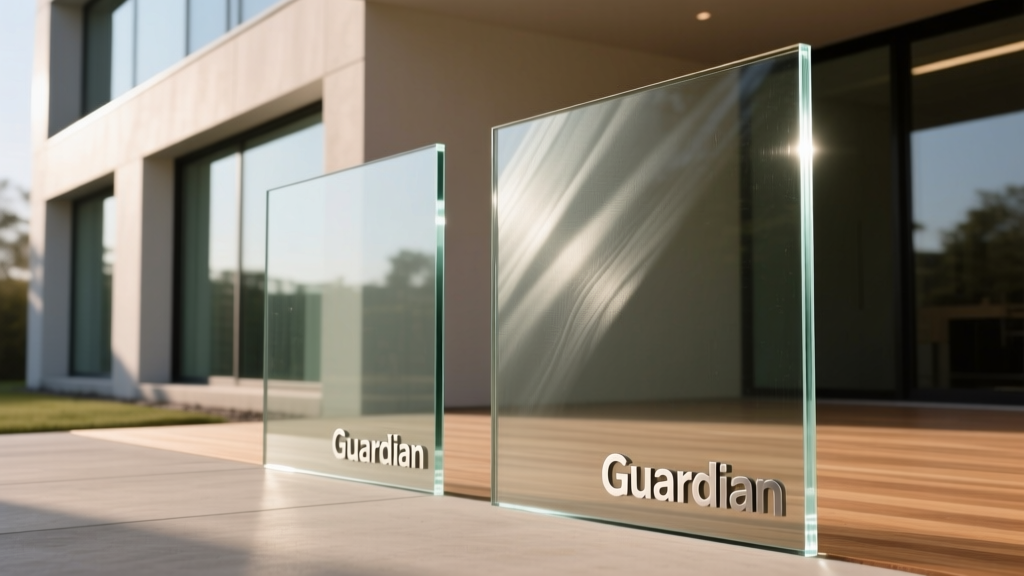
The Core Engineering of a Tempered Glass Window
Specifying a tempered glass window for commercial facades, high-traffic storefronts, or structural balustrades requires navigating a complex matrix of thermal performance, safety standards, and fabrication tolerances. Unlike annealed glass, which breaks into large, jagged shards, fully tempered glass undergoes a controlled thermal quenching process. This creates a surface compression of at least 10,000 psi and an edge compression of at least 9,700 psi, as mandated by the ASTM C1048 Standard Specification for Heat-Strengthened and Fully Tempered Flat Glass. When broken, it fractures into small, relatively harmless cubical pieces, making it the baseline requirement for safety glazing in hazardous locations per CPSC 16 CFR 1201.
However, not all tempered glass is created equal. The distinction between standard architectural lines and premium ultra-clear or low-emissivity (Low-E) tempered products dictates both the aesthetic outcome and the long-term energy performance of the building envelope. This deep-dive analyzes the flagship tempered product lines from two industry titans: Guardian Glass and Vitro Architectural Glass.
The Nickel Sulfide (NiS) Threat: Standard vs. Heat-Soaked Tempered Glass
Standard tempered glass carries a latent risk of spontaneous breakage caused by Nickel Sulfide (NiS) inclusions trapped in the glass matrix during the float manufacturing process. When exposed to solar heat over time, these inclusions expand, shattering the pane from the inside out. For high-rise curtain walls or overhead canopies where falling glass poses a severe liability, standard tempered glass is insufficient.
To mitigate this, both Guardian and Vitro offer Heat Soak Tested (HST) tempered glass. The HST process involves placing the tempered panes in a specialized oven and cycling them to 290°C (554°F) for several hours. This accelerates the phase change of any NiS inclusions, causing defective panes to break in the factory rather than on the building facade. While HST adds roughly $3.50 to $5.00 per square foot and extends lead times by 10 to 14 days, it reduces the field breakage rate from approximately 1 in 500 panes to less than 1 in 10,000.
Brand Deep-Dive: Guardian Glass Tempered Lines
Guardian Glass approaches the tempered glass window market with a focus on optical clarity and advanced solar control coatings that can survive the extreme temperatures of the tempering furnace.
ClarityGuard™ Ultra-Clear Tempered
Standard clear glass contains iron oxide, which gives it a distinct green tint, especially visible at the edges or in thick laminations. Guardian’s ClarityGuard utilizes a low-iron float glass substrate. When tempered, it achieves a Visible Light Transmittance (VLT) of up to 91% (at 1/4" thickness). It is the premier choice for high-end retail storefronts, museum display cases, and structural glass fins where color rendering and absolute transparency are paramount.
SunGuard® Low-E Tempered
Historically, applying a Low-E coating to glass before tempering was problematic because the silver layers would oxidize or melt in the 600°C+ tempering furnace. Guardian’s SunGuard line utilizes hard-coat (pyrolytic) and advanced sputtered coatings specifically engineered to withstand the quenching process without degrading. This allows specifiers to achieve Solar Heat Gain Coefficients (SHGC) as low as 0.23 in a fully tempered, monolithic or insulated glass unit (IGU) configuration.
Brand Deep-Dive: Vitro Architectural Glass
Vitro (formerly PPG Glass) leverages its massive North American manufacturing footprint to offer highly specialized tempered products, particularly excelling in acoustic and ultra-white applications.
Starphire Ultra-Clear® Tempered
Vitro’s direct competitor to ClarityGuard is Starphire. What sets Starphire apart in the tempered category is its proprietary edge-work retention. Because ultra-clear glass highlights edge flaws, Vitro’s tempering lines are calibrated to minimize edge distortion (roller waves) during the quenching phase. Starphire tempered glass is frequently specified in frameless glass door systems and interior corporate partitions where the polished edges remain fully exposed.
Solarban® Tempered & Acoustic Interlayers
Vitro’s Solarban solar control glasses are widely used in commercial curtain walls. When these panes are required to be tempered for wind-load resistance or safety glazing compliance, Vitro pairs them seamlessly with Saflex® acoustic PVB interlayers. A typical Vitro specification for a noisy urban environment might feature a 1/4" Solarban tempered outer lite, a 0.060" Saflex interlayer, and a 1/4" heat-strengthened inner lite, providing both impact resistance and a Sound Transmission Class (STC) rating of 38 or higher.
Product Line Comparison Matrix
| Feature | Guardian ClarityGuard | Vitro Starphire | Guardian SunGuard Low-E | Vitro Solarban Low-E |
|---|---|---|---|---|
| Iron Content | Ultra-Low | Ultra-Low | Standard | Standard |
| VLT (1/4" Mono) | ~91% | ~91% | 40% - 70% | 40% - 73% |
| SHGC Range | 0.82 (Uncoated) | 0.82 (Uncoated) | 0.23 - 0.45 | 0.22 - 0.46 |
| Max Tempered Thickness | 3/4" (19mm) | 3/4" (19mm) | 1/2" (12mm) | 1/2" (12mm) |
| Primary Application | Retail, Museums, Glass Fins | Frameless Doors, High-End Interiors | Exterior Facades, Skylights | Curtain Walls, Urban Acoustic |
Edge Work, Fabrication, and Tolerances
A critical failure point in tempered glass window installations is improper edge specification. Because the tempering process puts the edges under immense compressive stress, any micro-fracture or chip introduced after the glass leaves the float line will cause catastrophic failure. All cutting, drilling, and notching must be completed prior to tempering.
- Seamed Edge (Standard): The edges are ground flat to remove sharp arrises. This is the most economical option and is mandatory for any tempered glass that will be captured in a U-channel or glued into a structural silicone joint. It leaves a matte, slightly rough finish.
- Flat Polish (Machine Polished): The edges are ground and polished to a smooth, glossy 90-degree finish. Required for frameless glass partitions, balustrades, and heavy glass doors where the edge is exposed to view and touch.
- Pencil Polish: The edge is ground into a rounded, C-shaped profile. Often used for curved glass applications or specific aesthetic requirements in interior design.
Fabricator's Note on Roller Wave: During the tempering process, glass rides on ceramic rollers, which can induce a slight optical distortion known as 'roller wave' or 'quench marks.' To minimize this in high-end architectural applications, specify that the glass be tempered with the rollers running parallel to the primary sightline, and request a maximum peak-to-valley roller wave tolerance of 0.005 inches per 12 inches of span.
2026 Commercial Pricing & Lead Time Breakdown
Pricing for architectural tempered glass fluctuates based on raw material (soda ash and silica) costs, energy prices for the tempering furnaces, and regional fabrication capacity. Below is the baseline commercial pricing matrix for Q1/Q2 2026 (prices reflect material and standard fabrication, excluding freight, taxes, and installation):
1/4" (6mm) Clear Tempered
Base Cost: $14.00 - $18.00 / sq. ft.
Flat Polish Adder: +$2.50 / linear ft.
Lead Time: 2 - 3 weeks.
3/8" (10mm) Low-E Tempered
Base Cost: $32.00 - $45.00 / sq. ft.
Flat Polish Adder: +$4.00 / linear ft.
Lead Time: 4 - 6 weeks.
1/2" (12mm) Ultra-Clear HST
Base Cost: $48.00 - $62.00 / sq. ft.
Heat Soak Adder: +$4.50 / sq. ft.
Lead Time: 6 - 8 weeks.
Custom Fabrication Premiums
Every hole drilled or notch cut into a tempered glass window adds significant cost due to the CNC machining time and the increased risk of breakage during the tempering quench. Expect to pay $15 to $25 per hole (minimum 1/2" diameter, located at least 2x the glass thickness from any edge) and $30 to $50 per notch or corner cutout.
Specifier's Decision Framework
Choosing between Guardian and Vitro tempered lines ultimately depends on the specific performance requirements of the building envelope:
- For High-Rise Curtain Walls (Wind Load & Solar Control): Specify Vitro Solarban tempered paired with a heat-strengthened inner lite in an IGU. The Solarban coating provides superior solar heat rejection, while the heat-strengthened inner lite prevents the 'dishing' effect that can occur with fully tempered inner lites in large IGUs.
- For Frameless Glass Entrances & Retail: Specify Guardian ClarityGuard or Vitro Starphire in 1/2" or 3/4" thickness with flat polished edges and HST. The ultra-clear substrate ensures the hardware (spider fittings, patch fittings) is seen without the distracting green tint of standard glass.
- For Overhead Glazing (Skylights & Canopies): Never use monolithic tempered glass. Specify a laminated assembly using Guardian SunGuard tempered as the outer lite, bonded with a structural SentryGlas® (SGP) interlayer to a heat-strengthened inner lite. If the outer tempered lite breaks due to thermal stress or impact, the SGP interlayer will hold the fragments in place and maintain structural integrity.