Marble Table and Dining Chairs: Material Taxonomy Guide
Explore the material taxonomy for selecting a marble table and dining chairs, covering stone grades, structural loads, and acoustic pairings.
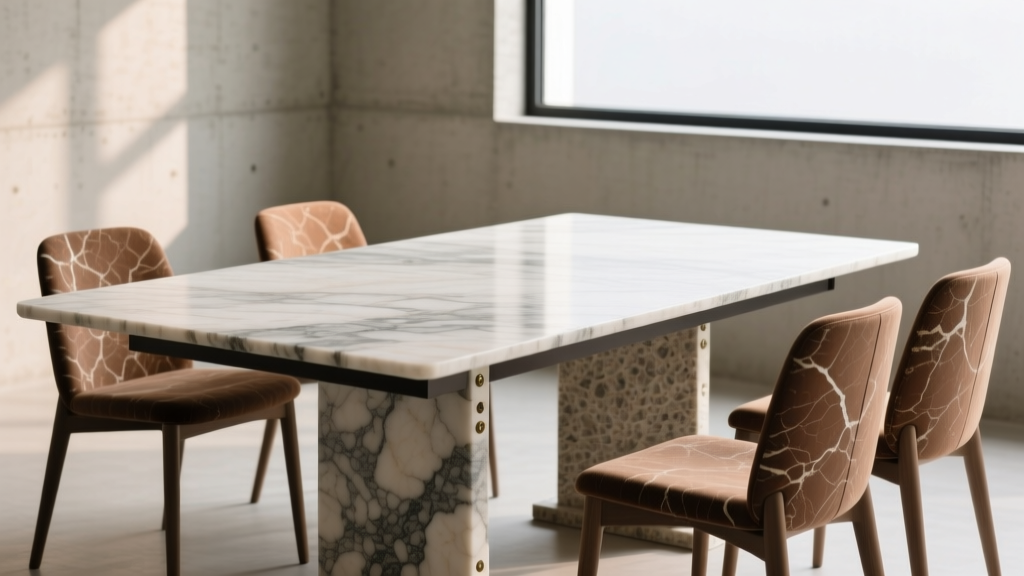
Stone Taxonomy: Classifying Marble for Dining Surfaces
Selecting a marble table and dining chairs requires navigating the intersection of geological material science and structural furniture design. The taxonomy of natural stone dictates not only the visual hierarchy of the dining space but the physical load requirements, acoustic properties, and chemical maintenance protocols of the room. True marble is a metamorphic rock composed primarily of calcite (calcium carbonate), ranking between 3 and 4 on the Mohs hardness scale. This relative softness makes it highly susceptible to both mechanical scratching and chemical etching, necessitating precise material selection for high-use dining environments.
Geological and Visual Grades
The commercial stone market categorizes marble into distinct grades based on quarry origin, veining density, and structural integrity. Understanding these classifications prevents costly mismatches between aesthetic expectations and material performance.
- Carrara (C-Grade): Sourced from Tuscany, characterized by a light gray background with feathery, low-contrast veining. It possesses higher porosity and is more prone to staining, making it a budget-friendly but high-maintenance option for dining surfaces.
- Calacatta (Premium): Features a stark white background with thick, dramatic gold or brown veining. Calacatta is geologically denser than Carrara, offering slightly better resistance to liquid penetration, though it remains vulnerable to acidic etching.
- Statuario (Premium): Recognized for its bright white base and sharp, high-contrast gray veining. It is heavily prized for luxury dining tables but requires rigorous sealing due to its prominent calcite exposure.
- Dolomitic Marble (e.g., Super White): Often misclassified as quartzite, dolomitic marble contains magnesium carbonate. This chemical alteration provides marginally higher resistance to acidic etching, making it a pragmatic choice for households that frequently entertain.
Surface Finish Profiles
The mechanical finish applied to the marble slab fundamentally alters its porosity, light reflection, and maintenance cycle. According to the Natural Stone Institute, the finish profile dictates the frequency of required chemical sealant applications.
| Finish Profile | Surface Porosity | Etch Visibility | Dining Suitability |
|---|---|---|---|
| Polished | Low (pores closed via friction) | High (matte etch marks contrast with gloss) | Moderate; shows water rings and wine etching immediately. |
| Honed | High (pores left open) | Low (matte surface hides matte etch marks) | High; requires bi-annual sealing but masks daily wear. |
| Leathered | Very Low (diamond brushes close pores) | Very Low (texture diffuses light and hides marks) | Excellent; ideal for heavy-use dining tables. |
Structural Specifications: Thickness, Edges, and Load
Marble is exceptionally dense, weighing approximately 165 pounds per cubic foot. A standard 84-inch by 42-inch dining table top (24.5 square feet) fabricated from a 3cm (1 1/4-inch) slab will weigh roughly 404 pounds. This mass dictates the structural requirements of both the table base and the flooring beneath it.
A 2cm (3/4-inch) marble slab lacks the tensile strength to span a dining table base without flexing, which can lead to catastrophic snapping under uneven load. If using 2cm stone, a 3/4-inch marine-grade plywood subtop must be epoxy-bonded to the underside, and the perimeter must be built up with a mitered drop edge to conceal the plywood and simulate a thicker slab.
Edge Profiles and Impact Resistance
The edge profile of a marble table and dining chairs interaction zone is a critical failure point. Sharp, square edges (eased or mitered) are highly susceptible to chipping when heavy dining chairs are pushed against them. For high-traffic dining rooms, specify a half-bullnose or a 1/8-inch rounded pencil edge. These profiles distribute impact force across a curved surface, reducing the likelihood of edge spalling when chair backs strike the stone.
Chair Material Matrix: Pairing Bases with Stone
The selection of dining chairs must address two physical challenges introduced by a heavy stone table: acoustic reverberation and lateral torque. Stone surfaces reflect high-frequency sound waves (clinking silverware, glassware), which can elevate a room's reverberation time (RT60) to uncomfortable levels. Furthermore, the sheer mass of the table requires chairs with robust joinery to withstand the lateral forces applied when users push back from the table.
| Chair Material | Acoustic Dampening | Structural Joinery Requirement | Visual Contrast with Stone |
|---|---|---|---|
| Solid Black Walnut | Moderate | Mortise-and-tenon; resists lateral torque. | High warmth; grounds the cold stone visually. |
| Upholstered (Bouclé/Wool) | High (absorbs mid/high frequencies) | Kiln-dried hardwood frame with corner blocks. | Softens the visual hardness of the dining set. |
| Cast Brass / Steel | None (reflects sound) | TIG-welded joints required for rigidity. | High contrast; risks severe edge chipping if unbuffered. |
When pairing metal or hard-wood chairs with a marble table, it is mandatory to install high-durometer rubber or felt bumpers on the upper backrests where they contact the stone edge. As noted in Architectural Digest's material guides, preventing mechanical impact is vastly more cost-effective than attempting to repair chipped calcite edges with epoxy resins.
The Sealing and Maintenance Protocol
Because calcite reacts instantly with acids (pH below 7), sealing is not optional. However, not all sealers perform equally in a dining environment where hot plates, wine, and citrus are prevalent.
Impregnating vs. Topical Sealers
Avoid topical sealers (waxes or polyurethanes) entirely. They sit on the surface, trap moisture, and create a plastic-like sheen that ruins the natural depth of the stone. Instead, specify a fluoropolymer-based impregnating sealer (such as Dry-Treat Stain-Proof or Tenax Aton). These sealers penetrate up to 3mm into the stone's capillary network, creating an oleophobic and hydrophobic barrier below the surface without altering the tactile feel of the marble.
- Surface Preparation: Clean the table with a pH-neutral stone cleaner. Allow 24 hours for complete moisture evaporation from the pores.
- Application: Flood the surface with the impregnating sealer using a low-lint microfiber applicator. Maintain a wet edge for 15 minutes to ensure deep capillary penetration.
- Wipe-Off: Before the sealer becomes tacky (usually 20 minutes), buff the surface completely dry with a clean microfiber cloth. Any residual sealer left on the surface will cure into a hazy, unremovable film.
- Cure Time: Allow 48 hours before placing dining chairs or tableware on the surface.
Sealers prevent staining (liquid pigments penetrating pores). They do not prevent etching (acid dissolving the calcium carbonate surface). If a guest spills lemon juice or tomato sauce on a marble table, the resulting dull spot is a chemical burn, not a stain. Etch marks on honed marble can be removed by the homeowner using a 400-grit diamond polishing pad, while polished marble requires professional re-polishing.
Cost Analysis: Slab Fabrication vs. Pre-Fabricated
Budgeting for a custom marble table and dining chairs requires separating the raw material cost from the fabrication and structural support costs. Prices below reflect 2026 market averages for premium stone fabrication in North America.
- Carrara Marble (2cm/3cm): $70 – $120 per square foot (material only).
- Calacatta Gold / Statuario: $180 – $320 per square foot (material only).
- Custom Fabrication: $90 – $150 per linear foot for precision mitering, edge profiling, and honing/leathering.
- Structural Table Base: A custom powder-coated steel or cast-brass base, engineered to support a 500+ lb dynamic load without deflection, typically ranges from $1,200 to $3,500.
- Dining Chairs (High-End): Solid hardwood or premium upholstered chairs with the necessary structural joinery to pair with heavy stone tables average $600 to $1,400 per seat.
Investing in a 3cm slab with a leathered finish and a structurally over-engineered base minimizes long-term maintenance costs and prevents the catastrophic failure of the stone under the dynamic loads of daily dining use.