2026 Step Fiberglass Ladder Brand Guide for Contractors
Compare top step fiberglass ladder brands for 2026. Deep-dive into Werner, Louisville, and Little Giant FRP models, pricing, and structural failure modes.
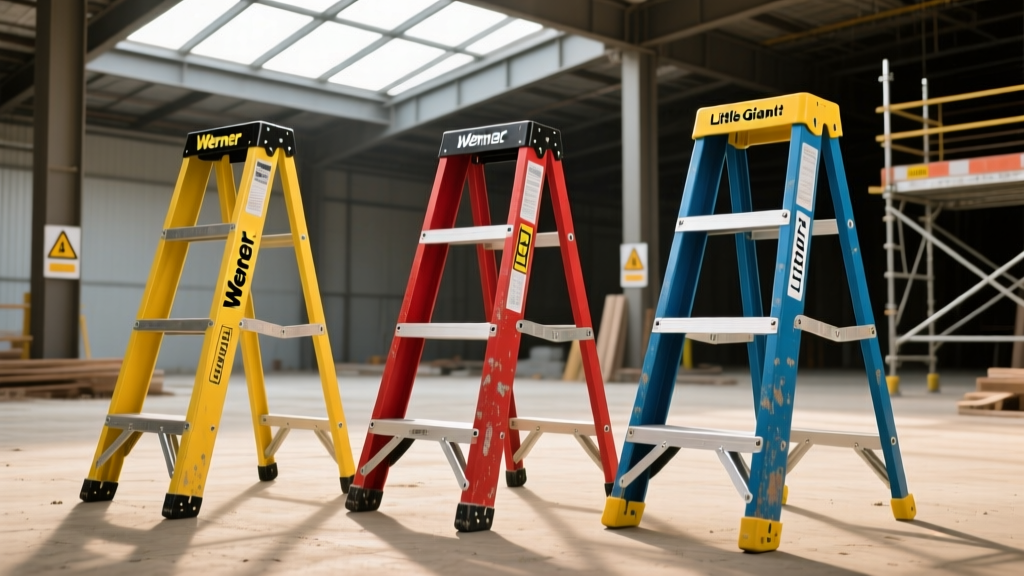
Commercial contractors require non-conductive, high-rigidity access equipment for environments where electrical hazards and heavy dynamic loads are present. The modern step fiberglass ladder is not merely a wooden ladder wrapped in plastic; it is an engineered composite tool. By utilizing glass fiber reinforced polymer (FRP) rails, these ladders offer the dielectric protection necessary for MEP (Mechanical, Electrical, and Plumbing) trades while maintaining the structural integrity required for daily commercial abuse. This guide provides a technical deep-dive into the material science of FRP, compares the dominant 2026 product lines from Werner, Louisville, and Little Giant, and outlines critical failure modes that safety managers must monitor.
The Material Science: Pultruded E-Glass and Resin Matrices
To understand brand differentiation, one must first understand the manufacturing process of the rails. High-grade fiberglass ladder rails are produced via pultrusion. Continuous strands of E-glass (electrical-grade glass fiber) are pulled through a thermoset resin bath and heated die. The resulting composite profile typically consists of 70% glass fiber and 30% resin matrix by weight.
The choice of resin dictates the ladder's environmental resistance. Premium commercial lines utilize vinyl ester or high-grade isophthalic polyester resins. These matrices resist the alkaline degradation that can occur when ladders are repeatedly exposed to wet concrete, stucco, or masonry dust on active job sites. The glass fibers provide the tensile and flexural strength, while the resin binds the fibers, transfers shear loads between them, and protects against moisture ingress.
Under ANSI A14.5 (Safety Requirements for Portable Reinforced Plastic Ladders), FRP rails must withstand a dielectric test of 30,000 volts per inch without breakdown, ensuring the glass matrix remains completely non-conductive even under high-voltage proximity.
Brand Deep-Dive: Werner vs. Louisville vs. Little Giant
The commercial market is dominated by three primary manufacturers, each engineering their step fiberglass ladder lines with distinct trade-specific features. Below is an analysis of their flagship Type I (250 lbs) and Type IA (300 lbs) commercial series.
Werner FS1000 & D6200 Series: The Industry Workhorse
Werner’s FS1000 (Type I) and D6200 (Type IA) series represent the baseline for commercial fleet purchasing. The defining engineering feature of these models is the EDGE bracing system, which utilizes a continuous U-channel aluminum brace wrapped around the bottom of the FRP rails. This distributes the lateral shear forces over a wider surface area of the fiberglass, significantly reducing the risk of rail splitting at the foot.
Werner pairs these rails with their TRACTION-TRED aluminum steps, which are ribbed for slip resistance and secured with heavy-duty steel gussets. The top cap is a standardized, impact-resistant copolymer that includes a curved profile for resting against walls without marring drywall. While the FS1000 lacks integrated tool storage, its simplified design results in fewer points of mechanical failure, making it the preferred choice for high-turnover general contracting fleets.
Louisville FS1500 & FS2000 Series: The Integrated Toolkit
Louisville Ladder targets the finish carpentry, electrical, and HVAC trades with the FS1500 (Type I) and FS2000 (Type IA) lines. The primary differentiator is the proprietary ProTop. This multi-functional top cap features integrated slots for paint brushes, a magnetic tray for drywall screws, and a dedicated hole for holding power drills or caulk guns.
Structurally, Louisville utilizes a slightly wider rail profile (3.125 inches compared to Werner’s 2.95 inches) which increases the moment of inertia, reducing the lateral "sway" felt by heavier users at full extension. The base features the SHU-LOK boot system, a spring-loaded, pivoting rubber foot that locks into place for outdoor or uneven terrain use. For electricians running wire in commercial plenums, the integrated tool slots reduce the need to descend the ladder to retrieve dropped fasteners.
Little Giant Sentinel: Heavy-Duty Stance and Ergonomics
Little Giant’s Sentinel series is engineered specifically for Type IA (300 lbs) and Type IAA (375 lbs) duty ratings. The Sentinel features a noticeably wider front-to-back footprint at the base, increasing the ladder's pitch stability. This wider stance is critical for HVAC technicians and sprinkler fitters who frequently lean laterally while working at height. The Sentinel also incorporates a heavy-duty steel hinge assembly with internal bearing surfaces, eliminating the metal-on-FRP friction that causes rail wear at the pivot point over time.
2026 Specification & Pricing Matrix
Procurement managers must balance initial capital expenditure against the expected lifecycle of the asset. The table below outlines the MSRP and structural specifications for the standard 6-foot commercial models across these three lines, reflecting early 2026 market pricing.
| Brand & Model Line | Duty Rating | Rail Profile Width | Top Cap Feature | Approx. 6ft MSRP (2026) |
|---|---|---|---|---|
| Werner FS1006 | Type I (250 lbs) | 2.95 inches | Standard Copolymer | $155.00 |
| Werner D6206-2 | Type IA (300 lbs) | 3.25 inches | Standard Copolymer | $195.00 |
| Louisville FS1506 | Type I (250 lbs) | 3.125 inches | ProTop w/ Tool Slots | $148.00 |
| Louisville FS2006 | Type IA (300 lbs) | 3.375 inches | ProTop w/ Tool Slots | $185.00 |
| Little Giant Sentinel 6' | Type IA (300 lbs) | 3.50 inches | Wide Stance / Tray | $210.00 |
Critical Failure Modes: Inspecting FRP Rails
Unlike aluminum, which yields and dents visibly, fiberglass composites can suffer from insidious degradation mechanisms. Safety officers must train crews to identify the following specific failure modes as outlined by the American Ladder Institute (ALI) and OSHA ladder safety guidelines.
The most common failure in FRP ladders is "fiber bloom." When the thermoset resin matrix is degraded by prolonged UV exposure (e.g., leaving ladders in the bed of a truck or against south-facing glass facades), the resin chalks and erodes. This exposes the raw E-glass fibers, which appear as a white, fuzzy texture on the rail. Inspection Rule: If the bloom is superficial, it can be sealed with a clear polyurethane coating. If the fibers are loose, frayed, or catch on a cotton swab dragged up the rail, the structural integrity is compromised and the ladder must be destroyed immediately.
Impact Fractures and Delamination
When an FRP rail is struck by heavy equipment (such as a drywall lift or scaffolding crossbrace), the outer resin may crack, but the inner layers can delaminate without visible surface indicators. Inspectors should perform a percussive test: tapping the rail with a hard rubber mallet. A sharp, resonant "ping" indicates a solid matrix, while a dull "thud" reveals internal delamination. Any ladder subjected to a high-velocity impact must be retired, as the compressive strength of the delaminated section will fail under vertical loading.
Hardware Galvanic Corrosion
While the glass rails are non-conductive and immune to rust, the steel rivets and aluminum steps are not. In coastal commercial projects or interior environments with high humidity and chemical vapor (such as indoor pool enclosures or water treatment plants), galvanic corrosion can occur where the aluminum step meets the steel rivet inside the FRP rail. This causes the rivet hole to elongate, leading to step wobble and eventual pull-through. Specifying ladders with isolated or coated hardware is mandatory for these specific environments.
Procurement Framework: Matching the Ladder to the Trade
Purchasing a single brand for an entire construction firm is a misuse of capital. Align the step fiberglass ladder specification to the specific trade's operational profile:
- Electricians & Low-Voltage Data: Specify the Louisville FS1500/FS2000. The ProTop magnetic tray and tool slots drastically reduce the time spent ascending and descending to retrieve wire nuts, connectors, and hand tools, directly improving labor efficiency.
- Drywall & Framing Crews: Specify the Werner FS1000. These trades subject ladders to extreme physical abuse, mud splatter, and impact. The simplified top cap and robust EDGE bracing offer the highest survivability rate in high-traffic, messy environments.
- HVAC, Sprinkler, & Ceiling Grid: Specify the Little Giant Sentinel. The wider base footprint provides the necessary lateral stability for technicians who must reach far outside the ladder's vertical plane to thread ductwork or tighten sprinkler heads in tight plenum spaces.
By treating the step fiberglass ladder as a specialized composite tool rather than a generic commodity, commercial contractors can reduce asset replacement costs, mitigate OSHA compliance violations, and provide their tradesmen with the exact ergonomic platform required for their specific scope of work.