Limewash Paint Performance Ratings and Technical Specifications
Analyze limewash paint performance ratings, including breathability Sd values, pH levels, coverage, and substrate specs for durable masonry finishes.
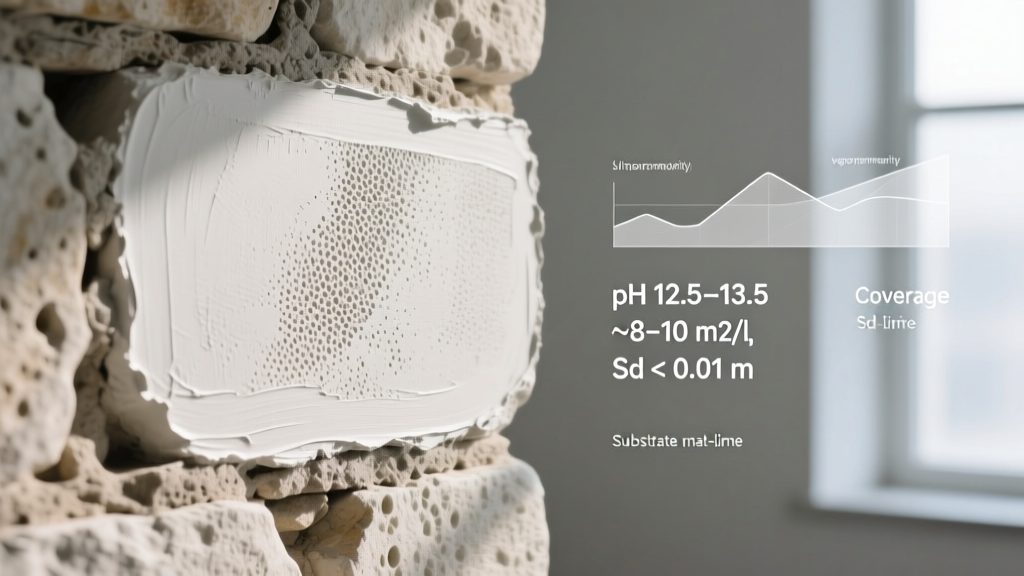
Core Chemical and Physical Baseline Specifications
Limewash is not a conventional surface coating; it is a penetrating, mineral-based finish composed primarily of calcium hydroxide (slaked lime) suspended in water. Unlike acrylic or elastomeric paints that rely on synthetic binders to form a continuous plastic film, limewash relies on a chemical reaction with atmospheric carbon dioxide to petrify into calcium carbonate. Understanding the exact technical specifications of limewash paint is critical for architects, preservationists, and masonry contractors to prevent moisture entrapment and substrate degradation.
- Binder Type: Calcium Hydroxide [Ca(OH)2]
- Wet pH Level: 12.5 to 13.5 (Highly Alkaline)
- Cured pH Level: 8.5 to 9.0 (Post-Carbonation)
- Density: 1.05 - 1.15 kg/L (depending on pigment load)
- VOC Content: 0 g/L (Zero volatile organic compounds)
- Solids Content by Volume: 15% - 25%
Vapor Permeability and Moisture Transmission (Sd Values)
The most critical performance rating for any masonry coating is its water vapor diffusion equivalent air layer thickness, commonly known as the Sd value. The Sd value measures how resistant a material is to vapor transmission. A lower Sd value indicates higher breathability. According to building science principles outlined by Building Science Corporation, trapping moisture inside porous masonry with low-permeability coatings leads to freeze-thaw spalling and structural deterioration.
Permeability Comparison Matrix
When specifying coatings for historic brick, stone, or lime-rendered walls, the Sd value dictates whether the substrate can safely expel internal moisture. Limewash consistently outperforms synthetic alternatives in this metric.
| Coating Type | Sd Value (m) | Permeability Class | Film Formation | Masonry Compatibility |
|---|---|---|---|---|
| Limewash | < 0.05 m | Class I (Highly Permeable) | Penetrating / Micro-crystalline | Excellent (Historic & Modern) |
| Silicate (Mineral) Paint | 0.01 - 0.05 m | Class I (Highly Permeable) | Petrification (Silicification) | Excellent (Requires mineral substrate) |
| Acrylic Masonry Paint | 0.15 - 0.50 m | Class II (Semi-Permeable) | Continuous Plastic Film | Poor (Traps moisture in soft masonry) |
| Elastomeric Coating | > 1.00 m | Class III (Impermeable) | Thick Elastic Membrane | Restricted (CMU/Concrete only) |
The Carbonation Cycle: Curing vs. Drying Specifications
A common specification error in construction documents is conflating the 'drying time' of limewash with its 'curing time'. Limewash dries via water evaporation in 2 to 4 hours, but it cures via carbonation—a chemical reaction where calcium hydroxide absorbs CO2 from the air to form calcium carbonate. As detailed in conservation literature by The Building Conservation Directory, this crystalline matrix is what binds the lime to the substrate.
Carbonation Chemistry: Ca(OH)2 + CO2 → CaCO3 + H2O.
Full carbonation of a standard 3-coat limewash system requires 28 to 90 days, depending on ambient humidity and CO2 concentration. If the surface dries too rapidly (low humidity, high wind, direct hot sun), the water evaporates before CO2 can dissolve into it, halting the carbonation process and resulting in a weak, powdery finish that fails to adhere.
Environmental Application Limits
- Minimum Temperature: 45°F (7°C). Carbonation stops below this threshold.
- Maximum Temperature: 85°F (29°C). Higher temperatures cause flash-drying.
- Relative Humidity: 50% to 80% is optimal. Humidity below 40% requires aggressive substrate misting.
- Rain Resistance: 24 hours minimum post-application; full wash-off resistance takes 7 days.
Substrate Suction Control and Preparation Metrics
Limewash requires a porous, mineral substrate to mechanically lock into the microscopic pores of the masonry. The National Park Service Technical Preservation Briefs emphasize that moisture dynamics and substrate preparation are paramount for lime-based materials. The critical metric for preparation is 'substrate suction'.
Applying limewash to a dry, highly absorptive brick wall will cause the substrate to instantly suck the water out of the lime suspension. This prevents the lime particles from penetrating the pores and halts carbonation, leading to immediate flaking and dusting upon drying.
Suction Control Protocol
- Clean the Substrate: Remove biological growth, efflorescence, and loose mortar. Do not use acid etching, as residual acid neutralizes the alkaline lime.
- Pre-Wetting (Misting): Apply a fine water mist to the wall 12 hours before application, and again 1 hour before. The wall should be 'damp-dry' (saturated internally but with no surface sheen or free water).
- First Coat Dilution: Dilute the first coat of limewash with 20% to 30% additional water by volume to create a 'slip coat' that deeply penetrates the pore structure.
- Inter-Coat Misting: Lightly mist the wall between subsequent coats to maintain the moisture required for the carbonation cycle.
Application Rates, Film Thickness, and Coverage
Because limewash does not build a surface film, traditional Dry Film Thickness (DFT) metrics used for acrylics do not apply. Instead, performance is measured by penetration depth and the number of micro-layers applied. Standard specification requires a minimum of three coats for full opacity and adequate mineral buildup.
- Theoretical Coverage: 80 to 120 sq. ft. per gallon (2.0 to 3.0 sq. meters per liter) per coat, heavily dependent on substrate porosity.
- Application Tools: Large, dense masonry block brushes. Rollers and airless sprayers are not recommended as they fail to mechanically work the lime into the masonry pores.
- Coat Buildup: Apply in thin, cross-hatched layers. Thick applications will shrink and craze (spider-crack) as the high water content evaporates.
Alkalinity and Biocidal Performance Ratings
Limewash is inherently biocidal. With a wet pH of 12.5 to 13.5, it creates an environment where mold, mildew, and algae cannot survive. This makes it highly specified for damp climates, agricultural buildings, and historic cellars. Unlike modern paints that rely on added chemical biocides (which leach out over 3 to 5 years), limewash's mold resistance is structural and permanent, lasting as long as the highly alkaline lime matrix remains intact on the surface.
Diagnostic Guide: Chalking vs. Flaking
When evaluating the lifecycle performance of a limewash finish, inspectors must differentiate between natural weathering and systemic failure.
| Symptom | Mechanism | Diagnosis | Corrective Action |
|---|---|---|---|
| Uniform Chalking | Surface micro-erosion from wind/rain over 5-10 years. | Normal Lifecycle Behavior. Limewash is a sacrificial coating. | Reapply a single maintenance coat after cleaning. |
| Flaking / Peeling | Loss of adhesion; chunks of material detaching. | Systemic Failure. Applied over a sealed substrate, acrylic paint, or applied to a bone-dry wall. | Complete removal via low-pressure water blasting; re-prep substrate. |
| Efflorescence Blistering | Soluble salts migrating to the surface and crystallizing behind the lime. | Moisture intrusion from behind the wall (e.g., failing gutters, rising damp). | Fix the water source. Brush off salts. Do not seal with waterproofers. |
Specification Summary for Architects
When writing Division 09 (Finishes) specifications for limewash, explicitly mandate the use of non-hydraulic (CL90) or feebly hydraulic (NHL 2) lime putties. Prohibit the use of acrylic fortifiers or siloxane water-repellents as additives, as these destroy the vapor permeability that defines the material's core performance. Require contractor mock-ups on a 4x4 foot test area to verify substrate suction control and final color cure, noting that limewash dries 10 to 15 shades lighter than its wet appearance.