Marble Queen Devils Ivy Living Walls: Stone Veneer Specs
Explore ASTM performance ratings, moisture resistance, and structural specs for integrating Marble Queen stone veneer with Devils Ivy living walls.
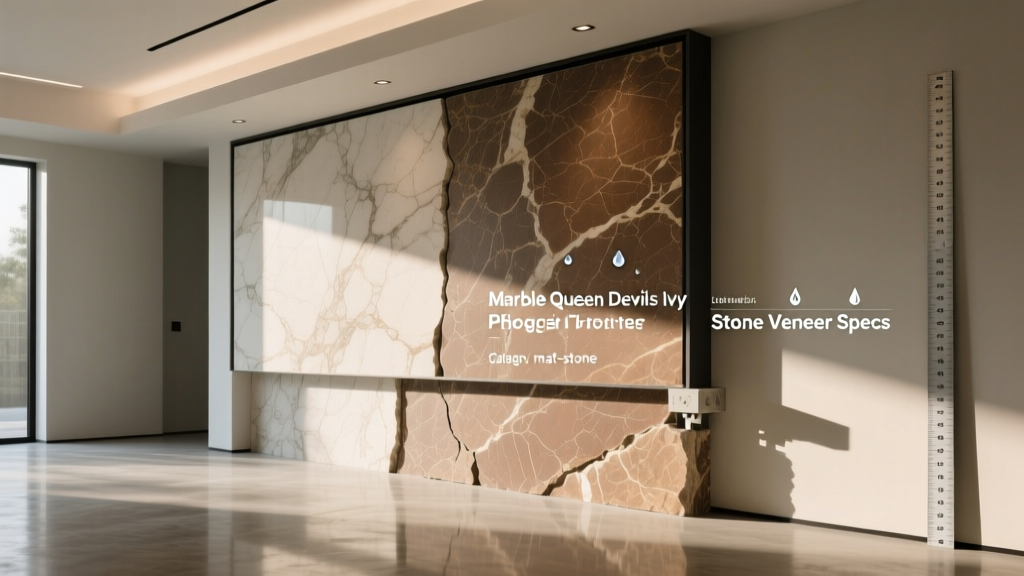
The Biophilic Challenge: Calcite Stone Meets High-Moisture Botanicals
Integrating natural stone with living architectural elements is a cornerstone of modern biophilic design. However, pairing Marble Queen natural stone veneer with a Devils Ivy (Epipremnum aureum) living wall introduces severe material compatibility challenges. Marble Queen is a dolomitic and calcitic marble characterized by its stark white background and dramatic grey veining. Devils Ivy, conversely, requires consistent high humidity, frequent irrigation, and slightly acidic soil environments to thrive. When irrigation runoff and botanical acids interact with calcium carbonate-based stone, the result is rapid chemical etching, micro-fissure expansion, and structural degradation.
This guide details the exact ASTM performance ratings, waterproofing specifications, and structural anchorage requirements necessary to successfully install Marble Queen stone veneer in direct proximity to irrigated Devils Ivy systems without compromising the stone's integrity or the building's substrate.
Chemical Vulnerability and pH Thresholds
Marble Queen stone is highly susceptible to acid erosion. The primary mineral component, calcite (CaCO3), begins to dissolve when exposed to environments with a pH below 6.5. Devils Ivy thrives in soil mixtures with a pH between 6.0 and 6.5, and the fertilizers required to maintain its rapid growth often drop the irrigation runoff pH to 5.5 or lower.
When this acidic runoff migrates across the face of unsealed or improperly sealed Marble Queen veneer, it causes immediate microscopic etching. Over a 12-to-18-month period, this etching dulls the polished or honed finish, opens the stone's natural pores, and creates pathways for moisture infiltration. To mitigate this, the stone must be treated with a high-performance impregnating sealer rather than a topical coating.
Do not use acrylic or polyurethane topical sealers on Marble Queen veneer in living wall applications. Topical sealers trap moisture vapor migrating from the Devils Ivy soil bed behind the stone, leading to subflorescence (salt crystallization beneath the surface) and catastrophic spalling. You must use a penetrating fluoropolymer or siloxane-based impregnator that allows vapor transmission while blocking liquid water and acidic compounds.
ASTM Performance Ratings for Marble Queen Veneer
Specifying Marble Queen for high-moisture biophilic zones requires strict adherence to ASTM C97 (Absorption and Bulk Specific Gravity) and Natural Stone Institute guidelines for interior/exterior wet environments. Below are the target performance metrics that quarry batches must meet before fabrication into veneer panels.
| ASTM Standard | Test Method | Required Spec for Wet Zones | Typical Marble Queen Yield |
|---|---|---|---|
| ASTM C97 | Absorption by Weight | < 0.20% | 0.12% - 0.35% (Batch dependent) |
| ASTM C880 | Flexural Strength | > 1,000 psi | 1,100 - 1,400 psi |
| ASTM C241 | Abrasion Resistance (Ha) | > 10 Ha | 12 - 15 Ha |
| ASTM C97 | Density (lbs/ft³) | > 160 lbs/ft³ | 165 - 172 lbs/ft³ |
Note: Because Marble Queen features heavy grey veining, the veining channels often possess higher porosity than the white calcite matrix. Specifiers must mandate a factory-applied epoxy resin fill on the back and edges of the veneer panels to consolidate these natural micro-fissures before site installation.
Waterproofing Membrane Specifications for Irrigated Zones
The most common failure mode in stone-and-plant integrations is not the stone itself, but the degradation of the substrate behind it. Devils Ivy living walls require constant moisture. Standard building paper or felt will rot and transfer moisture to the structural framing, causing wood rot or steel corrosion.
Required Membrane Architecture
- Substrate Preparation: Cementitious backer board (minimum 1/2-inch thickness) or fluid-applied leveling compound over concrete masonry units (CMU). Drywall or greenboard is strictly prohibited.
- Primary Waterproofing: A fluid-applied elastomeric polyurethane membrane. The membrane must be applied in two coats to achieve a minimum 40-mil dry film thickness.
- Drainage Matrix: A 3/16-inch high-density polyethylene (HDPE) dimpled drainage mat must be installed over the cured membrane. This creates an air gap that allows gravity to pull Devils Ivy irrigation runoff down to a weep system, preventing hydrostatic pressure buildup against the stone veneer.
- Mortar Bed and Adhesive: Use a polymer-modified, latex-Portland cement mortar (ANSI A118.15) that is specifically rated for submerged or constant-moisture applications.
Structural Load and Anchorage Requirements
Combining stone veneer with living botanical systems drastically increases the dead load on the wall assembly. Marble Queen veneer panels, typically cut to 3/4-inch or 1-1/4-inch thickness for wall applications, carry significant weight. When you add the saturated soil matrix, the HDPE drainage mat, and the mature biomass of a dense Devils Ivy canopy, the structural demands multiply.
- Marble Queen Veneer (1-inch thick): ~14.5 lbs per square foot.
- Saturated Soil Matrix & Felt Pockets: ~12.0 to 18.0 lbs per square foot.
- Mature Devils Ivy Biomass: ~3.0 to 5.0 lbs per square foot.
- Total Estimated Dead Load: 29.5 to 37.5 lbs per square foot.
Because the total dead load exceeds 15 lbs per square foot, adhesive-only installation is a critical structural hazard. The Marble Queen panels must be mechanically anchored to the structural framing.
For panels exceeding 2 square feet in surface area, utilize Type 316 stainless steel spot anchors (pins) drilled into the bottom edge of each stone panel, tied directly into the structural studs or CMU. Type 304 stainless steel is insufficient due to the constant presence of chloride-based fertilizers used in Devils Ivy care, which will cause 304-grade steel to pit and corrode within 24 months.
Long-Term Maintenance and Degradation Metrics
Even with perfect installation, the intersection of Marble Queen stone and Devils Ivy requires a strict, scheduled maintenance protocol to maintain the stone's aesthetic and structural performance.
Sealer Reapplication Schedule
Penetrating fluoropolymer sealers degrade under constant moisture exposure and UV light (if installed near atrium glazing). In a living wall environment, the sealer on the Marble Queen veneer must be tested via water-drop absorption tests every 6 months. If the water droplet darkens the stone within 3 minutes, a fresh coat of impregnator is required. Expect to re-seal the bottom 36 inches of the wall annually, as this zone receives the highest concentration of soil splash-back and fertilizer runoff.
Botanical Management
Devils Ivy is an aggressive climber. Its aerial roots can penetrate microscopic fissures in the Marble Queen veining. As the roots expand, they exert immense hydraulic pressure, capable of cleaving the stone along its natural fault lines. Facility maintenance teams must prune aerial roots away from the stone face quarterly and apply a root-barrier mesh between the soil pockets and the veneer surface.
Frequently Asked Questions
Can I use a honed finish on Marble Queen for this application?
Yes, a honed or flamed finish is actually preferred over a polished finish. Polished calcite shows acid etching from Devils Ivy fertilizer runoff almost immediately. A honed finish masks minor chemical degradation and provides a better mechanical key for the penetrating sealer to bond to the stone's open pores.
Is it possible to use manufactured stone veneer instead of natural Marble Queen?
While manufactured concrete-based stone veneers (MSV) can mimic the look of Marble Queen, they are highly alkaline (pH 11-13). The constant moisture from the Devils Ivy living wall will draw alkaline salts to the surface of the MSV, resulting in severe efflorescence (white, crusty deposits) that will ruin the aesthetic and potentially harm the plant's root systems. Natural Marble Queen, properly sealed, remains the superior choice for chemical neutrality.
What is the maximum height for this combined assembly?
Without intermediate structural shelf angles, the combined dead load of Marble Queen veneer and a saturated Devils Ivy system should not exceed 12 feet in continuous vertical height. For multi-story atrium installations, stainless steel shelf angles anchored to the primary structure must be integrated every 10 to 12 feet to transfer the dead load directly to the building's frame and relieve the lower panels of compressive stress.