Concrete Bricks Taxonomy: Selecting CMU Types for Structural Loads
Explore the complete taxonomy of concrete bricks and CMUs. Compare solid vs. hollow types, compressive strengths, and selection criteria for structural loads.
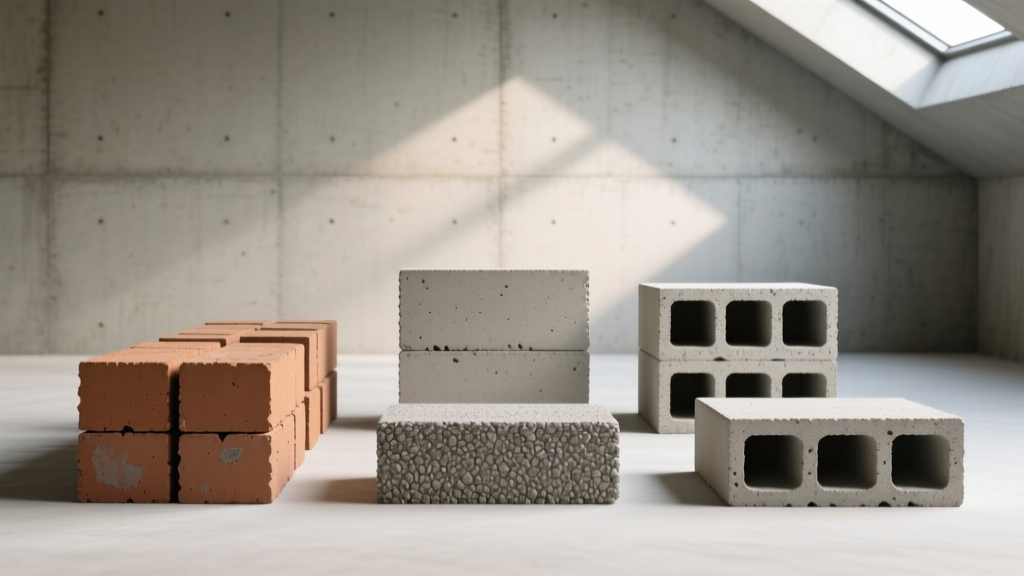
Defining the Taxonomy: Concrete Bricks vs. CMUs
In architectural and structural specifications, the term 'concrete bricks' is frequently conflated with Concrete Masonry Units (CMUs). However, strict material taxonomy separates these into distinct categories governed by different ASTM standards. Understanding this distinction is critical for load calculations, thermal detailing, and procurement.
Concrete Building Bricks (ASTM C55): These are solid, smaller-format units typically measuring 4x4x8 inches or 3x5x9 inches. They mimic the dimensions of traditional clay bricks and are primarily utilized for veneers, pavers, and non-load-bearing partitions. Because they are solid, they possess high compressive strength but lack the core cavities required for vertical rebar integration.
Concrete Masonry Units (ASTM C90 & C129): Commonly referred to as cinder blocks or concrete blocks, these are the standard 8x8x16 inch (nominal) units. ASTM C90 governs load-bearing units, while ASTM C129 covers non-load-bearing applications. The hollow cores reduce weight, provide thermal mass, and allow for grout and steel reinforcement, making them the backbone of commercial and multi-family structural walls.
When specifying concrete bricks for a load-bearing shear wall, architects must explicitly reference ASTM C90 hollow units to ensure the masonry assemblage can accept vertical reinforcement and grout injection.
Aggregate Classification and Density Metrics
The structural and thermal performance of concrete bricks is dictated by the aggregate used in the mix design. The Portland Cement Association categorizes these units into three distinct density classes based on oven-dry weight per cubic foot.
| Density Class | Oven-Dry Density (lbs/ft³) | Typical Aggregates | Weight per 8x8x16 Unit | Primary Application |
|---|---|---|---|---|
| Normal Weight | 125 – 145 | Sand, gravel, crushed stone | 38 – 42 lbs | Foundations, retaining walls, high-impact zones |
| Medium Weight | 105 – 125 | Slag, expanded shale, clay | 30 – 35 lbs | Exterior load-bearing walls, commercial retail |
| Lightweight | 85 – 105 | Pumice, perlite, vermiculite | 24 – 28 lbs | Interior partitions, multi-story shear walls |
Compressive Strength and the Net vs. Gross Area Distinction
Selecting the correct compressive strength is the most common failure point in concrete brick specification. According to ASTM C90 standards, the minimum net compressive strength for load-bearing units is 1,900 psi. However, structural engineers design based on masonry design strength ($f'_m$), which accounts for the prism assembly (unit + mortar + grout).
Strength Selection Framework
- 1,900 psi (Baseline): Adequate for single-story residential foundations and low-rise non-seismic partitions.
- 2,800 psi (Standard Commercial): Required for 2-to-3 story load-bearing structures and standard shear walls.
- 3,750 psi to 4,800 psi (High-Seismic/High-Rise): Mandated for mid-rise construction, heavy axial loads, and regions with high seismic design categories (SDC D, E, F) where ductility and energy dissipation are critical.
Critical Engineering Note: Compressive strength for hollow units is tested on the net cross-sectional area (the actual solid concrete footprint), whereas solid concrete bricks (ASTM C55) are tested on the gross area. Confusing these metrics during submittal reviews can lead to catastrophic under-specification.
Moisture Dynamics and Shrinkage Cracking
Concrete bricks undergo irreversible volumetric shrinkage as they cure and dry. If units are laid while their moisture content is too high, the subsequent shrinkage will induce horizontal stepping cracks along the mortar joints.
ASTM C426 dictates the maximum linear drying shrinkage limits based on regional climate:
- Arid Regions (Southwest US): Maximum shrinkage of 0.045%.
- Humid Regions (Southeast US): Maximum shrinkage of 0.065%.
To mitigate this, specify concrete bricks that have been steam-cured and stored under tarps at the block plant to reach moisture equilibrium before delivery. Furthermore, integrate horizontal joint reinforcement (such as 3/16-inch galvanized wire trusses) every 16 inches on center to distribute tensile stresses and control crack widths.
Thermal Mass and Insulation Integration
Uninsulated normal-weight concrete bricks offer poor thermal resistance (R-2.0 for an 8-inch unit). To meet modern energy codes (such as ASHRAE 90.1-2022), the taxonomy of the wall assembly must change.
Optimizing the CMU Envelope
- Core Insulation: Injecting loose-fill perlite or vermiculite into the hollow cores of lightweight units increases the R-value to approximately R-3.9. This is a low-cost upgrade but insufficient for exterior envelope compliance in most climate zones.
- Interior Furring: Applying rigid polyiso board to the interior face of the concrete bricks preserves the thermal mass on the interior side of the insulation, stabilizing indoor temperature swings.
- Exterior CI (Continuous Insulation): The most effective method. Placing mineral wool or EPS on the exterior face of the concrete bricks breaks the thermal bridge and allows the masonry to act as a thermal battery inside the building envelope.
2026 Procurement and Cost Baselines
Material costs for concrete bricks fluctuate based on regional cement availability and freight distances. Because concrete blocks are heavy and low-margin, block plants typically only serve a 50-to-75-mile radius. Below are baseline material costs for 2026, excluding sales tax and delivery freight.
| Unit Type | Dimensions (Nominal) | Price per Unit | Price per Pallet (90-108 units) |
|---|---|---|---|
| Solid Concrete Brick (C55) | 4x4x8 | $0.85 – $1.15 | $85.00 – $115.00 |
| Hollow CMU (Normal Weight) | 8x8x16 | $1.95 – $2.45 | $185.00 – $240.00 |
| Hollow CMU (Lightweight) | 8x8x16 | $2.60 – $3.10 | $250.00 – $300.00 |
| Architectural Split-Face | 8x8x16 | $3.80 – $4.50 | $360.00 – $430.00 |
Final Selection Matrix
When finalizing your material submittals, use this decision matrix to ensure the specified concrete bricks align with the structural and environmental demands of the project:
- Foundation / Below-Grade: Normal weight, solid or grouted hollow, minimum 2,800 psi, integral water repellent.
- Exterior Load-Bearing: Medium or lightweight, hollow (for rebar/grout), minimum 2,800 psi, paired with exterior CI.
- Interior Demising Walls: Lightweight, non-load-bearing (ASTM C129), 1,900 psi, optimized for acoustic STC ratings and mason ergonomics.
- Veneer / Aesthetic Facades: Solid concrete bricks (ASTM C55) or architectural split-face CMUs, matched to the clay brick coursing lines.