Cement Truck vs Concrete Truck: Technical Specs & Nomenclature
Discover the technical differences in the cement truck vs concrete truck debate, comparing transit mixer drum specs with pneumatic bulk trailer fluidization.

The Nomenclature Error: Transit Mixer vs. Bulk Pneumatic Trailer
In construction logistics, the search for 'cement truck vs concrete truck' usually stems from a widespread linguistic inaccuracy. Laypeople and media outlets routinely use the term 'cement truck' to describe the heavy vehicles with rotating drums seen on highways and job sites. Technically, this is a misnomer. As clarified by the National Ready Mixed Concrete Association (NRMCA), cement is merely the dry, powdery binder (typically Portland cement) that reacts with water to glue aggregates together. The resulting composite material is concrete.
Therefore, in strict industry terminology, the comparison is actually between two entirely different classes of heavy machinery:
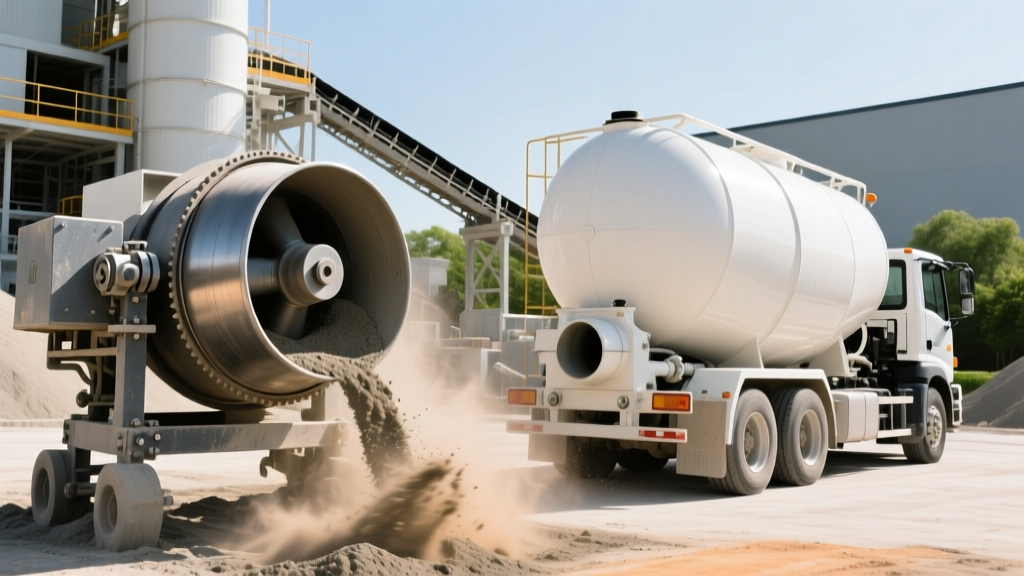
- The Concrete Truck (Transit Mixer): A straight truck or tractor-trailer equipped with a rotating drum that transports and agitates wet, mixed concrete from the batch plant to the pour site.
- The Cement Truck (Pneumatic Bulk Trailer): A specialized trailer featuring pressurized cylindrical hoppers used exclusively to transport dry, powdered cement from the manufacturing plant to the ready-mix batch facility.
Understanding the technical specifications of both vehicles is critical for fleet procurement, site logistics planning, and material handling safety.
Concrete Transit Mixer: Technical Specifications & Chassis Integration
The modern concrete transit mixer is a complex integration of heavy-duty vocational chassis and hydraulic drum mechanics. In 2026, the dominant chassis platforms for these vehicles include the Mack Granite and the Oshkosh S-Series, engineered specifically to handle the extreme dynamic weight shifts of liquid cargo.
Drum Geometry and Blade Pitch
The mixing drum is not a simple cylinder; it is a truncated cone featuring internal Archimedean spiral blades. The geometry dictates the material flow based on the drum's rotational direction and speed.
- Struck Capacity vs. Heaped Capacity: A standard 10-yard mixer holds 10 cubic yards of concrete up to the blade edges (struck), but can physically contain up to 11.5 cubic yards when heaped over the center cone. Operating above struck capacity risks spillage and inadequate mixing.
- Blade Pitch: The spiral blades are typically pitched at a 15-to-20-degree angle. This pitch ensures that when the drum rotates counter-clockwise (charging/mixing), the concrete is pulled deep into the bowl. When rotated clockwise (discharging), the blades act as a screw conveyor, pushing the material up and out.
Rotational Speeds and Hydraulic PTO
The drum is driven by a hydraulic motor powered by the truck's Power Take-Off (PTO) or a separate auxiliary diesel engine (common in older or extreme-duty models). The rotational speed (RPM) is strictly regulated based on the operational phase:
- Charging/Mixing: 14 to 16 RPM. This high speed creates the necessary shear force to fold the aggregates, cement, and water into a homogeneous slurry.
- Agitating (Transit): 2 to 4 RPM. This slow rotation prevents aggregate segregation and delays the initial set without adding excess water or heat.
- Discharging: 8 to 12 RPM in reverse, pushing the concrete up the chute at a rate of 1 to 3 cubic yards per minute.
Pneumatic Bulk Cement Trailer: Fluidization and Pressure Specs
While the transit mixer handles wet concrete, the actual 'cement truck'—the pneumatic bulk trailer—handles dry powder. Manufacturers like Heil Trailer and Tremcar engineer these vessels to fluidize dry bulk materials, turning solid powder into a fluid-like state using compressed air.
Hopper Geometry and Aeration
Dry Portland cement is highly cohesive and prone to bridging (arching) inside a hopper. To prevent this, bulk cement trailers utilize specific geometric and pneumatic designs:
- Cone Angles: The bottom discharge cones on cement trailers are pitched at a steep 45-degree angle (compared to 35 degrees for less cohesive materials like sand or fly ash) to ensure gravity assists the flow.
- Fluidization Pads: Located at the base of each hopper, these porous membranes (typically woven polyester or canvas) allow low-pressure air to seep through, aerating the cement immediately above the discharge valve.
- Capacity: Standard multi-hopper trailers range from 1,000 to 1,500 cubic feet, translating to roughly 80 to 120 tons of dry cement payload.
Compressor and Discharge Dynamics
Unlike transit mixers that use hydraulic PTOs, bulk cement trailers rely on external or PTO-driven air compressors to generate the necessary pressure for discharge.
- Operating Pressure: Fluidization requires a constant 15 to 20 PSI. Exceeding 25 PSI risks rupturing the fluidization pads or blowing out the trailer's pressure relief valves.
- Air Volume (CFM): Compressors must deliver 100 to 150 Cubic Feet per Minute (CFM) to maintain the air-to-solids ratio required for continuous flow.
- Discharge Rate: A properly aerated cement trailer discharges at a rate of 1 to 1.5 tons per minute, meaning a full 100-ton load takes approximately 75 to 90 minutes to offload into a batch plant silo.
Operational Matrix: Transit Mixer vs. Pneumatic Bulk Trailer
| Specification | Concrete Transit Mixer | Pneumatic Bulk Cement Trailer |
|---|---|---|
| Primary Cargo | Wet, mixed concrete (slurry) | Dry Portland cement (powder) |
| Standard Capacity | 8 to 11 cubic yards (struck) | 1,000 to 1,500 cu. ft. (80-120 tons) |
| Discharge Mechanism | Hydraulic drum rotation (Archimedean screw) | Pneumatic fluidization via compressed air |
| Power Source | Truck PTO or auxiliary diesel engine | External plant compressor or PTO air compressor |
| Operating Pressure | Atmospheric (open drum) | 15 to 20 PSI (pressurized vessel) |
| Primary Hazard | Chemical burns (alkalinity), rollover | Silica dust inhalation, pressure vessel failure |
Failure Modes and Material Degradation
Operating either vehicle outside its technical parameters results in catastrophic material loss or mechanical failure. The failure modes for these two systems are entirely distinct.
Transit Mixer Failure: Drum Lock-Up and Slump Crash
If a transit mixer is delayed on-site beyond the 90-minute discharge window mandated by most structural specifications, the concrete undergoes accelerated hydration. If the drum stops rotating during this window, the concrete will set against the internal blades, resulting in 'drum lock-up.' Removing hardened concrete requires mechanical chipping or hydro-demolition, costing upwards of $3,000 per incident and taking the truck out of service for days. Furthermore, if an operator adds unauthorized water to revive a stiff mix, the water-cement ratio spikes, permanently destroying the compressive strength (PSI) of the cured slab.
Bulk Trailer Failure: Pad Blinding and Moisture Ingress
The most common mechanical failure on a pneumatic cement trailer is 'pad blinding.' If the trailer is loaded with slightly damp cement, or if moisture enters the hopper during washing, the cement hydrates and packs into the microscopic pores of the fluidization pads. Once blinded, air cannot pass through, and the trailer will fail to discharge, requiring the pads to be physically removed and replaced. Additionally, because dry cement is highly hygroscopic, any failure in the top manhole seals or bottom butterfly valves will allow ambient humidity to enter, causing pre-hydration that ruins the entire 100-ton payload before it reaches the batch plant.
Capital Expenditure and Procurement Framework
When budgeting for fleet expansion or replacement in 2026, the capital requirements for these two asset classes differ significantly due to chassis integration and mechanical complexity.
- Concrete Transit Mixer CapEx: A new, fully spec'd front-discharge or rear-discharge transit mixer on a vocational chassis (e.g., Mack Granite) ranges from $190,000 to $260,000. The drum and hydraulic package alone account for roughly 40% of this cost. Maintenance is heavily focused on hydraulic hose replacement, chute wear-liner swapping, and water system winterization.
- Pneumatic Bulk Cement Trailer CapEx: A new 4-hopper or 5-hopper aluminum or stainless-steel pneumatic trailer ranges from $95,000 to $130,000. Because it lacks an engine or drivetrain, the CapEx is lower, but maintenance requires strict adherence to pressure vessel inspections, compressor oil changes, and annual fluidization pad integrity tests.
Ultimately, resolving the 'cement truck vs concrete truck' confusion is the first step in proper logistics planning. The Portland Cement Association (PCA) emphasizes that maintaining the strict boundary between dry binder transport and wet composite delivery is essential for structural integrity, site safety, and operational efficiency.
Written by
Priya KapoorPriya Kapoor is a real estate market analyst and construction economics researcher with expertise in housing affordability, development feasibility, and infrastructure investment. She holds a Master of Regional Planning from Cornell University and previously worked as a senior analyst at CBRE's Investment Properties group, where she modeled returns for $4B in mixed-use development pipelines. Priya now runs an independent research practice advising developers, municipalities, and REITs on construction cost forecasting and market timing. She publishes the quarterly "BuildMat Market Pulse" report tracking material price indices across 12 commodity categories. Based in Austin, TX, Priya serves on the board of Habitat for Humanity Austin and is a marathon runner.
More from Priya Kapoor
View all
Construction Cost
Cost to Build a 1600 Sq Ft Home in 2026: Full Breakdown
Accurate 2026 cost to build a 1600 sq ft home—material, labor, and regional pricing breakdowns included. Plan your budget with real-time estimates.
Aug 11, 2026

Wood & Lumber
Name the Types of Wood for Pressure Treatment and Preservation
Learn how to name the types of wood best suited for pressure treatment. Compare species treatability, chemical retention levels, and 2026 preservation costs.
Aug 4, 2026

Stone & Masonry
Stone Veneer Suppliers Lindenhurst: 2026 Cost Analysis
Analyze 2026 stone veneer costs in Lindenhurst, NY. Compare local supplier pricing, delivery fees, and Suffolk County installation labor rates.
Aug 4, 2026