Grout Saw Lifespan Analysis: Blades, Motors, and Wear
Analyze grout saw durability, comparing diamond vs. carbide blade lifespans, rotary vs. oscillating motor wear, and replacement cost metrics.
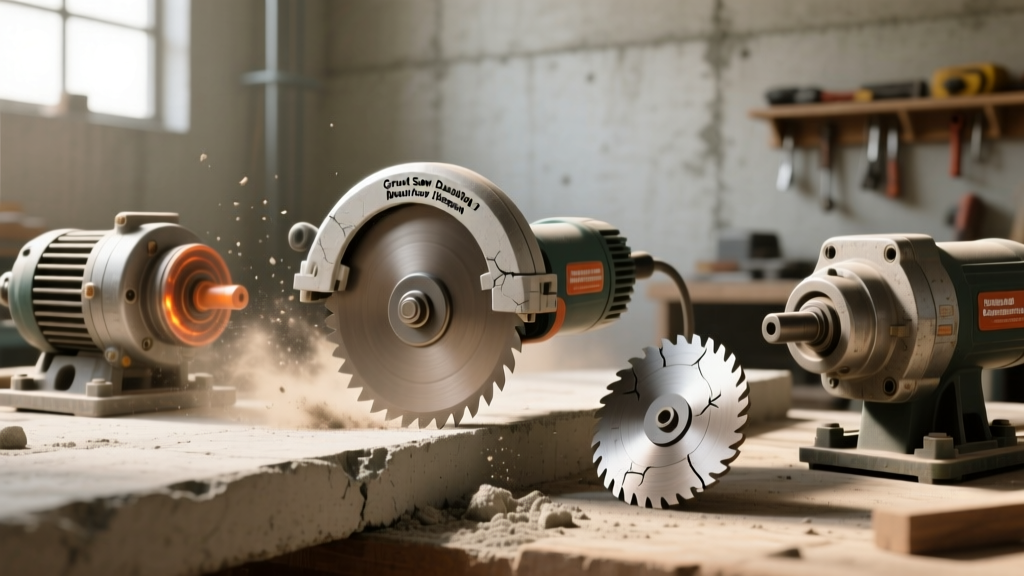
The Anatomy of Grout Saw Wear and Degradation
Grout removal is an inherently abrasive, high-friction process that accelerates tool degradation far beyond standard woodworking or metalworking applications. When evaluating the true cost and durability of a grout saw, contractors and restoration specialists must analyze two distinct wear vectors: the consumable cutting edges (blades and bits) and the mechanical drive system (motors, bearings, and eccentrics). Understanding the lifespan of these components is critical for accurately bidding tile restoration projects and preventing catastrophic substrate damage caused by failing tool mechanics.
The lifespan of any grout removal tool is dictated by the hardness of the target material. Standard cementitious grout (Mohs hardness 3-4) is relatively forgiving, but modern epoxy grouts and sanded grouts containing quartz aggregates (Mohs hardness 7) act as lapping compounds that rapidly destroy inferior cutting edges and overheat underpowered motors. According to guidelines from the Tile Council of North America (TCNA), improper tool selection during grout removal is a leading cause of adjacent tile chipping and substrate delamination.
Blade and Bit Lifespan: Diamond vs. Carbide Matrices
The cutting edge is the primary consumable in grout removal. The market is dominated by two material categories: tungsten carbide and diamond grit. While carbide is cheaper upfront, its lifespan in high-silica environments is severely limited compared to diamond matrices.
| Blade/Bit Type | Material Composition | Avg. Lifespan (Linear Ft) | Avg. Unit Cost | Cost Per Linear Ft | Primary Failure Mode |
|---|---|---|---|---|---|
| Rotary Carbide Bit (e.g., Dremel 569D) | Tungsten Carbide | 15 - 25 ft | $6 - $8 | $0.32 - $0.53 | Tooth shearing and edge rounding |
| Rotary Diamond Bit (e.g., Bosch DC515) | Electroplated Diamond | 70 - 100 ft | $15 - $20 | $0.15 - $0.28 | Grit stripping and matrix balding |
| Oscillating Carbide (e.g., Fein 63502122230) | Precision Milled Carbide | 30 - 45 ft | $25 - $30 | $0.66 - $1.00 | Lateral tooth fracture |
| Oscillating Diamond (e.g., Bosch OSC114DG) | Sintered Diamond Grit | 120 - 150 ft | $35 - $45 | $0.23 - $0.37 | Delamination from base plate |
For large-scale commercial restoration, sintered diamond oscillating blades offer the lowest cost-per-linear-foot, despite the high initial capital outlay. Electroplated rotary diamond bits are optimal for small residential repairs where maneuverability in tight corners is required.
The True Burn Rate Formula
To accurately calculate your consumable costs for a bid, use the following formula:
True Cost = (Tool Amortization per Hour) + (Blade Cost / Expected Linear Foot Lifespan)
Example: If a $35 diamond blade lasts 140 linear feet, your consumable cost is $0.25 per foot. If you use a $7 carbide bit that lasts only 20 feet, your consumable cost is $0.35 per foot, making the diamond blade 28% cheaper in the long run, excluding the labor cost of stopping to change dull bits.
Mechanical Drive Durability: Rotary vs. Oscillating Systems
Beyond the blade, the internal mechanics of the grout saw dictate its overall operational lifespan. The two dominant platforms—rotary tools and oscillating multi-tools—suffer from entirely different mechanical failure modes.
Thermal Degradation in Rotary Tools
Rotary grout saws (such as the Dremel 8220 or RotoZip platforms) operate at extreme speeds, typically between 15,000 and 30,000 RPM. This high rotational velocity generates immense friction heat at the cutting interface. In corded models utilizing universal motors, the carbon brushes are the primary wear item, typically requiring replacement every 250 to 300 hours of continuous use. However, the more insidious failure mode is thermal degradation of the spindle bearings. When operators fail to utilize thermal rest cycles (15 minutes of cutting followed by 5 minutes of cooling), the grease inside the sealed spindle bearings liquefies and leaks, leading to catastrophic spindle wobble within 100 to 150 hours.
Mechanical Fatigue in Oscillating Multi-Tools
Oscillating multi-tools (like the Bosch GOP18V-28 or Fein MultiMaster) operate at lower speeds but higher torque, typically oscillating between 10,000 and 20,000 OPM (oscillations per minute). The lifespan of these tools is limited by the eccentric bearing assembly that converts rotary motor motion into lateral oscillation. According to engineering specs from Bosch Power Tools, the needle bearings in the oscillating head are subjected to severe lateral shock loads every time the blade binds in a dense grout joint. Under heavy commercial use, these bearings develop micro-pitting after 150 to 200 hours. This wear manifests as increased harmonic vibration, which not only reduces cutting efficiency but severely increases the risk of damaging the surrounding tile.
Substrate Impact: How Tool Wear Compromises Tile Integrity
A degrading grout saw does not just cost money in replacements; it actively threatens the substrate. As internal bearings wear and spindle tolerances widen, the tool develops 'chatter'—high-frequency micro-vibrations that transfer directly into the surrounding ceramic or porcelain tile.
- Micro-fracturing: Porcelain tile is highly dense and brittle. Chatter from a worn rotary spindle can induce hairline micro-fractures along the tile edge, which later propagate into visible cracks under thermal expansion.
- Glaze Chipping: Worn oscillating bearings cause the blade to deflect laterally. This deflection results in the blade striking the glazed edge of the tile, causing irreversible chipping that requires full tile replacement.
- Waterproofing Breaches: Aggressive, uncontrolled vibration from a failing tool can compromise underlying liquid-applied waterproofing membranes (such as Laticrete Hydro Ban or Schluter Kerdi) if the grout joint is shallow. Technical data from LATICRETE technical resources emphasizes that membrane integrity must be preserved during partial renovations.
Maintenance Protocols to Maximize Tool Lifespan
Contractors can effectively double the mechanical lifespan of their grout saws by implementing strict, job-site maintenance protocols tailored to the specific tool architecture.
For Rotary Grout Saws:
- Mandatory Thermal Cycling: Never run a rotary grout saw continuously for more than 15 minutes. Allow a 5-minute cooldown to preserve spindle bearing grease viscosity.
- Compressed Air Blowouts: After every shift, use compressed air (regulated to 60 PSI) to blow silica dust out of the motor cooling vents. Silica infiltration is the primary cause of universal motor armature failure.
- Collet Replacement: Replace the collet nut and sleeve every 100 hours. A worn collet causes bit slippage, which ruins the bit shank and transfers destructive rotational friction to the spindle.
For Oscillating Multi-Tools:
- Blade Clamp Debris Clearance: Grout dust packs tightly into the quick-release blade clamp mechanism. Clean this with a wire brush daily to ensure rigid blade lock-up; a loose blade accelerates eccentric bearing wear by 40%.
- Load Management: Let the tool's oscillation rate do the work. Applying heavy downward pressure does not speed up cutting; it merely overloads the internal worm gears and strips the lateral needle bearings.
Professional Insight: In 2025 and 2026, the industry has seen a shift toward brushless oscillating multi-tools. While brushless motors eliminate the carbon brush wear point and offer 30% longer motor lifespans, they do not protect the oscillating head bearings from mechanical shock. The bearing assembly remains the critical failure point, regardless of motor type.
Summary: Decision Framework for Tool Selection
When selecting a grout saw for long-term durability, match the tool architecture to the project scale. For residential repairs involving less than 100 linear feet of standard cementitious grout, a high-quality rotary tool with diamond bits offers the best balance of capital cost and precision. For commercial restoration, epoxy grout removal, or projects exceeding 500 linear feet, a premium oscillating multi-tool equipped with sintered diamond blades is mandatory. The higher initial investment is rapidly offset by the superior linear-foot lifespan of the diamond matrix and the reduced risk of catastrophic tile damage caused by rotary chatter.