How Much Does It Cost to Build a House in Arizona? 2026 Cost Comparison
Discover how much it costs to build a house in Arizona in 2026. Compare regional pricing, material costs, and hidden expenses like caliche excavation.
Baseline Construction Costs: The 2026 Arizona Average
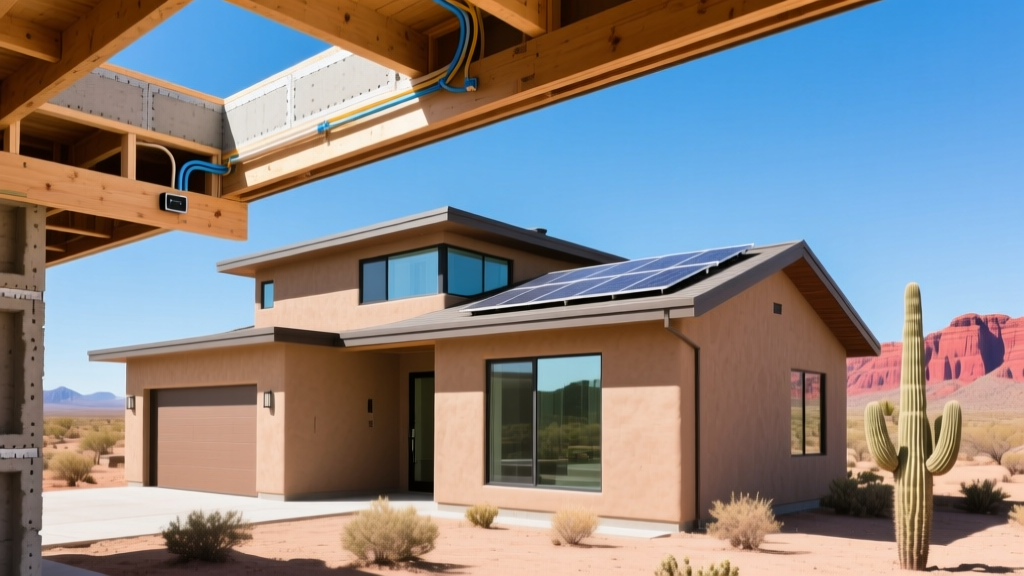
Calculating exactly how much it costs to build a house in Arizona requires moving beyond national averages. The state's unique topography, extreme temperature gradients, and specific soil compositions create a localized pricing ecosystem. As of 2026, the baseline cost to build a custom, single-family home in Arizona ranges from $165 to $285 per square foot for the structural shell and interior finishes, excluding land acquisition and site development.
According to building permit data tracked by the U.S. Census Bureau, Arizona remains one of the fastest-growing states for new residential construction. However, the shift toward stricter energy codes and increased labor demands in the Sun Belt has pushed baseline material and labor costs upward. Production-built homes in master-planned communities typically sit at the lower end ($165–$195 per sq. ft.), while fully custom architectural builds in areas like North Scottsdale or Paradise Valley easily exceed $350 per sq. ft.
Cost Estimates by Home Size
| Home Size (Sq. Ft.) | Production Build (Tract) | Semi-Custom Build | Full Custom Build |
|---|---|---|---|
| 1,500 - 2,000 | $247,500 - $330,000 | $330,000 - $440,000 | $450,000+ |
| 2,000 - 2,500 | $330,000 - $412,500 | $440,000 - $550,000 | $600,000+ |
| 2,500 - 3,500 | $412,500 - $577,500 | $550,000 - $770,000 | $875,000+ |
| 3,500+ | N/A (Rare for Tract) | $770,000 - $980,000 | $1,200,000+ |
Regional Cost Variations Across Arizona
Arizona is not a monolith. The cost to build in the Sonoran Desert differs drastically from building in the high-altitude ponderosa pine forests of the north. The Arizona Department of Housing frequently highlights the disparity in infrastructure and code requirements between counties, which directly impacts your bottom line.
Phoenix Metro (Maricopa County)
The Phoenix metropolitan area benefits from high builder density and optimized supply chains. Average costs hover between $165 and $220 per square foot. The primary cost drivers here are cooling infrastructure, expansive soil mitigation, and municipal impact fees, which can range from $8,000 to $15,000 per lot depending on the specific city (e.g., Gilbert vs. Buckeye).
Tucson and Southern Arizona (Pima County)
Tucson generally sees slightly lower labor rates than Phoenix, bringing average custom build costs to $155–$200 per square foot. However, strict hillside development ordinances in areas like the Catalina Foothills can add $20,000 to $50,000 in grading, retaining wall, and environmental mitigation costs before the foundation is even poured.
Flagstaff and Northern Arizona (Coconino County)
Building in Flagstaff or Prescott requires designing for IECC Climate Zone 5. Costs jump to $220–$285+ per square foot. You must account for deep frost-line foundations (often 36 to 48 inches deep), heavy snow-load roof trusses (40-50 PSF ground snow load), and specialized cold-weather concrete curing admixtures if pouring in late fall.
Material and Framing Method Comparison
The choice of structural system heavily influences both upfront costs and long-term energy efficiency, particularly in Arizona's extreme heat.
Traditional Wood Frame with 3-Coat Stucco
This remains the dominant building method in the Phoenix and Tucson basins. A 2x6 wood frame with R-19 cavity insulation, wrapped in a fluid-applied weather barrier, and finished with traditional 3-coat Portland cement stucco costs approximately $9.50 to $13.00 per square foot of exterior wall area. Stucco provides excellent thermal mass and fire resistance but requires careful weep screed installation to prevent moisture wicking from landscape irrigation.
Insulated Concrete Forms (ICF)
ICF construction uses interlocking expanded polystyrene (EPS) blocks filled with reinforced concrete. While it adds 5% to 8% to the total upfront build cost (roughly $12 to $16 per sq. ft. of exterior wall area), it yields a continuous R-22+ insulation value and massive thermal mass. In the Sonoran Desert, ICF walls delay heat transfer so effectively that peak cooling loads are shifted to nighttime hours, drastically reducing HVAC sizing requirements and summer utility bills. Furthermore, ICF is increasingly preferred in northern Arizona for its superior wildfire ember resistance.
Climate Zone Specifics: Insulation and Glazing
Arizona spans multiple International Energy Conservation Code (IECC) climate zones. Treating a build in Yuma (Zone 2) the same as a build in Show Low (Zone 5) guarantees either wasted capital or failed inspections.
- Zone 2 & 3 (Phoenix, Tucson, Yuma): The priority is heat rejection. Budget for a radiant barrier roof sheathing (e.g., LP TechShield), which adds roughly $0.60 per square foot of roof deck but reduces attic temperatures by up to 30°F. For windows, specify Low-E3 or Low-E366 glazing with a Solar Heat Gain Coefficient (SHGC) of 0.23 or lower. Standard Low-E2 glass will result in unbearable solar gain on west-facing elevations.
- Zone 4 & 5 (Prescott, Flagstaff, Show Low): The priority is heat retention. Radiant barriers are unnecessary. Instead, allocate budget toward high-R exterior continuous insulation (ci) to eliminate thermal bridging through wood studs, and specify Low-E glazing with a higher SHGC (0.30+) on south-facing windows to capture passive winter solar heating.
Hidden Arizona-Specific Construction Costs
Out-of-state builders and first-time owner-builders frequently underestimate three localized site-development costs that can derail a construction budget.
1. Caliche Soil Excavation
Caliche is a hardened, concrete-like layer of calcium carbonate found just inches or feet below the topsoil in much of the Sonoran Desert. Standard excavators cannot dig through it. If your soil test reveals a thick caliche layer, you will need to hire specialized ripping equipment or blasting crews. Expect to pay an additional $2,500 to $7,500 for foundation trenching and pool excavation in heavy caliche zones like Chandler Heights or Queen Creek.
2. Post-Tensioned Slab Foundations
Because expansive clay soils are prevalent in the Phoenix metro, traditional rebar-reinforced slab-on-grade foundations are prone to severe cracking. Engineers routinely specify post-tensioned (PT) concrete slabs. High-strength steel tendons are laid in the forms, poured with concrete, and then hydraulically stressed to compress the slab. This adds roughly $1.50 to $2.50 per square foot of foundation area compared to standard rebar, but it is virtually mandatory to prevent structural failure in areas mapped with high plasticity index (PI) soils.
3. Rural Water and Septic Infrastructure
If building in unincorporated areas of Yavapai, Mohave, or Cochise counties, municipal water and sewer are rarely available. Drilling a residential water well in Arizona's fractured bedrock aquifers costs between $45 and $65 per linear foot. A 500-foot well, complete with pump, pressure tank, and trenching, will cost $25,000 to $35,000. Additionally, an engineered alternative septic system (required if the lot fails a standard perc test) will add $18,000 to $28,000 to your site work budget.
'Always conduct a Phase 1 Environmental Site Assessment and a comprehensive geotechnical soil boring test before purchasing raw land in Arizona. The $2,500 you spend on soil testing will save you from a $30,000 surprise when the excavator hits bedrock or a high water table.' — Senior Geotechnical Engineer, Phoenix Metro
HVAC Sizing and the SEER2 Mandate
Under current Department of Energy standards, the minimum allowable efficiency for new split-system air conditioners in the Southwest is 15.2 SEER2. However, building to the bare minimum code in a Phoenix summer is a false economy. Upgrading to an 18+ SEER2 variable-speed inverter system (such as the Daikin Fit or Lennox SL series) costs $3,500 to $5,500 more upfront than a standard single-stage 15.2 SEER2 unit. This upgrade provides superior dehumidification, maintains exact temperature set-points, and typically achieves a 3-to-5-year ROI via utility savings and extended compressor lifespan.
Furthermore, insist that your HVAC contractor performs a room-by-room ACCA Manual J load calculation. Oversizing an AC unit in a dry climate leads to short-cycling, which fails to remove latent humidity and causes premature mechanical wear.
Budgeting Framework for Your Arizona Build
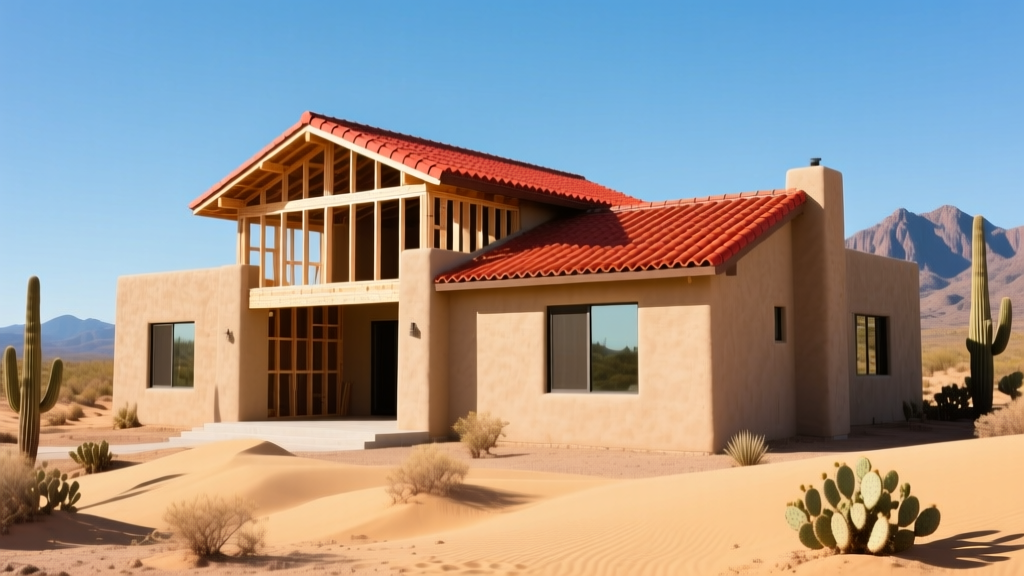
To maintain financial control over your project, structure your capital allocation using the following framework, verified by ENERGY STAR certified builders and local construction lenders:
- Land & Site Prep (15-20%): Includes purchase, well/septic, grading, and caliche mitigation.
- Hard Construction Costs (55-60%): Foundation, framing, MEP (mechanical, electrical, plumbing), roofing, and exterior finishes.
- Interior Finishes (15-20%): Cabinetry, flooring, drywall, trim, and appliances.
- Soft Costs & Permits (5-8%): Architectural plans, structural engineering, city impact fees, and utility hookups.
- Contingency Reserve (10%): Non-negotiable. Supply chain delays and summer monsoon work-stoppages frequently impact Arizona build timelines.
By understanding the distinct regional requirements, soil challenges, and climate-zone mandates, you can accurately forecast how much it costs to build a house in Arizona and avoid the expensive pitfalls that catch unprepared developers off guard.
Written by
Priya KapoorPriya Kapoor is a real estate market analyst and construction economics researcher with expertise in housing affordability, development feasibility, and infrastructure investment. She holds a Master of Regional Planning from Cornell University and previously worked as a senior analyst at CBRE's Investment Properties group, where she modeled returns for $4B in mixed-use development pipelines. Priya now runs an independent research practice advising developers, municipalities, and REITs on construction cost forecasting and market timing. She publishes the quarterly "BuildMat Market Pulse" report tracking material price indices across 12 commodity categories. Based in Austin, TX, Priya serves on the board of Habitat for Humanity Austin and is a marathon runner.
More from Priya Kapoor
View all
Construction Cost
Cost to Build a 1600 Sq Ft Home in 2026: Full Breakdown
Accurate 2026 cost to build a 1600 sq ft home—material, labor, and regional pricing breakdowns included. Plan your budget with real-time estimates.
Aug 11, 2026

Wood & Lumber
Name the Types of Wood for Pressure Treatment and Preservation
Learn how to name the types of wood best suited for pressure treatment. Compare species treatability, chemical retention levels, and 2026 preservation costs.
Aug 4, 2026

Stone & Masonry
Stone Veneer Suppliers Lindenhurst: 2026 Cost Analysis
Analyze 2026 stone veneer costs in Lindenhurst, NY. Compare local supplier pricing, delivery fees, and Suffolk County installation labor rates.
Aug 4, 2026