Cost of Solar Panels: 2026 Installation Procedures & Pricing Guide
Analyze the true cost of solar panels in 2026, focusing on installation procedures, roof prep, racking systems, and electrical integration pricing.
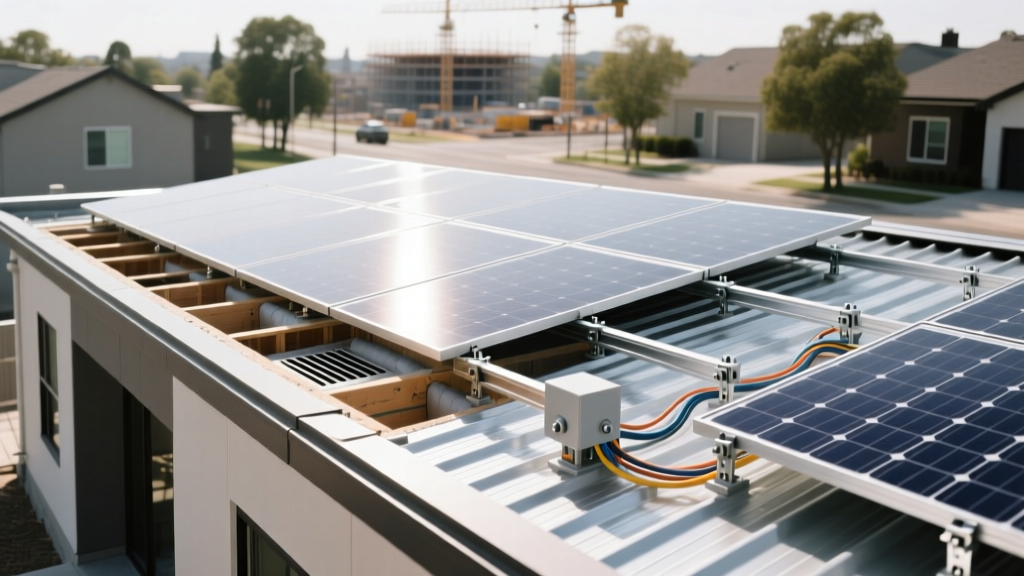
The Anatomy of Solar Panel Installation Costs
When evaluating the total cost of solar panels for a residential or light commercial project, the hardware (photovoltaic modules and inverters) represents only a fraction of the final invoice. In 2026, the physical installation, structural integration, and electrical application procedures account for 35% to 45% of the total system price. According to the latest benchmarking data from the National Renewable Energy Laboratory (NREL), soft costs and installation labor for a standard 8kW residential system average between $0.85 and $1.15 per watt, translating to $6,800 to $9,200 of an average $22,000 total project.
Understanding these installation procedures is critical for accurate construction cost estimating. The application process is not merely bolting modules to a roof; it requires structural load verification, weatherproofing integration, and complex electrical routing. Failing to account for site-specific installation variables is the primary reason solar project estimates run 15% to 20% over budget.
Step-by-Step Roof Preparation and Structural Assessment
Before any racking is mounted, the roof deck must be evaluated for structural integrity and remaining lifespan. Solar arrays add a dead load of approximately 2.5 to 4.0 pounds per square foot, plus localized point loads at the mounting feet that can exceed 300 lbs per attachment during high-wind uplift events.
Sheathing and Rafter Verification
Installers must verify the thickness and condition of the roof sheathing. Modern building codes generally require a minimum of 5/8-inch CDX plywood or OSB for solar attachments. If a site inspection reveals 1/2-inch sheathing or degraded boards, the installation procedure must include structural reinforcement.
- Sheathing Replacement: Swapping out compromised decking adds $450 to $900 per 4x8 sheet area, including labor and materials.
- Rafter Sistering: For homes with 24-inch on-center rafter spacing (common in 1990s construction), structural hangers or sistering rafters with 2x6 lumber may be required to meet the Solar Energy Industries Association (SEIA) structural guidelines, adding $1,200 to $2,500 to the project.
- Composition Shingle Tear-Off: If the roof has less than 10 years of life remaining, a simultaneous roof replacement is mandatory. Factoring this into the cost of solar panels prevents paying for double labor on mounting and flashing.
Mounting Hardware and Flashing Procedures
The racking system serves as the structural bridge between the roof and the PV modules. In 2026, rail-based systems like the IronRidge XR100 and rail-less systems like Unirac ProLine dominate the market. The choice of racking directly impacts both the material cost and the labor hours required for installation.
Flashing is the most critical application procedure to prevent catastrophic water intrusion. The industry standard has shifted away from simple mastic applications toward mechanical, multi-layered waterproofing. Professional installers now utilize integrated flashing systems (such as IronRidge FlashFoot2 or QuickBOLT MicroFlash) paired with high-grade butyl tape and counter-flashing shingles.
Using roofing tar or cheap caulk instead of mechanical step-flashing with butyl seals will void both the racking manufacturer's warranty and the roofing material warranty. Water damage claims resulting from improper solar flashing average $8,500 in remediation costs, entirely negating any initial labor savings.
2026 Installation Cost Breakdown by Phase
The following table outlines the estimated labor and material costs for the installation phase of a standard 8kW (approx. 20 panels) rooftop system on a composite shingle roof with a 5/12 pitch.
| Installation Phase | Key Procedures | Estimated Cost Range (8kW) | Time Required |
|---|---|---|---|
| Site Prep & Layout | Chalk lines, stud finding, conduit routing planning | $400 - $650 | 2 - 4 Hours |
| Roof Penetrations & Flashing | Drilling, butyl sealing, mechanical flashing install | $900 - $1,400 | 4 - 6 Hours |
| Racking Assembly | Mounting L-feet, rails, splicing, and torque marking | $1,200 - $1,800 | 6 - 8 Hours |
| Module Mounting | Lifting panels, securing mid/end clamps, grounding | $1,100 - $1,600 | 5 - 7 Hours |
| Electrical & Inverter Integration | Conduit bending, wire pulling, inverter mounting | $1,800 - $2,900 | 8 - 12 Hours |
| Inspection & PTO | Municipal inspection, utility interconnection | $500 - $1,200 | 1 - 3 Weeks (Wait) |
Electrical Integration and Inverter Application
The electrical application procedure dictates how direct current (DC) from the panels is converted to alternating current (AC) and integrated into the building's main service panel. This phase is highly regulated by the National Electrical Code (NEC) and represents the most variable cost component in solar estimating.
Microinverters vs. String Inverters
In 2026, microinverters (such as the Enphase IQ8+) are the default for residential applications due to module-level power electronics (MLPE) requirements and shade tolerance. Installing microinverters requires running a specialized 240V trunk cable beneath the panels, which increases material costs by $0.15 per watt compared to traditional DC homeruns used with string inverters like the SolarEdge HD-Wave. However, microinverters reduce the labor time required for high-voltage DC wire management and combiner box assembly.
Main Service Panel Upgrades
The NEC 120% rule governs solar interconnections. If a home has a 100-amp main breaker panel, the maximum allowable solar backfeed is typically limited to 16 amps (roughly 3.8kW). To install an 8kW system, the installation procedure must include a main service panel upgrade to 200 amps or 400 amps. This electrical upgrade adds $2,200 to $3,800 to the overall cost of solar panels and requires a separate municipal permit and utility coordination.
Post-Installation Inspection and Interconnection
The physical installation is not complete until the system passes municipal building and electrical inspections, and the utility grants Permission to Operate (PTO). Estimators must account for the soft costs associated with this phase:
- AHJ (Authority Having Jurisdiction) Inspections: Local inspectors verify structural attachment torque marks, grounding continuity, and NEC-compliant conduit labeling. Failed inspections require remobilization, costing $350 to $500 per trip.
- Utility Interconnection: The utility company installs a bi-directional net meter. Some utilities charge interconnection fees ranging from $75 to $300, which must be factored into the initial estimate.
- System Commissioning: The lead electrician performs a final voltage test, activates the monitoring gateway (e.g., Enphase Envoy), and hands over the system to the owner.
Frequently Asked Questions on Installation Costs
How does a clay tile roof affect the cost of solar panels installation?
Clay or concrete tile roofs require specialized mounting procedures. Installers must either remove tiles to install stand-off mounts and flash them with mastic and metal base sheets, or use tile hooks that slide under the overlapping tiles. This procedure is labor-intensive and increases the installation labor cost by 30% to 50%, adding approximately $2,500 to $4,000 to an 8kW system estimate. Furthermore, a 5% to 10% tile breakage rate is standard, requiring the purchase of replacement tiles.
Are ground-mounted solar panels cheaper to install than roof-mounted?
Ground mounts eliminate the need for roof structural assessments and high-angle fall protection gear, reducing roofing labor. However, they require trenching (typically 50 to 100 feet of 24-inch deep trenching for PVC conduit), pouring concrete footings, and erecting heavy steel torque tubes. For standard residential lots, ground mount installation costs are generally 10% to 15% higher than roof mounts due to the civil work and extra racking steel required.
What is the cost impact of installing a solar battery alongside the panels?
Adding a DC-coupled or AC-coupled battery (like the Tesla Powerwall 3 or Enphase IQ 5P) to the installation procedure requires additional conduit runs, a dedicated critical loads subpanel, and complex commissioning software setup. Expect the installation labor and electrical materials for a single battery integration to add $1,800 to $2,800 to the project cost, exclusive of the battery hardware itself.