How Much Does It Cost to Build a Screened-In Porch by Region?
Discover how much does it cost to build screened in porch additions across US regions. Get 2026 pricing, material breakdowns, and labor rates.

National Baseline vs. Regional Reality
When evaluating how much does it cost to build screened in porch additions, national averages only tell a fraction of the story. In 2026, the baseline national cost to construct a new 200-square-foot screened porch ranges from $5,600 to $9,000 (or $28 to $45 per square foot). However, treating this as a fixed metric leads to severe budget miscalculations. Regional disparities in labor unionization, local building codes, climate-specific engineering, and material availability can swing your final invoice by up to 60%.
A homeowner in rural Texas building a basic pressure-treated pine enclosure will face a vastly different cost structure than a homeowner in coastal Florida, where Miami-Dade County wind-load mandates require engineered extruded aluminum framing. This regional price analysis breaks down the exact cost drivers, material specifications, and labor rates dictating your local project budget.
The 2026 Regional Cost Matrix
The following matrix outlines the estimated cost per square foot for a complete ground-up screened porch build (including concrete footings, framing, roofing, and screening) across the four primary US Census regions.
| Region | Avg Cost / Sq Ft | Labor Rate (Hr) | Primary Cost Driver | Typical Framing Material |
|---|---|---|---|---|
| Northeast | $40 - $65 | $85 - $130 | High union labor rates, snow-load engineering, strict permit fees. | Cedar or Engineered Lumber |
| Midwest | $26 - $42 | $60 - $95 | Frost-heave footing requirements, moderate labor costs. | Pressure-Treated Pine |
| South | $32 - $55 | $55 - $90 | Hurricane wind-load codes (FL/Gulf), termite-resistant materials. | Extruded Aluminum / PT Pine |
| West | $45 - $75 | $90 - $150 | Seismic bracing, Title 24 energy compliance (CA), high permit costs. | Redwood or Aluminum |
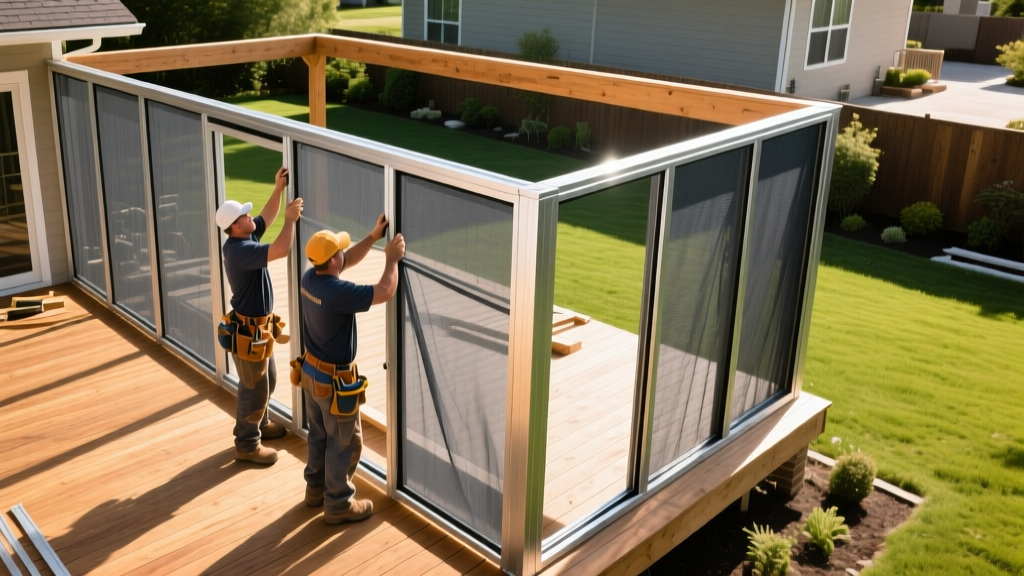
Climate and Code: The Hidden Regional Multipliers
Building codes are not uniform; they are localized responses to environmental threats. These structural requirements fundamentally alter material takeoffs and engineering costs.
The South: Wind Loads and Hurricane Codes
In High-Velocity Hurricane Zones (HVHZ) like South Florida and the Carolina coast, a screened porch is treated as a wind-load structure. Standard 2x4 wood framing with spline-screening will fail inspection. Builders must use heavy-gauge extruded aluminum systems (such as ScreenEze or Structall) anchored with 316 stainless steel lag bolts to prevent galvanic corrosion. Furthermore, the roof structure requires a structural engineer's stamp to prove it can withstand 150+ MPH uplift forces, adding $600 to $1,200 in upfront engineering fees before a single shovel hits the dirt.
The Northeast & Mountain West: Snow Loads
According to the International Code Council (ICC), regions with heavy winter precipitation require roofs to support specific ground snow loads (often 30 to 50 PSF). This mandates upgrading from standard 2x6 rafters spaced at 24 inches on-center to 2x8 or 2x10 rafters spaced at 16 inches on-center. The increased lumber volume and heavier roof sheathing directly inflate material costs by 15% to 22% compared to southern builds.
Permit Warning: In many northeastern municipalities, enclosing an existing open deck with a screen system triggers a "change of use" or "enclosure" permit. This often requires the existing deck footings to be dug up and inspected to prove they meet modern frost-line depth requirements (often 42 to 48 inches deep), adding $2,000+ in unexpected retrofit costs.
Material Selection & Regional Preferences
The choice of framing material dictates both the aesthetic and the longevity of the structure. Regional availability and climate heavily influence which materials are most cost-effective.
| Material | Cost per Linear Ft | Best Suited Regions | Lifespan & Maintenance |
|---|---|---|---|
| Pressure-Treated Pine | $2.50 - $4.50 | Midwest, Rural South | 15-20 years. Requires annual sealing and painting to prevent warping. |
| Western Red Cedar | $6.50 - $10.00 | Pacific Northwest, Northeast | 25+ years. Naturally rot-resistant. Weathers to silver-gray if untreated. |
| Extruded Aluminum | $8.00 - $14.00 | Coastal South, Florida, Urban West | 50+ years. Zero maintenance, impervious to termites and rot. |
Screen Mesh Technologies: Beyond Basic Fiberglass
The screen mesh itself represents a small percentage of the total budget, but choosing the wrong type for your region leads to premature failure. According to industry leaders like Phifer Incorporated, modern screen technology offers specialized solutions for specific environmental nuisances.
- Standard Charcoal Fiberglass ($0.15 - $0.25 / sq ft): The default choice for the Midwest and Northeast. It is flexible, easy to install with a standard spline tool, and provides good visibility. However, it degrades under intense UV exposure and is easily torn by pets.
- Polyester Pet-Resistant Mesh ($0.45 - $0.70 / sq ft): Up to 7x thicker than standard fiberglass. Highly recommended for suburban homes across all regions where dogs or cats will access the porch. It resists punctures and sagging over wide spans.
- Stainless Steel Micro-Mesh ($1.20 - $2.50 / sq ft): Essential for the Deep South and Gulf Coast. This marine-grade mesh blocks microscopic "no-see-ums" (biting midges) and resists corrosion from salt air. It requires specialized aluminum track systems rather than traditional wood spline grooves.
- Super Screen (Thick Polyester): Ideal for large, expansive openings (over 4 feet wide) where standard fiberglass would sag or billow in high winds.
Labor Market Disparities and Installation Systems
Labor accounts for 45% to 60% of your total project cost. The disparity between right-to-work states and prevailing-wage states is stark. In Illinois or California, union carpenters and electricians (required for porch lighting and ceiling fans) can command $95 to $150 per hour. In Texas or Georgia, non-union specialized crews typically charge $55 to $85 per hour.
To mitigate high regional labor costs, specify a track-based screening system like ScreenEze. Traditional spline installation requires a carpenter to meticulously roll rubber splines into wood grooves—a slow, labor-intensive process that fails if the wood warps. Track systems snap together and allow the screen to be pushed into place, reducing installation labor time by up to 40%. In high-labor-cost regions like the West Coast, this material upgrade pays for itself in saved man-hours.
Hidden Regional Costs to Budget For
When calculating how much does it cost to build screened in porch structures, contractors often omit site-specific logistical fees. Ensure your budget includes the following regional variables:
- HOA Architectural Review Fees: Prevalent in the South and West. Subdivisions often require specific roof pitch matches and color-matched aluminum framing, limiting your ability to choose cheaper, off-the-shelf materials.
- Seismic Bracing (West Coast): California's Title 24 and seismic codes may require lateral load brackets (like Simpson Strong-Tie A35s) at every post-to-beam connection, adding $300-$500 in hardware and inspection time.
- Termite Treatments (South/Southeast): If building with wood framing, pre-treating the lumber with borate solutions or installing physical termite barriers (like Termimesh) is often mandated by local county health departments.
- Electrical Upgrades: Adding outdoor-rated GFCI circuits, recessed lighting, and ceiling fans requires a licensed electrician. In the Northeast, upgrading an older home's main electrical panel to support the new porch load can add $2,500 to the project.
Return on Investment and Home Value Impact
While a screened porch is primarily a lifestyle upgrade, it carries tangible financial benefits. According to data analyzed in the Remodeling Magazine Cost vs. Value Report, outdoor living space additions consistently yield a high return on investment, particularly in regions with extended warm seasons. In the South and Mid-Atlantic, a well-constructed screened porch can recoup 65% to 75% of its cost at resale, largely because it effectively adds usable square footage to the home without the expense of HVAC integration. In the National Association of Home Builders (NAHB) consumer preference surveys, outdoor screened spaces remain a top-tier desired amenity, providing a distinct competitive edge in local real estate markets.
Ultimately, accurately estimating your project requires looking past national averages. By aligning your material choices with your local climate codes and understanding your region's specific labor market, you can engineer a screened porch that is both structurally compliant and financially predictable.
Written by
Elena RodriguezElena Rodriguez is a civil engineer and technical writer specializing in concrete technology, masonry systems, and ASTM/ACI compliance. She earned her B.S. in Civil Engineering from Texas A&M University and spent a decade at a materials testing laboratory, performing over 2,000 concrete compressive strength tests and masonry prism evaluations. Elena is an ACI-certified Field Testing Technician (Grade I) and a member of ASTM Committee C12 on Natural Building Stone. She currently consults on forensic engineering cases involving concrete failures and moisture intrusion. Based in San Antonio, TX, Elena is a proud member of the Society of Women Engineers (SWE) and coaches her daughter's FIRST Robotics team.
More from Elena Rodriguez
View all
Walls & Panels
Cost Analysis: Light Gauge Steel Framing Advantages and Disadvantages
Evaluate light gauge steel framing advantages and disadvantages through a strict cost analysis lens, comparing material, labor, and lifecycle expenses.
Aug 4, 2026

Walls & Panels
Gypsum Board Types: Exact Specifications, Thickness & Dimensions
Compare standard, Type X, and moisture-resistant gypsum board types. Get exact specifications, thicknesses, dimensions, and ASTM standards for your project.
Aug 4, 2026

Fire Resistance
Best Fire-Resistant Outdoor Decking Materials: 2026 Buyer Guide
Discover the best fire-resistant outdoor decking materials for 2026. Compare Class A PVC, aluminum, and hardwood options for WUI compliance and safety.
Aug 4, 2026