How Much Would It Cost to Build a Casino? 2026 Breakdown
Discover how much it costs to build a casino in 2026. Compare regional, tribal, and mega-resort construction costs, MEP requirements, and CapEx data.

The True Scale of Casino Construction Costs
Estimating the capital expenditure (CapEx) for a casino requires moving beyond standard commercial construction metrics. A casino is not merely a retail space; it is a highly regulated, 24/7 micro-city requiring specialized mechanical, electrical, and plumbing (MEP) systems, military-grade IT infrastructure, and luxury hospitality finishes. When developers ask how much it would cost to build a casino, the answer depends entirely on the asset class: a regional tribal gaming facility operates on a vastly different budget than a multi-billion-dollar integrated resort on the Las Vegas Strip.
According to data tracked by the American Gaming Association, the modernization and expansion of gaming properties have driven construction costs upward, heavily influenced by specialized labor and advanced surveillance technology requirements. Below is a comprehensive cost comparison across the three primary casino development tiers.
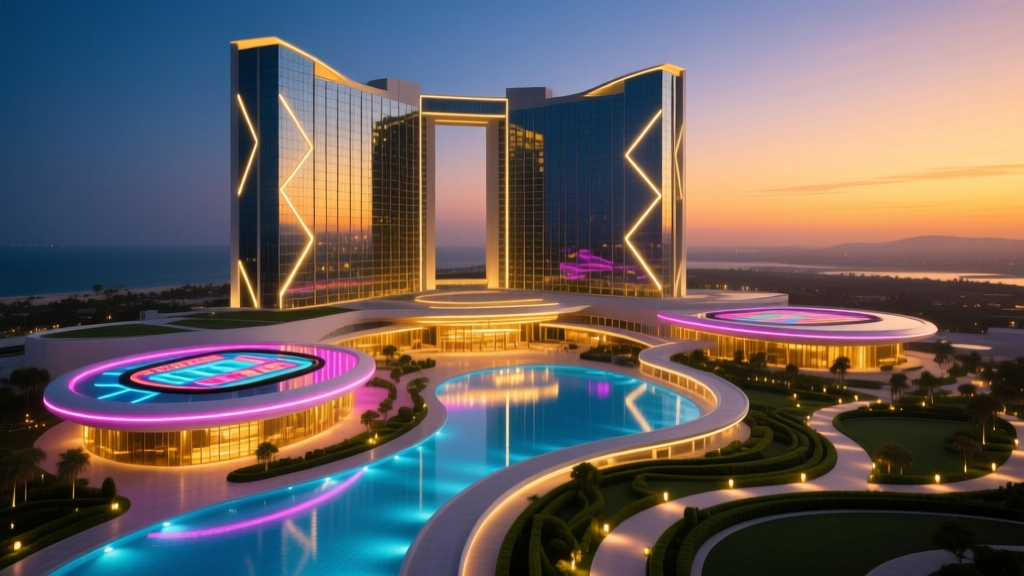
Casino Construction Cost Comparison by Tier
The following matrix breaks down the estimated hard and soft construction costs based on facility size and market positioning. These figures exclude land acquisition and gaming license fees, focusing strictly on the built environment and fixed infrastructure.
| Development Tier | Typical Size (Gross Sq Ft) | Total Construction Cost Range | Cost per Sq Ft | Primary Cost Drivers |
|---|---|---|---|---|
| Tier 1: Tribal / Card Room | 30,000 - 80,000 | $15 Million - $45 Million | $450 - $650 | Basic gaming floor, surface parking, limited F&B |
| Tier 2: Regional Racino / Riverboat | 150,000 - 400,000 | $120 Million - $350 Million | $600 - $950 | Mid-scale hotel, structured parking, entertainment venue |
| Tier 3: Mega-Resort (Strip / Macau) | 1,500,000 - 4,000,000+ | $1.5 Billion - $3.5 Billion+ | $900 - $1,400+ | High-rise towers, convention centers, complex MEP, water features |
Hard Cost Breakdown: Dissecting the CapEx
To understand where the budget actually goes, developers must segment the property into its distinct operational zones. The cost per square foot varies wildly between the gaming pit and the back-of-house (BOH) loading docks.
The Gaming Floor: A Masterclass in MEP Complexity
The gaming floor is the most expensive contiguous space to build on a per-square-foot basis, often exceeding $900 to $1,200 per square foot. This premium is driven by three non-negotiable factors:
- Raised Access Flooring: Modern slot machines and electronic table games require massive amounts of power, data, and HVAC airflow. Developers utilize raised access floors (such as Tate flooring systems) to route miles of fiber-optic cabling and chilled water lines without trenching the concrete slab.
- Advanced HVAC & Smoke Management: Casinos require immense air exchange rates to maintain comfort and manage indoor air quality, especially in smoking-permitted zones. Systems must comply with stringent ASHRAE 62.1 standards, requiring dedicated makeup air units (MAUs) and high-capacity exhaust systems that can cost upwards of $45 per square foot just for ductwork and air handling.
- Ceiling Plenums & Lighting: The ceiling of a gaming floor is a dense forest of sprinkler heads, surveillance cameras, HVAC diffusers, and decorative lighting. Coordinating these systems via BIM (Building Information Modeling) adds significant pre-construction soft costs but prevents catastrophic field clashes.
Underestimating the cooling load of a gaming floor is a common fatal error. Thousands of slot machines, combined with dense human occupancy and high-wattage decorative lighting, generate massive thermal loads. Failing to spec chillers with adequate redundancy (N+1 or 2N configurations) will result in emergency change orders that can inflate the mechanical budget by 15-20% mid-construction.
Hospitality Towers and F&B Venues
Hotel construction in a casino resort mirrors luxury hospitality standards. According to industry benchmarks tracked alongside the U.S. Bureau of Labor Statistics Producer Price Index, luxury hotel construction averages between $450,000 and $750,000 per key (room). A 1,000-room hotel tower will easily command $450M to $750M in hard costs. High-end restaurants and nightclubs add another $800 to $1,500 per square foot due to specialized commercial kitchen ventilation, acoustic isolation, and custom millwork.
Parking Structures: The Silent Budget Sink
Casinos require massive parking footprints. While surface lots are cheap, urban and resort casinos rely on structured parking garages. In 2026, the cost to build a single space in a multi-level concrete garage ranges from $28,000 to $42,000. A 3,000-space garage—a standard requirement for a mid-sized regional resort—represents an $84M to $126M line item before a single gaming table is installed.
Soft Costs, IT, and Regulatory Overhead
Hard construction is only part of the equation. Casino developers must allocate 25% to 35% of their total budget to soft costs and specialized technology infrastructure.
Surveillance and IT Infrastructure
The 'Eye in the Sky' is not just a camera network; it is a localized data center. A mid-sized casino may deploy 2,000 to 4,000 high-definition IP cameras. This requires:
- On-site Tier 3 equivalent server rooms with dedicated cooling and UPS battery backups.
- Miles of OM4 multimode fiber optic cabling.
- Network Video Recorders (NVRs) capable of storing petabytes of footage for the 90 to 180 days mandated by state gaming commissions.
Budgeting for IT infrastructure and low-voltage wiring typically requires $15 to $25 per square foot of gross building area.
Licensing, Compliance, and Environmental Studies
Before breaking ground, developers spend millions on environmental impact reports, traffic studies, and architectural renderings required for gaming commission approvals. As noted in historical development analyses by the UNLV Center for Gaming Research, the regulatory friction in new markets can add 18 to 36 months to the pre-construction timeline, carrying substantial holding costs and legal fees.
'The complexity of a casino build is not in its height, but in its density. You are essentially building a secure data center, a luxury hotel, a convention center, and a high-end retail mall, all stacked on top of each other and operating on a single, unified power grid.' — Senior Commercial MEP Engineer
Regional Cost Variations and Labor Markets
Geography dictates the final ledger. Building in established gaming hubs versus emerging markets presents distinct financial profiles:
- Las Vegas / Atlantic City: High union labor rates and strict prevailing wage requirements drive up hard costs. However, the proximity of specialized contractors (architects and engineers who exclusively design gaming spaces) reduces soft cost inefficiencies and design errors.
- Tribal Lands / Rural Markets: Non-union labor can reduce baseline construction costs by 10-15%. However, the remote location increases material transport costs, and developers often pay a premium to fly in specialized low-voltage and gaming-floor technicians.
- Riverboat / Waterfront: Marine construction introduces extreme variables. Barge stabilization, ballast systems, and marine-grade corrosion protection can increase the structural budget by 30% compared to a land-based equivalent.
Strategic Decision Framework: Phased vs. Mega-Launch
When determining how much capital to deploy on day one, developers must weigh the ROI of a phased approach against the market impact of a mega-launch.
Phase 1 (Core): Build the gaming floor, 50% of the hotel tower, and essential parking. This allows the property to generate cash flow and establish a customer database within 24 months.
Phase 2 (Expansion): Fund the completion of the hotel tower, convention center, and luxury spa using retained earnings and favorable debt restructuring, minimizing initial equity risk.
Ultimately, estimating the cost to build a casino requires a granular understanding of gaming-specific MEP loads, regulatory IT mandates, and luxury hospitality finishes. Developers who treat the project as a standard commercial retail build will inevitably face severe budget overruns when confronted with the unique demands of the gaming floor.
Written by
Marcus ChenMarcus Chen is a licensed structural engineer (PE) and building materials analyst with over 12 years of experience across residential, commercial, and industrial construction. He holds a Master of Science in Civil Engineering from UC Berkeley and spent six years at Thornton Tomasetti before transitioning to independent consulting and technical writing. Marcus specializes in material selection for seismic-prone regions, concrete reinforcement strategies, and lifecycle cost analysis. His work has been cited by the American Concrete Institute (ACI) and the Structural Engineers Association of California (SEAOC). When he is not on a job site or at his desk, you will find him hiking the Sierra Nevada or restoring a 1920s craftsman bungalow in Oakland, CA.
More from Marcus Chen
View all
Construction Cost
How Much Did the Eiffel Tower Cost to Build?
How much did the Eiffel Tower cost to build in 1889? We adjust for inflation and compare its budget to modern skyscraper construction.
Aug 4, 2026

Fire Resistance
What Is a Fire Resistant Material? Testing & Certification Guide
Discover what is a fire resistant material through ASTM and UL testing. Learn how fire ratings, certifications, and assemblies work in construction.
Aug 4, 2026

Construction Cost
How Much Did the Burj Khalifa Cost to Build?
How much did the Burj Khalifa cost to build? We break down the $1.5B project and extract 5 money-saving strategies for your next build.
Jul 30, 2026