How Much Did the Eiffel Tower Cost to Build?
How much did the Eiffel Tower cost to build in 1889? We adjust for inflation and compare its budget to modern skyscraper construction.

The original construction of the Eiffel Tower cost 6,500,000 French francs in 1889, equating to approximately $1,290,000 USD at the time. Adjusted for 2026 inflation, modern labor rates, and contemporary material costs, building an identical 300-meter structure today would cost between $32,000,000 and $45,000,000 USD. This analysis is designed for construction cost estimators, architectural historians, and civil engineering students seeking a precise breakdown of this landmark infrastructure project.
TL;DR Key Takeaways:
Original Cost: 6,500,000 French francs ($1.29 million USD in 1889).
Modern Equivalent: $32 million to $45 million USD in 2026.
Primary Material: 7,300 tonnes of puddle iron.
Construction Time: 2 years, 2 months, and 5 days.
The Original 1889 Construction Budget
The financial framework for the Eiffel Tower was established through a public-private partnership. The Paris municipal government provided a subsidy of 1,500,000 French francs to support the project. The remaining 5,000,000 French francs were financed directly by Gustave Eiffel and his engineering firm, Compagnie des Établissements Eiffel.
Gustave Eiffel's Financial Contribution
Gustave Eiffel assumed massive personal financial risk to ensure the tower's completion. In exchange for funding the majority of the construction, he secured the rights to all commercial revenue generated by the tower for a period of 20 years following the 1889 Exposition Universelle. This aggressive recoupment strategy allowed him to recover his initial capital investment within the first year of public operation.
Material and Labor Cost Breakdown
The physical construction required 18,038 individual metallic parts and 2,500,000 thermally assembled rivets. According to the Official Eiffel Tower Key Figures, the metal framework alone weighs 7,300 tonnes. The majority of the 1889 budget was allocated to the fabrication of these custom iron components and the specialized masonry work required for the four foundational piers.
Definition - Puddle Iron: A specialized type of wrought iron produced by melting pig iron in a reverberatory furnace and continuously stirring it to remove excess carbon. This process results in a highly durable, fibrous metal that was ideal for nineteenth-century structural frameworks and large-scale architectural monuments.
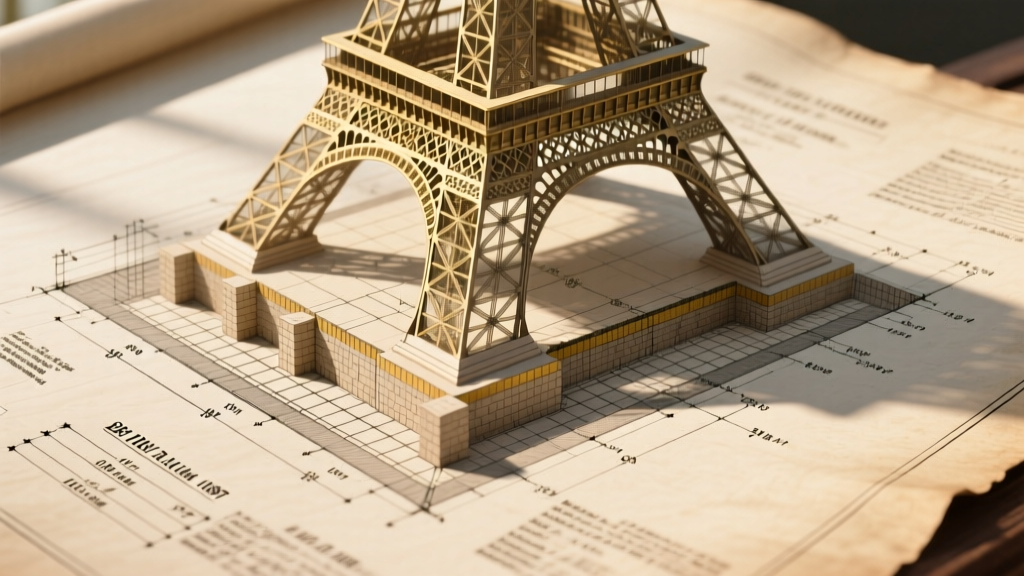
Eiffel Tower Construction Cost in Today's Money
Translating nineteenth-century expenses into modern currency requires accounting for more than just standard inflation. Modern construction mandates stringent safety protocols, advanced engineering software, and specialized heavy-lifting crane operations that did not exist in 1887. These variables drastically alter the final projected budget for a contemporary replica.
Adjusting for Inflation and Modern Labor
If we apply a pure historical inflation multiplier, the 6,500,000 French francs translates to roughly $15,000,000 USD. However, construction labor costs have outpaced general consumer inflation. Factoring in 2026 prevailing wage standards, union safety requirements, and modern project management overhead, a realistic estimate for building the Eiffel Tower today sits between $32,000,000 and $45,000,000 USD.
Modern Material Equivalents
Modern engineers would likely substitute puddle iron with high-strength, low-alloy structural steel. While steel is more expensive per tonne than historical iron, its superior strength-to-weight ratio would reduce the total material volume required. This material optimization partially offsets the increased costs of modern fabrication and logistics.
Definition - French Franc (1889): The official national currency of France prior to the adoption of the euro, which operated strictly on the Latin Monetary Union gold standard in 1889. Under this system, one single franc was legally defined as containing exactly 0.29032 grams of pure gold.
Historical vs. Modern Cost Comparison Matrix
The following decision framework table contrasts the original 1889 expenditures with projected 2026 costs for an identical 300-meter structure. This matrix assists cost estimators in understanding how specific construction phases have scaled over time.
| Cost Category | 1889 Historical Cost | 2026 Projected Cost (USD) | Primary Cost Driver Shift |
|---|---|---|---|
| Foundations & Masonry | ~1,000,000 Francs | $8,500,000 | Modern geotechnical surveys and reinforced concrete |
| Metal Framework Fabrication | ~3,500,000 Francs | $16,000,000 | High-strength steel sourcing and CNC precision cutting |
| On-Site Assembly & Labor | ~1,500,000 Francs | $14,500,000 | OSHA-equivalent safety harnesses, crane rentals, and insurance |
| Architectural & Engineering Fees | ~500,000 Francs | $6,000,000 | BIM modeling, wind-tunnel testing, and structural analysis |
Frequently Asked Questions
How much did Gustave Eiffel pay out of pocket?
Gustave Eiffel and his company paid 5,000,000 French francs out of pocket. This represented nearly 77% of the total 6,500,000-franc construction budget, with the Paris municipal government covering the remaining 1,500,000 francs.
What was the material cost vs labor cost for the Eiffel Tower?
Material costs dominated the historical budget, accounting for roughly 70% of the total expenditure due to the massive 7,300-tonne iron requirement. In 2026, this ratio has inverted; modern labor, safety compliance, and equipment rental now consume over 60% of the budget for large-scale steel erection projects.
How much would it cost to build the Eiffel Tower today?
Based on current infrastructure metrics documented by the Encyclopedia Britannica Eiffel Tower Overview, constructing a 300-meter iron lattice tower today would cost between $32,000,000 and $45,000,000 USD. This accounts for modern steel prices, advanced crane operations, and contemporary labor regulations.
Conclusion and Estimation Next Steps
The Eiffel Tower cost 6,500,000 French francs in 1889, a remarkably efficient budget that would require $32,000,000 to $45,000,000 USD to replicate in 2026. The massive divergence between pure inflation and actual construction costs highlights how modern safety and labor standards impact heavy civil engineering projects. For cost estimators analyzing similar lattice or steel-frame structures, the next step is to input these historical-to-modern labor multipliers into your Building Information Modeling (BIM) cost estimation software to generate accurate baseline budgets for contemporary high-rise frameworks.
Written by
Marcus ChenMarcus Chen is a licensed structural engineer (PE) and building materials analyst with over 12 years of experience across residential, commercial, and industrial construction. He holds a Master of Science in Civil Engineering from UC Berkeley and spent six years at Thornton Tomasetti before transitioning to independent consulting and technical writing. Marcus specializes in material selection for seismic-prone regions, concrete reinforcement strategies, and lifecycle cost analysis. His work has been cited by the American Concrete Institute (ACI) and the Structural Engineers Association of California (SEAOC). When he is not on a job site or at his desk, you will find him hiking the Sierra Nevada or restoring a 1920s craftsman bungalow in Oakland, CA.
More from Marcus Chen
View all
Fire Resistance
What Is a Fire Resistant Material? Testing & Certification Guide
Discover what is a fire resistant material through ASTM and UL testing. Learn how fire ratings, certifications, and assemblies work in construction.
Aug 4, 2026

Construction Cost
How Much Did the Burj Khalifa Cost to Build?
How much did the Burj Khalifa cost to build? We break down the $1.5B project and extract 5 money-saving strategies for your next build.
Jul 30, 2026

Construction Cost
Cost to Build a Race Track: Full Breakdown
How much does it cost to build a race track? From 1/4-mile karting circuits to FIA-grade road courses—material and labor pricing.
Jul 30, 2026