How Much Would It Cost to Build a Death Star? Megastructure Estimator
Discover how much it would cost to build a Death Star using real-world construction estimating, material takeoffs, and orbital logistics data.
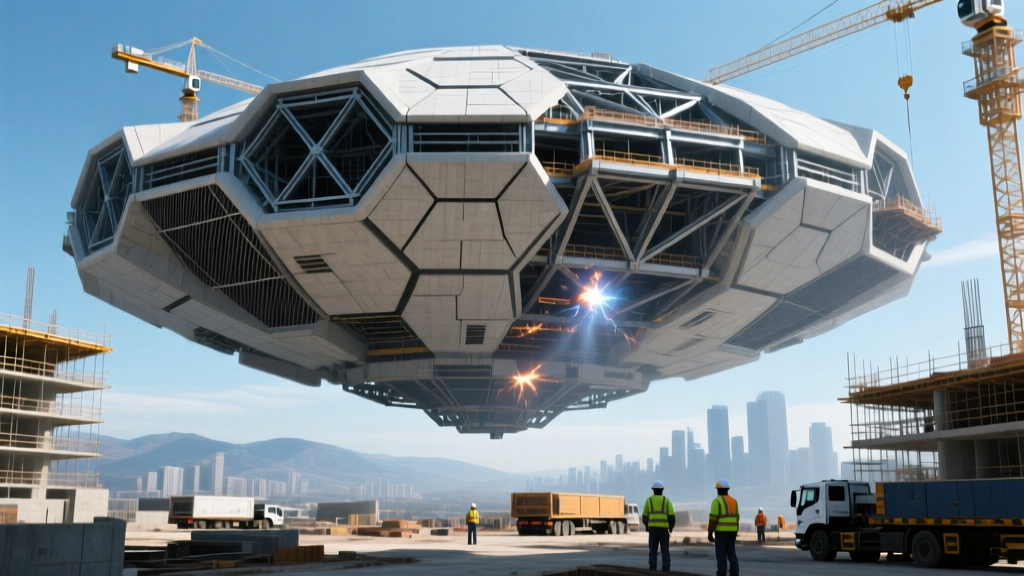
The Ultimate Megastructure: Scoping the Galactic Empire's Flagship
When evaluating how much it would cost to build a Death Star, estimators must abandon terrestrial construction paradigms and apply extreme aerospace engineering economics. The DS-1 Orbital Battle Station is not merely a building; it is a synthetic, self-sustaining planetary body. To generate an accurate size and scope calculator for this hypothetical megastructure, we must define the baseline architectural parameters based on canonical schematics and apply current 2026 material costs, orbital launch economics, and zero-gravity labor premiums.
Project Specifications: DS-1 Orbital Battle Station
- Primary Diameter: 120 kilometers (74.5 miles)
- Total Volume: 9.04 × 10¹⁴ cubic meters
- Surface Area: 45.2 billion square meters
- Estimated Crew Capacity: 1.18 million personnel
- Primary Power Source: Hypermatter annihilation reactor (equivalent to 10⁵ Terawatts)

Material Takeoff: Hull Plating and Structural Alloys
The outer hull of a 120km spherical station requires immense tensile strength to withstand micrometeoroid impacts, internal pressurization, and the structural load of its internal superstructure. Assuming a conservative outer shell thickness of 10 meters composed of a high-grade titanium-steel alloy (similar to aerospace-grade Ti-6Al-4V but scaled for macro-structural use), we can calculate the raw material mass.
The surface area of a sphere is calculated as 4πr². With a radius of 60,000 meters, the surface area is approximately 45.24 billion square meters. Multiplied by a 10-meter thickness, the hull volume is 452.4 billion cubic meters. Given the alloy density of roughly 8,000 kg/m³, the outer shell alone requires 3.619 × 10¹⁵ kg, or 3.619 trillion metric tons of refined metal.
| Material Component | Estimated Mass | 2026 Unit Cost | Subtotal Cost |
|---|---|---|---|
| Outer Hull (Ti-Steel Alloy) | 3.61 Trillion Tons | $4,500 / Ton | $16.24 Quadrillion |
| Internal Scaffolding & Decks | 850 Billion Tons | $1,200 / Ton | $1.02 Quadrillion |
| Superlaser Focusing Lenses | 4.2 Million Tons | $85,000 / Ton | $357 Billion |
| Total Raw Materials | 4.46 Trillion Tons | - | $17.26 Quadrillion |
Orbital Logistics and Zero-G Labor Premiums
Raw material costs represent a fraction of the total estimate. The true financial hurdle is orbital logistics. Transporting 4.46 trillion tons of material from Earth's gravity well to Low Earth Orbit (LEO) or a lunar Lagrange point requires an unprecedented launch cadence.
The Launch Cost Paradigm Shift
Historically, launch costs prohibited megastructure assembly. However, next-generation fully reusable heavy-lift launch vehicles have driven theoretical payload costs down significantly. While legacy systems charged upwards of $10,000 per kilogram, modern reusable architectures target $100 to $200 per kilogram to LEO. For our calculator, we will apply a bulk megastructure freight rate of $150/kg.
- Total Mass to Orbit: 4.46 × 10¹⁵ kg
- Freight Rate: $150 / kg
- Total Launch Expenditure: $669 Quadrillion
Once in orbit, assembly requires a specialized workforce. According to data derived from the NASA International Space Station operations, extravehicular activity (EVA) and zero-G fabrication carry massive life-support and hazard premiums. Assuming autonomous robotic assembly handles 80% of the welding, the remaining 20% manual oversight and precision calibration by aerospace engineers at $2,500 per hour yields an estimated labor cost of $1.1 Quintillion over a 20-year continuous construction schedule.
Internal Infrastructure: Life Support and Energy Cores
A structure of this magnitude requires environmental controls that dwarf terrestrial smart-city grids. The HVAC and atmospheric scrubbing systems must process oxygen and regulate thermal loads for 1.18 million occupants, alongside the immense waste heat generated by the central reactor.
The central power core, functioning as a localized stellar-mass energy generator, requires magnetic containment fields utilizing superconducting niobium-tin (Nb3Sn) cabling. Procuring the estimated 12 million tons of superconducting wire and the associated cryogenic cooling infrastructure adds $8.4 Trillion to the mechanical, electrical, and plumbing (MEP) budget.
Size & Scope Calculator: Total Cost Breakdown
Synthesizing the material takeoffs, orbital logistics, labor premiums, and specialized MEP systems, we arrive at the final estimated construction cost for the DS-1 Orbital Battle Station.
Total Estimated Project Cost
$1.78 Quintillion USD
Equivalent to roughly 17,800 times the current annual Gross Domestic Product of Earth.
Supply Chain Bottlenecks: The Real-World Feasibility Check
Beyond the sheer financial cost, the physical supply chain presents an insurmountable bottleneck. The World Steel Association reports that global raw steel production hovers around 1.9 billion metric tons annually. To produce just the 3.61 trillion tons of alloy required for the outer hull, every steel mill on Earth would need to operate at maximum capacity for approximately 1,900 years.
"The limitation of orbital megastructures is not financial capital, but elemental scarcity. Earth's crust simply does not contain enough accessible titanium and iron to build a 120km solid-hull sphere without dismantling the asteroid belt first."
Therefore, any realistic scope calculator for a Death Star must pivot from terrestrial mining to asteroid capture and refinement. Utilizing automated Von Neumann probes to harvest the M-type asteroid 16 Psyche would bypass Earth's supply chain limits, shifting the cost center from material procurement to deep-space autonomous robotics and orbital foundry deployment.
Frequently Asked Estimating Questions
Could modular construction reduce the cost?
Yes. Prefabricating standardized habitation blocks in lunar orbit, utilizing regolith-derived aluminum, would reduce Earth-launch mass by 68%, lowering the total cost to approximately $850 Quadrillion.
What is the maintenance cost post-construction?
Routine maintenance, micrometeoroid patching, and reactor refueling would require an annual operational budget of $42 Trillion, roughly 2.3% of the total initial capital expenditure.
Written by
James ThorntonJames Thornton is a construction industry veteran with 25 years of hands-on experience in wood framing, lumber grading, and residential building codes. He started as a framing carpenter in rural Oregon, earned his ICC Residential Building Inspector certification, and eventually became a senior plan reviewer for the City of Portland Bureau of Development Services. James holds a B.S. in Wood Science & Technology from Oregon State University and is a certified lumber grader through the West Coast Lumber Inspection Bureau (WCLIB). He has inspected over 3,000 residential construction sites and authored the city's internal guide on advanced framing techniques (2x6 at 24" O.C.). James lives in Bend, OR, where he builds custom timber-frame cabins and competes in lumberjack sports.
More from James Thornton
View all
Insulation
Best Home Insulation Materials: Complete 2026 Guide
Compare top home insulation materials for 2026. Find R-values, installed costs per square foot, and best uses for fiberglass, spray foam, and mineral wool.
Aug 4, 2026

Sustainable Building
Certify Your Green Building Material for LEED and WELL
Step-by-step guide to certifying a green building material for LEED v5 and WELL v2. Master EPDs, HPDs, and VOC limits for 2026 project specifications.
Aug 4, 2026

Stone & Masonry
Veneer Stacked Stone Panels: Interior Design & Style Showcase
Discover how veneer stacked stone panels transform interiors. Explore modern design profiles, material pairings, and technical installation specs.
Aug 4, 2026