Cost to Build a House in Colorado: 2026 Regional Price Analysis
Analyze the 2026 cost to build a house in Colorado. Breakdowns for Front Range vs. mountain resorts, snow load engineering, and WUI code impacts.

Calculating the true cost to build a house in Colorado requires looking far beyond national averages. The state’s dramatic topography creates micro-economies where construction pricing fluctuates wildly between the Eastern Plains, the Front Range, and high-altitude mountain resorts. In 2026, supply chain stabilization has normalized some material costs, but localized labor shortages, stringent Wildland-Urban Interface (WUI) codes, and extreme weather engineering requirements continue to drive regional disparities.
This regional price analysis breaks down the exact cost drivers, code-mandated structural upgrades, and logistical realities you must budget for when building in the Centennial State.
The Baseline: Average Cost to Build a House in Colorado
According to recent data tracked by the National Association of Home Builders (NAHB), the national average for custom home construction hovers around $170 per square foot. However, Colorado’s diverse building zones push this number significantly higher. A 2,500-square-foot custom home that costs $450,000 to build in Pueblo could easily exceed $1.2 million to build to the same finish level in Summit County.
| Colorado Region | Cost Per Sq. Ft. (2026) | Est. Total (2,500 Sq. Ft.) | Primary Cost Drivers |
|---|---|---|---|
| Eastern Plains (e.g., Pueblo, Lamar) | $160 - $190 | $400,000 - $475,000 | Standard labor rates, minimal snow load engineering. |
| Front Range (e.g., Denver, Fort Collins) | $210 - $260 | $525,000 - $650,000 | High land prep costs, strict municipal zoning, premium labor. |
| Mountain Foothills (e.g., Evergreen, Estes Park) | $280 - $350 | $700,000 - $875,000 | Sloped lot excavation, WUI compliance, bedrock blasting. |
| Resort Counties (e.g., Summit, Eagle, Pitkin) | $450 - $750+ | $1,125,000 - $1,875,000+ | Extreme snow loads, remote logistics, luxury finishes, per diem labor. |
Hidden Colorado Construction Costs: Engineering for Extremes
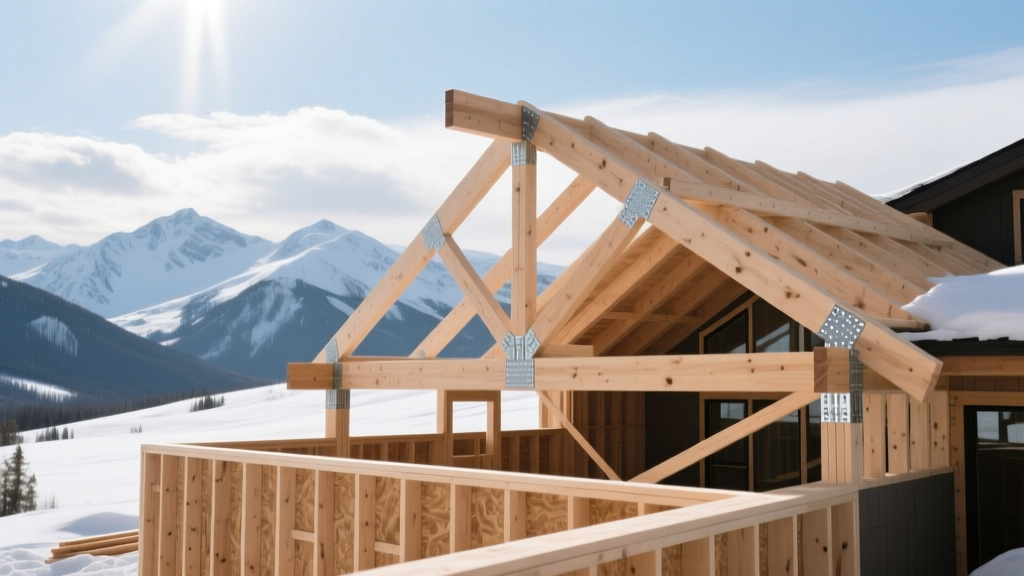
Out-of-state builders frequently underestimate the structural requirements mandated by Colorado’s building codes. The International Residential Code (IRC) is heavily amended at the county level to address local environmental hazards. Failing to account for these three specific engineering requirements will result in massive change orders during the framing and foundation phases.
1. Snow Load Engineering and Roof Truss Upgrades
The ground snow load ($P_g$) dictates the structural integrity of your roof. In Denver, the design snow load is relatively mild at roughly 25 pounds per square foot (psf). Standard 2x4 top-chord roof trusses spaced 24 inches on center are often sufficient. However, in Summit County (Breckenridge, Frisco), the $P_g$ jumps to 50–90+ psf, and in areas near Wolf Creek Pass, it can exceed 150 psf.
Engineering Reality Check: Building in a 90 psf snow load zone requires engineered trusses with 2x6 or 2x8 top chords, heavier gauge gusset plates, and continuous load-path hardware (like Simpson Strong-Tie H2.5A hurricane ties) connecting the truss to the top plate. This structural upgrade alone adds $8,500 to $14,000 to the framing package of a 2,500 sq. ft. home compared to Front Range specs.
2. Frost Line Depths and Foundation Excavation
Colorado’s freeze-thaw cycles are brutal on concrete. To prevent frost heave from cracking your foundation, footings must be poured below the local frost line.
- Front Range / Metro Denver: Frost line is typically 36 inches deep.
- Colorado Springs / Southern Plains: Frost line is roughly 30 inches deep.
- High Country / San Luis Valley: Frost line can reach 48 to 60 inches deep.
Digging an extra two feet of trench around a 60-linear-foot foundation perimeter requires moving significantly more soil and pouring substantially more concrete. For mountain builds, you must also specify 4000 PSI air-entrained concrete (which contains microscopic air bubbles to allow water expansion during freezing) rather than the standard 2500 or 3000 PSI mix used in milder climates. Expect to pay a $25 to $40 per-yard premium for air-entrained, high-psi mixes.
3. Wildland-Urban Interface (WUI) Code Compliance
Following severe fire seasons, the Colorado Department of Local Affairs and local mountain counties have aggressively expanded WUI zones. If your lot falls within a designated WUI area, you are legally required to use ignition-resistant materials. According to FEMA’s Building Science Wildfire guidelines, creating a defensible structure requires specific material choices:
- Roofing: Mandatory Class A fire-rated assemblies. Standard architectural asphalt shingles may not pass in extreme hazard zones; you will likely need to upgrade to standing seam metal roofing (e.g., 24-gauge Galvalume) or heavy concrete/clay tiles, adding $12,000–$22,000 to the roof budget.
- Vents: Standard soffit and ridge vents act as chimneys for wind-blown embers. WUI code requires 1/8-inch metal mesh ember-resistant vents (such as Brandguard Vents or Vulcan Vents), which cost 3x to 5x more than standard plastic or aluminum vents.
- Decks & Siding: Untreated wood decks are prohibited. You must budget for composite decking (like Trex Transcend) or heavy timber, and fiber-cement siding (like James Hardie) rather than vinyl or cedar lap.
Labor Market Realities: The Resort Town Premium
Material costs are only half the equation; labor is where Colorado budgets truly balloon. In resort counties like Eagle (Vail) and Pitkin (Aspen), the local workforce is severely constrained by the high cost of living. General contractors often cannot house their crews locally, resulting in a "commuter labor" model.
When building in these remote zones, you must budget for a 15% to 25% labor premium. This covers daily per diems, fuel surcharges for crews driving 90+ minutes over mountain passes from towns like Leadville or Glenwood Springs, and winter heating enclosures (temporary shrink-wrap and propane heaters) required to keep drywall mud and paint curing properly when exterior temperatures drop below 20°F.
Logistics and the CDOT Spring Thaw Restriction
A highly specific, often overlooked cost factor in Colorado is the Colorado Department of Transportation (CDOT) spring weight restriction. As snow melts and the ground thaws, mountain highways become susceptible to "frost boils." From roughly March through May, CDOT restricts the weight of commercial trucks on key mountain corridors (like I-70 over the Eisenhower Tunnel and US-40 over Berthoud Pass).
If your foundation pour or heavy timber delivery is scheduled during this window, your material suppliers will be forced to use lighter, smaller trucks, requiring double the number of trips. This logistical bottleneck can add thousands in delivery surcharges and cause weeks of scheduling delays. Smart project managers in Colorado intentionally front-load heavy material deliveries for late autumn or schedule them for late summer to bypass the spring thaw restrictions entirely.
Step-by-Step Budgeting Framework for Colorado Builds
To ensure your financing holds up against Colorado’s unique construction environment, structure your budget using this localized framework:
- Base Hard Costs (55%): Standard materials and labor for framing, MEP (mechanical, electrical, plumbing), and interior finishes. Use Climate Zone 5B/6B insulation standards (minimum R-49 attic, R-20+ exterior continuous insulation).
- Site Prep & Earthwork (15%): Allocate heavily here if building in the foothills. Bedrock blasting, steep-slope retaining walls, and extended driveway paving often exceed initial estimates by 30%.
- Environmental Engineering Upgrades (10%): Earmark funds specifically for snow load truss upgrades, 4000 PSI frost-protected foundations, and WUI-compliant exterior envelopes.
- Utility Trenching & Taps (10%): Rural mountain lots rarely have municipal water/sewer. Budget $35,000–$60,000 for well drilling (which can go 400+ feet deep in granite) and advanced aerobic septic systems required for high water tables.
- Contingency Fund (10% - 20%): Keep a strict 10% contingency for Front Range builds, but never start a mountain resort build without a 20% contingency. Weather delays, sub-contractor no-shows, and freight surcharges will inevitably consume it.
Building in Colorado offers unparalleled lifestyle rewards, but it demands a highly localized, data-driven approach to cost estimation. By respecting the engineering realities of snow loads, frost lines, and wildfire zones, you can create an accurate budget that survives contact with the mountain environment.
Written by
Marcus ChenMarcus Chen is a licensed structural engineer (PE) and building materials analyst with over 12 years of experience across residential, commercial, and industrial construction. He holds a Master of Science in Civil Engineering from UC Berkeley and spent six years at Thornton Tomasetti before transitioning to independent consulting and technical writing. Marcus specializes in material selection for seismic-prone regions, concrete reinforcement strategies, and lifecycle cost analysis. His work has been cited by the American Concrete Institute (ACI) and the Structural Engineers Association of California (SEAOC). When he is not on a job site or at his desk, you will find him hiking the Sierra Nevada or restoring a 1920s craftsman bungalow in Oakland, CA.
More from Marcus Chen
View all
Construction Cost
How Much Did the Eiffel Tower Cost to Build?
How much did the Eiffel Tower cost to build in 1889? We adjust for inflation and compare its budget to modern skyscraper construction.
Aug 4, 2026

Fire Resistance
What Is a Fire Resistant Material? Testing & Certification Guide
Discover what is a fire resistant material through ASTM and UL testing. Learn how fire ratings, certifications, and assemblies work in construction.
Aug 4, 2026

Construction Cost
How Much Did the Burj Khalifa Cost to Build?
How much did the Burj Khalifa cost to build? We break down the $1.5B project and extract 5 money-saving strategies for your next build.
Jul 30, 2026