How Much Does It Cost to Build a House? 2026 Guide
Discover how much it costs to build a house in 2026. Compare framing methods, regional prices, and material tiers to budget your new home construction.
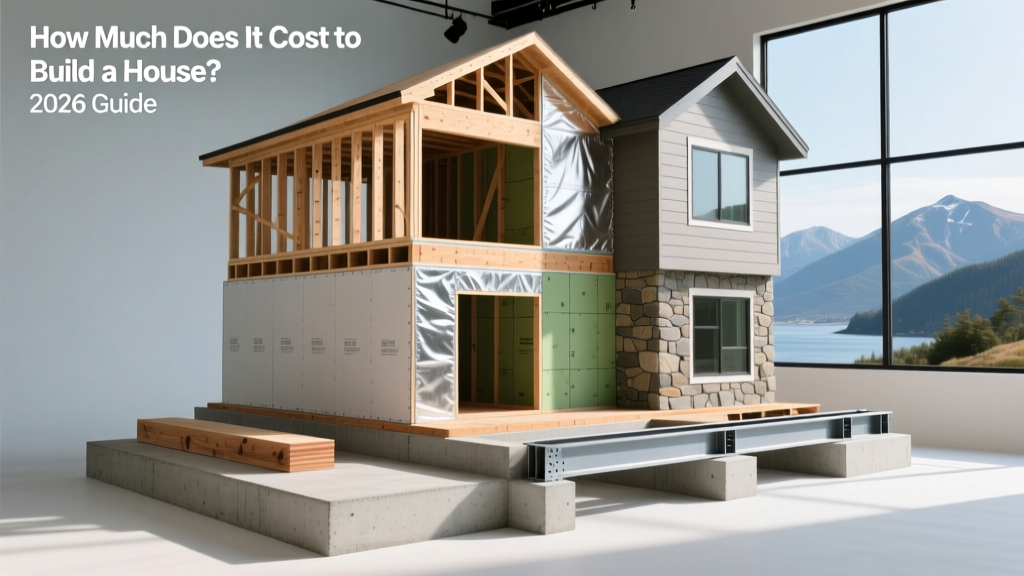
National Baseline: How Much Does It Cost to Build a House?
When calculating how much it costs to build a house in 2026, the national average for a standard stick-built, single-family home ranges from $155 to $265 per square foot. For a typical 2,000-square-foot residence, this translates to a total construction cost between $310,000 and $530,000, excluding land acquisition. According to the National Association of Home Builders (NAHB), construction costs have stabilized compared to the volatile pandemic years, but material specifics and labor shortages in specialized trades continue to push the upper bounds of custom builds.
This baseline assumes a relatively flat, easily accessible lot with municipal water and sewer connections. The moment you introduce complex topography, rural utility requirements, or alternative structural systems, the cost per square foot fluctuates significantly. To build an accurate budget, you must break the project down into structural systems, hard vs. soft costs, and finish tiers.
Structural System Cost Comparison Matrix
The framing and envelope system dictates not only your upfront structural budget but also your long-term HVAC sizing and energy costs. Below is a 2026 cost comparison of the four primary residential structural systems.
| Structural System | Material Cost (per sq ft) | Labor Cost (per sq ft) | Total Shell Cost | Best Application |
|---|---|---|---|---|
| Stick-Built (2x6, 16" OC) | $7.50 - $10.00 | $6.00 - $9.00 | $13.50 - $19.00 | Standard suburban builds; highest contractor availability. |
| SIPs (6" EPS Core) | $11.00 - $14.50 | $4.50 - $7.00 | $15.50 - $21.50 | Tight building envelopes; reduced HVAC tonnage requirements. |
| ICF (e.g., NUDURA, Fox Blocks) | $14.00 - $18.00 | $8.00 - $12.00 | $22.00 - $30.00 | Hurricane/tornado alleys; high thermal mass requirements. |
| Post-Frame (Barndominium) | $9.00 - $13.00 | $5.00 - $8.00 | $14.00 - $21.00 | Large open-concept spaces; integrated shop/garage living. |
Expert Insight: While ICF (Insulated Concrete Forms) carries a 15% to 20% premium over stick framing for the shell, the continuous R-23+ insulation and reduced air infiltration often allow builders to downsize the HVAC system by 20% to 30%, recovering a portion of the upfront premium.
Hard Costs vs. Soft Costs Allocation
A common budgeting error is allocating 100% of the budget to physical materials and labor (hard costs). The U.S. Census Bureau tracks new residential construction data that highlights the heavy burden of soft costs, which consistently consume 15% to 25% of the total project budget before a single shovel hits the dirt.
Typical Budget Allocation for a $400,000 Build
- Site Work & Foundation (12-15%): $48,000 - $60,000. Includes excavation, grading, footings, and slab or basement pouring.
- Framing & Exterior Shell (20-25%): $80,000 - $100,000. Lumber, trusses, sheathing, roofing, and windows.
- Major Systems (15%): $60,000. Plumbing, electrical, and HVAC rough-ins and trim-outs.
- Interior Finishes (25-30%): $100,000 - $120,000. Drywall, flooring, cabinetry, trim, and paint.
- Soft Costs (15-20%): $60,000 - $80,000. Architectural plans ($3,000-$8,000), structural engineering ($2,000-$4,500), permits, impact fees, and construction loan interest.
Regional Price Multipliers and Labor Markets
National averages mask severe regional disparities. Labor rates and local code requirements drastically alter the final price tag. According to regional construction cost indices tracked by platforms like Angi, you must apply a regional multiplier to your baseline square-footage estimates:
Site Preparation: The Most Volatile Cost Variable
If you are building on raw land, site preparation is the greatest source of budget overruns. A $15,000 site prep estimate can easily balloon to $60,000 if edge cases are not identified during the due diligence period.
Geotechnical and Soil Bearing Edge Cases
Before designing your foundation, a geotechnical engineer must perform soil borings ($1,500 - $3,000). If the soil has low bearing capacity (e.g., expansive clay or high organic content), you will require over-excavation and engineered fill, or deep helical piers. Helical piers can add $15,000 to $35,000 to the foundation budget.
Rock Blasting and Ledge Removal
Hitting subsurface granite ledge during excavation requires heavy machinery or controlled blasting. Blasting contractors typically charge $8 to $15 per cubic yard of solid rock. Removing a 500-square-foot basement footprint through 4 feet of ledge can add $20,000 to the site work budget.
Rural Utility Hookups
If municipal water and sewer are unavailable, you must budget for a private well ($6,000 - $15,000 depending on depth) and a septic system. A standard gravity-fed septic system costs $8,000 - $12,000, but if the soil fails a standard perc test, an engineered mound or aerobic treatment unit (ATU) will cost $20,000 to $35,000.
Interior Finish Tiers: Builder-Grade vs. Semi-Custom vs. Luxury
The interior finishes represent the most flexible portion of your budget. The difference between builder-grade and luxury finishes can swing the total cost of a 2,000-square-foot home by over $100,000.
| Material Category | Builder-Grade (Spec Home) | Semi-Custom (Mid-Range) | Luxury (High-End) |
|---|---|---|---|
| Flooring | LVP or basic carpet ($3-$5/sq ft) | Engineered hardwood ($8-$14/sq ft) | Site-finished solid hardwood or large-format porcelain ($18-$35/sq ft) |
| Cabinetry | Frameless MDF, standard hardware ($8,000 total) | Plywood boxes, soft-close, painted ($18,000 total) | Custom inset, solid wood, specialized storage ($45,000+ total) |
| Countertops | Laminate or entry-level granite ($35-$50/sq ft) | Quartz (e.g., Cambria, Caesarstone) ($70-$110/sq ft) | Book-matched marble or quartzite ($150-$250/sq ft) |
| HVAC Systems | Standard 14 SEER gas/electric split ($8,000) | 16 SEER heat pump with zoned ducting ($15,000) | Geothermal or multi-zone mini-splits with ERV ($35,000+) |
Strategic Budgeting for 2026
To maintain control over how much it costs to build a house, lock in material pricing early. Lumber and steel prices remain susceptible to global supply chain disruptions and tariff adjustments. Utilizing a Guaranteed Maximum Price (GMP) contract with your general contractor shifts the risk of material overages away from the homeowner, provided the architectural plans and finish schedules are 100% complete before signing.
'The most expensive phase of construction is the design phase. Spending an extra $5,000 on comprehensive architectural and structural drawings prevents $50,000 in change orders and field-engineering delays during the build.' — Industry Standard Construction Management Principle
Ultimately, accurately estimating your build requires moving beyond national averages. Secure your land, complete the geotechnical survey, finalize your structural system, and obtain localized bids from subcontractors to establish a true, actionable budget for your specific project.
Written by
Priya KapoorPriya Kapoor is a real estate market analyst and construction economics researcher with expertise in housing affordability, development feasibility, and infrastructure investment. She holds a Master of Regional Planning from Cornell University and previously worked as a senior analyst at CBRE's Investment Properties group, where she modeled returns for $4B in mixed-use development pipelines. Priya now runs an independent research practice advising developers, municipalities, and REITs on construction cost forecasting and market timing. She publishes the quarterly "BuildMat Market Pulse" report tracking material price indices across 12 commodity categories. Based in Austin, TX, Priya serves on the board of Habitat for Humanity Austin and is a marathon runner.
More from Priya Kapoor
View all
Construction Cost
Cost to Build a 1600 Sq Ft Home in 2026: Full Breakdown
Accurate 2026 cost to build a 1600 sq ft home—material, labor, and regional pricing breakdowns included. Plan your budget with real-time estimates.
Aug 11, 2026

Wood & Lumber
Name the Types of Wood for Pressure Treatment and Preservation
Learn how to name the types of wood best suited for pressure treatment. Compare species treatability, chemical retention levels, and 2026 preservation costs.
Aug 4, 2026

Stone & Masonry
Stone Veneer Suppliers Lindenhurst: 2026 Cost Analysis
Analyze 2026 stone veneer costs in Lindenhurst, NY. Compare local supplier pricing, delivery fees, and Suffolk County installation labor rates.
Aug 4, 2026