How Much Does It Cost to Build Per Square Foot? 2026 Data
Discover exactly how much it costs to build per square foot in 2026. Detailed phase breakdowns, quality tiers, and regional labor multipliers.
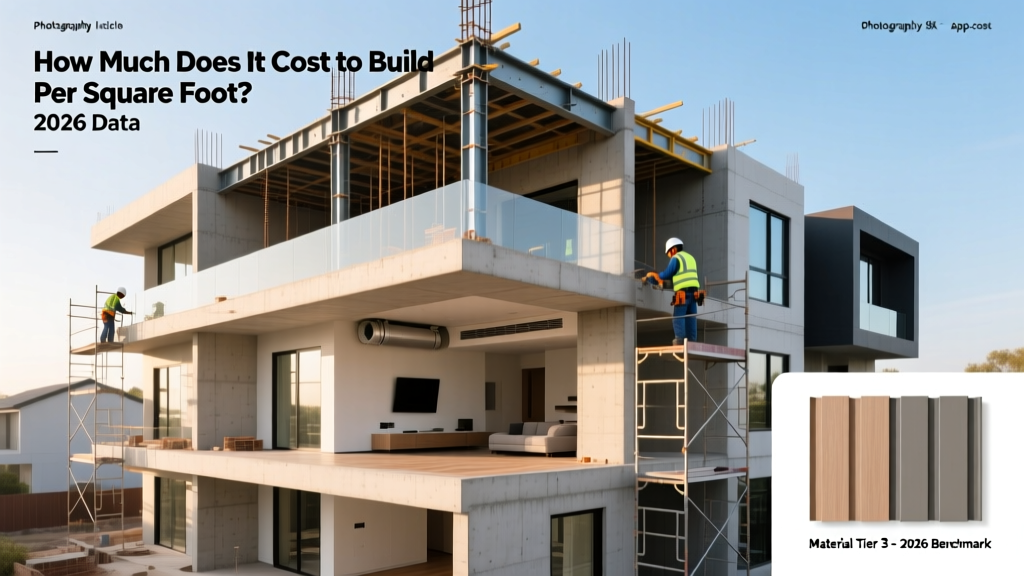
The Anatomy of a Per-Square-Foot Estimate
When evaluating how much does it cost to build per square foot, the metric is only as accurate as the definition of the space being measured. In 2026, the national average for a standard, stick-built single-family home ranges from $155 to $210 per square foot of Gross Floor Area (GFA). However, this number is highly volatile based on what is included in the denominator.
According to the National Association of Home Builders (NAHB) Construction Cost Surveys, interior finishes and framing consistently consume the largest share of the budget, but site work and foundation costs are the primary drivers of regional variance.
2026 Phase-by-Phase Cost Breakdown
To understand where your capital is actually going, we must deconstruct the aggregate square-foot cost into its sequential construction phases. The following data assumes a 2,500 sq. ft. two-story home with standard finishes on a flat, prepared lot.
| Construction Phase | Cost per Sq Ft | % of Total | Key 2026 Material Drivers |
|---|---|---|---|
| Site Work & Prep | $8 - $14 | 5% | Excavation, soil testing, utility taps |
| Foundation | $14 - $22 | 9% | Poured concrete, rebar, waterproofing membranes |
| Framing & Sheathing | $28 - $42 | 18% | Dimensional lumber, engineered I-joists, ZIP System panels |
| Exterior Finishes | $18 - $26 | 12% | HardiePlank siding, architectural asphalt shingles, vinyl windows |
| MEP (Mechanical, Electrical, Plumbing) | $26 - $38 | 16% | Heat pumps, PEX-a tubing, 200A electrical panels |
| Insulation & Drywall | $12 - $18 | 8% | Closed-cell spray foam, 5/8" Level 4 finish gypsum |
| Interior Finishes | $35 - $55 | 22% | Quartz countertops, LVP flooring, custom cabinetry |
| Final Cleanup & Landscaping | $6 - $10 | 5% | Debris removal, grading, basic sod, driveway pour |
Data sourced from Gordian's RSMeans construction cost databases indicates that while lumber prices have stabilized compared to the early 2020s, skilled labor shortages in the MEP trades continue to push mechanical and electrical costs upward by 4-6% annually.
The Footprint Multiplier: Why 1-Story Homes Cost More
A 2,500 sq. ft. ranch-style home will cost 15% to 25% more per square foot than a 2,500 sq. ft. two-story home. The square footage is identical, but the structural economics are entirely different.
This is the most misunderstood variable in residential estimating. When you build a two-story home, the foundation and the roof only need to cover half the total living area. A single-story home requires double the concrete for the slab, double the excavation, double the roof trusses, and double the shingles to achieve the same interior square footage. Furthermore, plumbing stacks and HVAC duct runs are significantly longer in a sprawling ranch, increasing material waste and labor hours.
Quality Tier Adjustments
The baseline costs above assume 'Standard' builder-grade materials. Adjust your per-square-foot expectations based on your finish tier:
- Economy Tier ($120 - $150/sq ft): Utilizes slab-on-grade foundations, standard asphalt 3-tab shingles, basic vinyl windows, laminate countertops, and carpet in bedrooms. Tract housing model.
- Standard Tier ($155 - $210/sq ft): Features poured basement or crawlspace, architectural shingles (e.g., Owens Corning Duration), fiberglass windows, engineered hardwood or premium LVP, and quartz or entry-level granite countertops.
- Custom Luxury ($250 - $400+/sq ft): Incorporates deep foundations, standing seam metal roofing, triple-pane aluminum-clad wood windows, radiant floor heating, and fully custom milled cabinetry with high-end appliances (e.g., Sub-Zero/Wolf).
Regional Labor and Material Variance
National averages mask extreme local realities. The U.S. Census Bureau Value of Construction Put in Place tracks regional spending, but local union density, permitting fees, and seismic code requirements dictate your actual out-of-pocket costs. Apply these multipliers to the base standard cost:
- Northeast (NY, MA, CT): 1.25x - 1.40x multiplier. High union labor rates, strict energy codes, and deep frost-line foundation requirements.
- West Coast (CA, WA, OR): 1.30x - 1.50x multiplier. Driven by seismic engineering, Title 24 energy compliance, and extreme permitting delays.
- Southeast (TX, FL, GA): 0.90x - 1.05x multiplier. Lower labor costs, slab-on-grade foundations, but Florida requires costly impact-resistant windows and hurricane strapping.
- Midwest (OH, IN, MO): 0.85x - 0.95x multiplier. Most cost-effective region due to flat topography, abundant local materials, and moderate labor rates.
Calculating Your Specific Build: A 4-Step Framework
To generate a highly accurate preliminary budget without relying on generic online calculators, follow this sequential framework:
- Determine Conditioned Area: Calculate only the heated/cooled interior space. Exclude the garage, covered patios, and unfinished basements.
- Apply the Base Rate: Multiply the conditioned area by $180 (the 2026 national median for standard finishes).
- Apply the Regional Multiplier: Adjust the base total using the regional multipliers listed above.
- Add the 'Site & Soft Costs' Buffer: Add 15% to the final number to cover architectural fees, structural engineering, impact fees, and unexpected site prep (like hitting bedrock during excavation).
By deconstructing the metric and applying phase-specific data, you transition from relying on misleading marketing averages to utilizing a defensible, data-driven construction budget.
Written by
Priya KapoorPriya Kapoor is a real estate market analyst and construction economics researcher with expertise in housing affordability, development feasibility, and infrastructure investment. She holds a Master of Regional Planning from Cornell University and previously worked as a senior analyst at CBRE's Investment Properties group, where she modeled returns for $4B in mixed-use development pipelines. Priya now runs an independent research practice advising developers, municipalities, and REITs on construction cost forecasting and market timing. She publishes the quarterly "BuildMat Market Pulse" report tracking material price indices across 12 commodity categories. Based in Austin, TX, Priya serves on the board of Habitat for Humanity Austin and is a marathon runner.
More from Priya Kapoor
View all
Construction Cost
Cost to Build a 1600 Sq Ft Home in 2026: Full Breakdown
Accurate 2026 cost to build a 1600 sq ft home—material, labor, and regional pricing breakdowns included. Plan your budget with real-time estimates.
Aug 11, 2026

Wood & Lumber
Name the Types of Wood for Pressure Treatment and Preservation
Learn how to name the types of wood best suited for pressure treatment. Compare species treatability, chemical retention levels, and 2026 preservation costs.
Aug 4, 2026

Stone & Masonry
Stone Veneer Suppliers Lindenhurst: 2026 Cost Analysis
Analyze 2026 stone veneer costs in Lindenhurst, NY. Compare local supplier pricing, delivery fees, and Suffolk County installation labor rates.
Aug 4, 2026