How Much Does It Cost to Build Batting Cages? Size & Scope Guide
Calculate exactly how much it costs to build batting cages. Detailed size, scope, and material pricing for indoor and outdoor baseball facilities.

When facility directors, schools, and homeowners ask how much does it cost to build batting cages, the answer depends entirely on the dimensional scope, structural framing, and netting specifications. Generic online averages often fail to account for the engineering required to withstand high-velocity baseball impacts and environmental stress. This size and scope calculator guide breaks down the exact material requirements, unit costs, and structural variables needed to budget a batting cage project accurately in 2026.
The Size & Scope Cost Matrix: Pricing by Dimensions
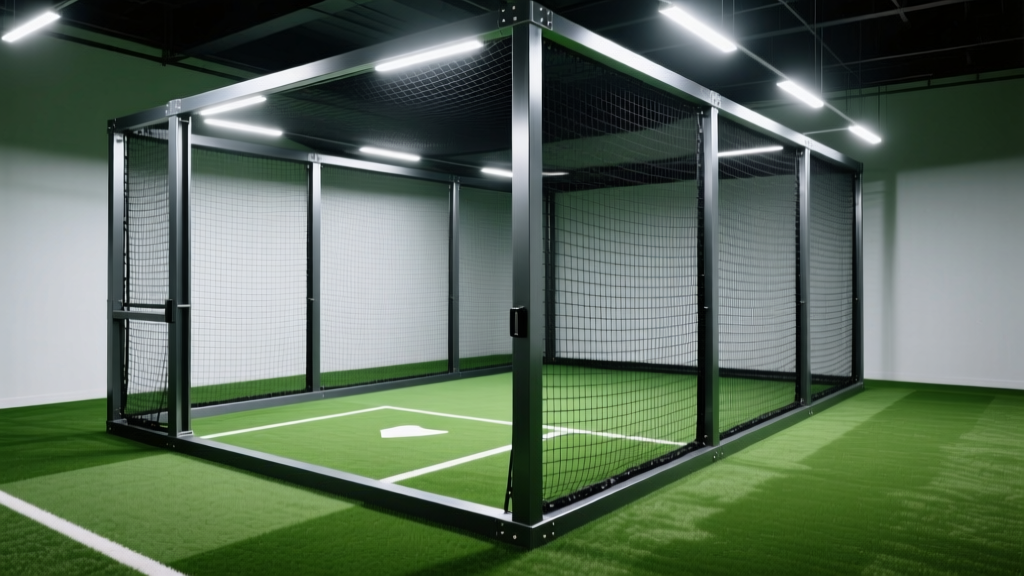
The foundational cost driver is the physical volume of the cage. Standardization exists in the industry, but scaling up for older athletes requires significant increases in both netting square footage and structural steel tonnage. Below is the baseline cost matrix for the frame and netting envelope, excluding site preparation and flooring.
| Cage Dimensions (W x H x L) | Intended Scope | Frame & Hardware Cost | Netting Envelope Cost | Total Envelope Estimate |
|---|---|---|---|---|
| 12' x 12' x 55' | Youth / Residential | $2,800 - $3,500 | $850 - $1,200 | $3,650 - $4,700 |
| 14' x 14' x 70' | High School / Standard | $4,200 - $5,500 | $1,400 - $1,900 | $5,600 - $7,400 |
| 16' x 16' x 70' | Collegiate / Pro | $5,800 - $7,200 | $1,800 - $2,400 | $7,600 - $9,600 |
| Multi-Lane (e.g., 3x 14x14x70) | Commercial Facility | $14,500 - $18,000 | $4,500 - $6,000 | $19,000 - $24,000 |
Material Specifications and Unit Cost Breakdown
To build an accurate estimate, you must specify materials based on the facility's usage intensity. Using residential-grade materials in a commercial setting is a primary cause of premature facility failure.
Netting: Nylon vs. Polyethylene
- #36 to #42 Nylon (Indoor/Pro): Nylon offers superior abrasion resistance and a softer feel, making it the standard for indoor collegiate and professional facilities. However, nylon absorbs water and loses up to 15% of its break strength when wet. Cost: $0.35 - $0.50 per square foot.
- #36 to #60 HDPE (Outdoor/Commercial): High-Density Polyethylene is mandatory for outdoor scopes. It does not absorb water, resists UV degradation (when treated), and maintains structural integrity in extreme weather. Specify a minimum #36 twine thickness for high school levels and #60 for heavy-use commercial facilities. Cost: $0.25 - $0.45 per square foot.
Structural Framing
The frame must absorb the kinetic energy of foul balls and errant pitches without permanent deflection.
- Schedule 40 Galvanized Steel (1.900" OD): The industry workhorse for outdoor and rigid indoor frames. It must be hot-dipped galvanized to prevent rust. Cost: $8.50 - $11.00 per linear foot.
- Structural Aluminum (2.0" OD): Used primarily for premium indoor facilities where weight restrictions on roof trusses apply, or in coastal areas with high salt-spray corrosion risks. Cost: $14.00 - $18.00 per linear foot.
- Aircraft Cable Systems (3/16" Galvanized): Used for the perimeter tension lines that suspend the netting from the rigid frame. Cost: $1.20 - $1.80 per linear foot.
Indoor vs. Outdoor: How Scope Alters the Budget
The environment dictates the secondary construction costs, which frequently exceed the cost of the cage itself.
Outdoor Scope Variables
Outdoor cages require deep foundation engineering to withstand wind uplift and lateral loads. A common catastrophic failure in outdoor batting cages is frame rust-out at the ground line. When steel pipes are buried directly in concrete without a galvanized post anchor, water pools at the concrete-steel interface, leading to structural collapse within 3 to 5 years. Always budget for hot-dipped galvanized base plates bolted to elevated concrete piers (minimum 36" depth below the frost line).
Indoor Scope Variables
Indoor scopes shift the budget toward building integration. The critical metric is clear height. A 14-foot high cage requires a minimum 16-foot clear ceiling height to accommodate the top cross-cables and lighting fixtures. If the facility requires structural roof reinforcement to hang a 4,000 lb steel cage frame, structural engineering costs can add $5,000 to $15,000 to the project scope.
Hidden Scope Creep: Permits, Lighting, and Automation
When calculating how much does it cost to build batting cages, project managers often overlook the MEP (Mechanical, Electrical, Plumbing) and regulatory requirements.
- Lighting (50-70 Foot-Candles): Proper visibility is critical for batter safety. Standard warehouse lighting creates shadows that obscure the spin of a pitched ball. Budget for specialized, shatter-proof LED sports fixtures with wire guards. Cost: $1,200 - $2,500 per lane.
- Building Permits & Code Compliance: Commercial indoor cages fall under the International Building Code (IBC) for assembly and recreational occupancy. The International Code Council mandates specific fire egress and sprinkler integration rules for netted enclosures, as netting can obstruct sprinkler spray patterns. Permit and engineering costs: $2,000 - $6,000.
- Flooring and Turf: Hitting off bare concrete destroys bats and causes severe joint fatigue. A proper scope includes a 1.25" padded turf system over a concrete subfloor, featuring a dedicated 15' x 15' pitcher's mound area with high-density foam underlayment. Cost: $4.50 - $7.50 per square foot installed.
- Pitching Machines: Commercial facilities require heavy-duty, dual-wheel or three-wheel machines (e.g., ATEC M3 or Iron Mike MP-6) capable of throwing 100+ MPH with backspin. Cost: $2,200 - $4,500 per unit.
Step-by-Step Scope Calculation Framework
Use this framework to build a customized estimate for your specific site dimensions.
Step 1: Calculate Netting Square Footage. Use the formula: 2(W x H) + 2(L x H) + (W x L). For a 14x14x70 cage, this equals 2(196) + 2(980) + 980 = 4,312 sq ft of netting.
Step 2: Calculate Linear Framing. Add the perimeter of the front and back frames, plus the longitudinal support beams. A standard 14x14x70 cage requires roughly 280 linear feet of primary steel piping.
Step 3: Apply Environmental Multipliers. Multiply the base material cost by 1.15 for high-wind coastal zones (requiring heavier gauge steel and thicker HDPE netting) or by 1.20 for indoor facilities requiring suspended cable systems and fire-rated netting treatments.
Ultimately, understanding how much does it cost to build batting cages requires treating the project as a specialized structural build rather than a simple equipment purchase. By defining the exact dimensional scope, specifying commercial-grade HDPE or Nylon netting, and engineering the foundation for local environmental loads, facility owners can avoid the costly rebuilds that plague under-scoped recreational projects.
Written by
Marcus ChenMarcus Chen is a licensed structural engineer (PE) and building materials analyst with over 12 years of experience across residential, commercial, and industrial construction. He holds a Master of Science in Civil Engineering from UC Berkeley and spent six years at Thornton Tomasetti before transitioning to independent consulting and technical writing. Marcus specializes in material selection for seismic-prone regions, concrete reinforcement strategies, and lifecycle cost analysis. His work has been cited by the American Concrete Institute (ACI) and the Structural Engineers Association of California (SEAOC). When he is not on a job site or at his desk, you will find him hiking the Sierra Nevada or restoring a 1920s craftsman bungalow in Oakland, CA.
More from Marcus Chen
View all
Construction Cost
How Much Did the Eiffel Tower Cost to Build?
How much did the Eiffel Tower cost to build in 1889? We adjust for inflation and compare its budget to modern skyscraper construction.
Aug 4, 2026

Fire Resistance
What Is a Fire Resistant Material? Testing & Certification Guide
Discover what is a fire resistant material through ASTM and UL testing. Learn how fire ratings, certifications, and assemblies work in construction.
Aug 4, 2026

Construction Cost
How Much Did the Burj Khalifa Cost to Build?
How much did the Burj Khalifa cost to build? We break down the $1.5B project and extract 5 money-saving strategies for your next build.
Jul 30, 2026