How to Budget the Cost to Build a Screened In Porch
Discover the true cost to build a screened in porch. Compare framing materials, screening types, labor rates, and hidden expenses for accurate budgeting.

The Real Cost to Build a Screened In Porch: Core Budget Metrics
Calculating the accurate cost to build a screened in porch requires moving beyond national averages and analyzing the specific structural, material, and site-prep variables of your property. In 2026, the baseline cost for a professionally installed screened porch ranges from $25 to $125 per square foot. For a standard 200-square-foot (10x20) structure, total project costs typically fall between $5,000 and $25,000.
- Economy Build (Slab-on-grade, pine framing, fiberglass mesh): $4,500 – $7,500
- Mid-Range Build (Elevated deck, cedar framing, aluminum mesh): $9,000 – $16,000
- Premium Build (Composite flooring, aluminum framing, solar screens, integrated lighting): $18,000 – $28,000+
Labor accounts for 40% to 55% of the total budget, while materials and site preparation consume the remainder. The primary cost drivers are the foundation type, roof integration complexity, and the grade of screening mesh selected.
Material Cost Matrix: Framing and Structural Options
The framing material dictates both the immediate material cost and the long-term maintenance budget. Selecting the wrong framing material for your climate can lead to premature rot or warping, drastically increasing lifecycle costs.
| Framing Material | Cost per Linear Ft. | Lifespan & Maintenance | Best Application |
|---|---|---|---|
| Pressure-Treated Pine | $3.50 – $5.50 | 15-20 years; requires annual sealing | Budget builds, painted finishes |
| Western Red Cedar | $7.00 – $11.00 | 25+ years; natural rot resistance | Exposed beams, stain finishes |
| Extruded Aluminum | $10.00 – $16.00 | 50+ years; zero maintenance | Coastal zones, modern aesthetics |
| Cellular PVC (e.g., AZEK) | $8.50 – $13.00 | 30+ years; paintable, no rot | High-moisture environments |
Screening Materials: Technical Specs and Pricing
Do not default to standard fiberglass mesh without evaluating your specific environmental needs. The mesh you choose impacts visibility, airflow, durability against pets, and solar heat gain. According to Phifer's technical specifications, mesh density and yarn thickness dictate performance.
Standard vs. Premium Mesh Breakdown
- Standard Fiberglass (18x16 mesh): Costs $0.15 to $0.25 per square foot. Highly flexible and easy to install using a standard .140 spline. However, it tears easily under pet claws or heavy impacts and degrades under UV exposure within 5 to 7 years.
- Aluminum Wire (18x16 mesh): Costs $0.30 to $0.45 per square foot. Offers superior rigidity and airflow but is prone to denting and can oxidize (chalk) in coastal salt-air environments unless specifically coated.
- Pet-Resistant Polyester (e.g., Phifer TuffScreen): Costs $0.60 to $0.90 per square foot. Woven from heavy-duty vinyl-coated polyester, it is 3x thicker than standard fiberglass. Requires a larger spline groove (typically .160 or .175) and specialized spline tools for installation.
- Solar Control Screens (e.g., Phifer SunTex 80/90): Costs $1.50 to $2.50 per square foot. Blocks 80% to 90% of solar heat gain, drastically reducing cooling loads if the porch adjoins a sun-facing interior room. The trade-off is reduced outward visibility and slightly restricted airflow.
Hidden Budget Killers: Site Prep and Roof Tie-Ins
Homeowners frequently underestimate the cost to build a screened in porch by ignoring structural integration points. These three elements routinely cause budget overruns of 15% to 30%:
If your porch roof ties into an existing vertical wall (especially brick or siding) at a low pitch, building codes require a 'cricket' or saddle flashing to divert water around the intersection. Installing a properly flashed cricket costs between $800 and $1,500 in additional labor and custom sheet metal work. Failing to include this leads to catastrophic water intrusion into your home's existing wall cavity.
- Foundation Frost Depth: If building an elevated porch, concrete footings must extend below the local frost line. In Climate Zone 5, this means digging 36 to 42 inches deep. Hitting bedrock or requiring helical piers instead of standard sonotubes can increase foundation costs from $1,200 to over $4,500.
- Electrical Tie-Ins: Running a dedicated 20-amp GFCI-protected circuit from your main panel to the porch for ceiling fans, recessed lighting, and outlets typically costs $600 to $1,400. If your main panel lacks capacity and requires a sub-panel upgrade, add $1,500 to $2,500.
- HVAC Extension: If you plan to use the porch year-round and extend your home's forced-air system, ductwork extension and load recalculation by an HVAC engineer will add $2,000 to $4,000. (Note: Most building codes require a physical door separation between conditioned and unconditioned spaces).
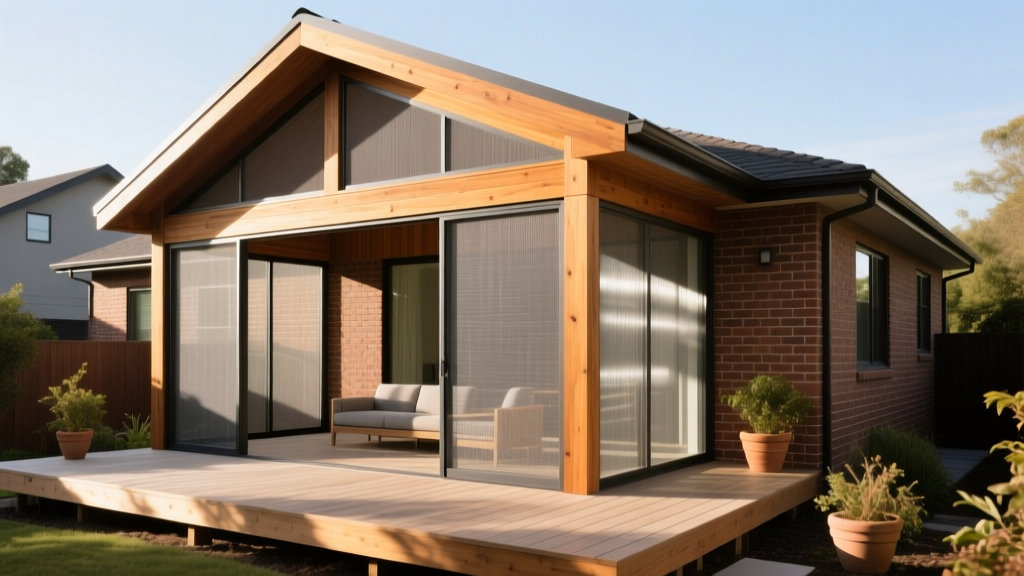
3-Tier Budget Planning Framework (200 Sq. Ft. Model)
Use this framework to align your expectations with current market rates. These estimates assume a 10x20 footprint, standard 8-foot ceiling height, and an asphalt shingle shed or gable roof matching the existing home.
| Budget Tier | Total Cost Range | Key Specifications |
|---|---|---|
| Tier 1: Essential | $4,500 – $8,000 | Existing concrete slab utilized; PT pine framing; standard fiberglass screen; exposed rafters; no electrical. |
| Tier 2: Enhanced | $9,500 – $16,500 | New elevated pressure-treated joists with composite decking; cedar framing; aluminum or pet screen; ceiling fan; recessed lighting. |
| Tier 3: Luxury | $18,000 – $28,000+ | Helical pier foundation; aluminum or PVC framing; Phifer solar mesh; vaulted ceiling with skylights; integrated outdoor kitchen pass-through. |
Permitting and Code Compliance
According to HomeGuide's national construction data, permit fees for a screened porch generally range from $150 to $600, depending on municipal valuation formulas. However, the cost of compliance is higher.
Because a screened porch is considered a 'roofed structure,' it impacts your property's lot coverage ratio. If your lot is near the maximum allowable impervious surface limit, you may need to pay for a variance application or remove existing concrete elsewhere on the property. Additionally, if the porch is elevated more than 30 inches above grade, the International Residential Code (IRC) mandates a 36-inch high guardrail with balusters spaced no more than 4 inches apart. Factoring in the materials and labor for code-compliant guardrails adds roughly $40 to $75 per linear foot to your overall budget.
Written by
James ThorntonJames Thornton is a construction industry veteran with 25 years of hands-on experience in wood framing, lumber grading, and residential building codes. He started as a framing carpenter in rural Oregon, earned his ICC Residential Building Inspector certification, and eventually became a senior plan reviewer for the City of Portland Bureau of Development Services. James holds a B.S. in Wood Science & Technology from Oregon State University and is a certified lumber grader through the West Coast Lumber Inspection Bureau (WCLIB). He has inspected over 3,000 residential construction sites and authored the city's internal guide on advanced framing techniques (2x6 at 24" O.C.). James lives in Bend, OR, where he builds custom timber-frame cabins and competes in lumberjack sports.
More from James Thornton
View all
Insulation
Best Home Insulation Materials: Complete 2026 Guide
Compare top home insulation materials for 2026. Find R-values, installed costs per square foot, and best uses for fiberglass, spray foam, and mineral wool.
Aug 4, 2026

Sustainable Building
Certify Your Green Building Material for LEED and WELL
Step-by-step guide to certifying a green building material for LEED v5 and WELL v2. Master EPDs, HPDs, and VOC limits for 2026 project specifications.
Aug 4, 2026

Stone & Masonry
Veneer Stacked Stone Panels: Interior Design & Style Showcase
Discover how veneer stacked stone panels transform interiors. Explore modern design profiles, material pairings, and technical installation specs.
Aug 4, 2026