Regional Breakdown: How Much Does It Cost to Build a Topgolf?
Discover how much it costs to build a Topgolf or high-tech golf venue. We break down regional construction prices, tech integration, and F&B costs.

The Economics of High-Tech Golf Entertainment Venues
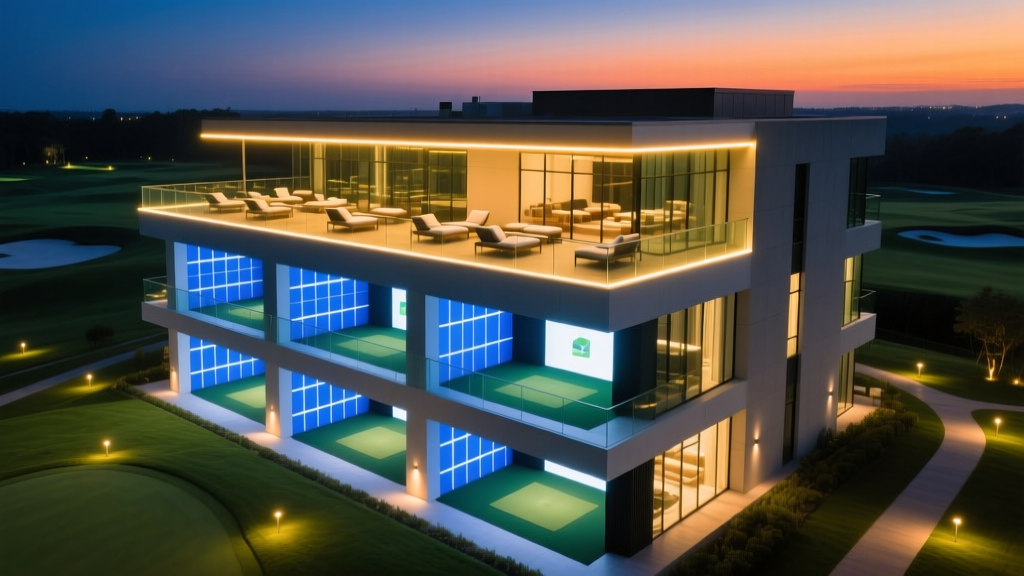
When commercial real estate developers and municipal planners ask how much does it cost to build a top golf facility, the answer requires dissecting a highly specialized asset class. A standard premium golf entertainment venue—modeled after the industry-standard Topgolf blueprint—is not merely a driving range. It is a 65,000 to 75,000-square-foot, three-story commercial hospitality complex featuring over 100 climate-controlled bays, a full-scale commercial kitchen, and enterprise-grade radar tracking infrastructure.
As of 2026, the total capital expenditure (CapEx) to develop a 102-bay venue ranges from $18 million in Sunbelt markets to over $42 million in coastal and Northeast corridors. This variance is driven by regional labor rates, seismic structural requirements, land acquisition costs, and local utility impact fees. According to data tracked by the U.S. Census Bureau on commercial construction spending, the hospitality and entertainment sector has seen sustained cost escalations in electrical and mechanical trades, directly impacting the bottom line of tech-heavy venues.
The Blueprint: Core Facility Specifications
Before analyzing regional pricing, developers must understand the baseline physical requirements of a Tier-1 golf entertainment complex. These specifications dictate the hard costs across all markets:
- Footprint: 10 to 15 acres (accommodating the building, 400+ parking spaces, and a 300-yard ball flight corridor).
- Structure: 65,000+ sq. ft. across three levels, utilizing 800 to 1,200 tons of structural steel.
- Bay Count: 102 to 108 individual hitting bays (approx. 14 ft wide x 12 ft high per bay).
- Electrical Load: 3,000 to 4,000 amps total service to support bay heaters, commercial kitchen equipment, and server infrastructure.
- Ball Inventory: 120,000 to 150,000 RFID-embedded golf balls requiring automated washing and sorting machinery.
Regional Construction Cost Matrix
Construction costs fluctuate wildly based on geography. The following matrix breaks down the estimated total project costs (including land, hard costs, soft costs, and FF&E) across four distinct U.S. regions. Regional labor availability and local building codes are the primary drivers of these disparities, a trend heavily documented in JLL's Construction Market Intelligence reports.
| Region | Target Markets | Land Cost (12 Acres) | Hard Construction Costs | Total Project CapEx |
|---|---|---|---|---|
| Sunbelt | TX, FL, AZ, NC | $3.5M - $6M | $12M - $16M | $18M - $25M |
| Midwest | IL, OH, MI, MN | $2M - $4.5M | $14M - $18M | $20M - $27M |
| West Coast | CA, WA, OR | $8M - $15M+ | $18M - $24M | $32M - $45M+ |
| Northeast | NY, NJ, MA, PA | $6M - $12M | $17M - $22M | $28M - $40M |
Hard Cost Deep Dive: Where the Capital Goes
Structural Steel and Seismic Engineering
The defining architectural feature of these venues is the massive, open-span cantilevered roof that covers the driving range bays while leaving the ball flight area open. This requires heavy structural steel moment frames. In Texas or Florida, standard steel erection might cost $12 to $15 per square foot. However, in California, seismic bracing requirements mandate deeper foundations, heavier steel tonnage, and specialized moment-resisting frames. This structural upgrade alone can add $1.5 million to $2.5 million to the hard costs of a West Coast build compared to a Sunbelt build.
Climate Control and Make-Up Air Systems
Unlike a traditional restaurant, a golf entertainment venue features 100+ large garage-style roll-up doors that remain open for hours. Conditioning this space requires massive commercial Rooftop Units (RTUs) paired with dedicated Make-Up Air (MAU) systems to balance the building pressure when kitchen exhaust hoods are running. In northern climates like Minnesota or Massachusetts, developers must specify high-efficiency infrared radiant tube heaters for the bays, alongside heavy-duty insulated roll-up doors, adding roughly $800,000 to the mechanical budget.
The Technology Layer: Radar and RFID Integration
The core product is not the food; it is the gamified ball-tracking technology. Outfitting 102 bays with enterprise-grade tracking systems (such as Toptracer Range or Trackman) represents a significant capital outlay.
- Radar Hardware & Mounts: $8,000 - $12,000
- Touchscreen Monitors & Enclosures: $2,500 - $4,000
- RFID Ball Sorting/Washing Machinery: $600,000 - $900,000 (Centralized facility cost)
- Server Infrastructure & Cabling: $150,000 - $250,000
Total Technology Package: $1.8M - $2.5M for a 102-bay venue.
Furthermore, the golf balls themselves are a consumable asset. RFID-embedded balls cost roughly $1.20 to $1.80 each wholesale. Stocking a venue with 150,000 balls requires an initial inventory investment of over $200,000, with an ongoing monthly shrinkage and degradation replacement budget of $15,000.
Food and Beverage: The Hidden Profit Center
While the bays drive traffic, the F&B operation drives profit margins. Building a commercial kitchen capable of serving 1,500+ guests daily on a busy weekend requires a 4,000-square-foot kitchen buildout. This includes Type 1 commercial exhaust hoods, automated grease interceptors, walk-in cold storage, and specialized prep stations. The plumbing and mechanical rough-ins for a venue of this scale frequently exceed $1.2 million, as local municipalities often require significant off-site water and sewer main upgrades to handle the sudden spike in utility demand.
Corporate Leaseback vs. Independent Development
It is critical to distinguish between building a branded corporate venue and an independent 'top golf' style competitor. Following Callaway's acquisition of Topgolf, the brand largely operates via corporate leasebacks or joint ventures with massive institutional developers (like Macerich or Simon Property Group). Independent developers looking to build competing concepts (e.g., Drive Shack, PopStroke, or bespoke local brands) must absorb 100% of the branding, proprietary software development, and marketing costs, which can add $2M to $4M in soft costs to the initial pro-forma.
Zoning, Land, and Site Work Variables
Securing 12 to 15 acres of commercially zoned land with high visibility from a major interstate is the most significant bottleneck in the development pipeline. Site work for these facilities is notoriously expensive due to the sheer volume of impervious surface (parking lots) and the need for massive stormwater retention ponds. In the Southeast, where water tables are high, developers routinely spend $1.5M+ just on earthwork, retaining walls, and underground detention systems before a single foundation pier is poured.
FAQ: Financing and Timelines
How long does it take to build a high-tech golf venue?
From land acquisition and zoning approval to ribbon-cutting, the timeline typically spans 24 to 36 months. The actual vertical construction phase takes 12 to 16 months, heavily dependent on structural steel lead times and the installation of the complex ball-handling conveyor systems.
What are the primary financing hurdles?
Lenders often struggle to underwrite these projects because they do not fit neatly into traditional 'hospitality' or 'retail' appraisal models. Developers usually need to secure SBA 504 loans, utilize Opportunity Zone tax incentives, or partner with municipal economic development councils that offer tax increment financing (TIF) to offset the massive infrastructure and site-work costs.
Can I franchise a Topgolf?
As of 2026, Topgolf does not offer traditional single-unit franchise opportunities to individual operators. The brand expands primarily through corporate channels and large-scale institutional real estate partnerships. Developers wishing to enter this space must either build independent tech-golf concepts or explore emerging franchise models from newer competitors in the indoor simulator and outdoor tech-range space.
Written by
Priya KapoorPriya Kapoor is a real estate market analyst and construction economics researcher with expertise in housing affordability, development feasibility, and infrastructure investment. She holds a Master of Regional Planning from Cornell University and previously worked as a senior analyst at CBRE's Investment Properties group, where she modeled returns for $4B in mixed-use development pipelines. Priya now runs an independent research practice advising developers, municipalities, and REITs on construction cost forecasting and market timing. She publishes the quarterly "BuildMat Market Pulse" report tracking material price indices across 12 commodity categories. Based in Austin, TX, Priya serves on the board of Habitat for Humanity Austin and is a marathon runner.
More from Priya Kapoor
View all
Construction Cost
Cost to Build a 1600 Sq Ft Home in 2026: Full Breakdown
Accurate 2026 cost to build a 1600 sq ft home—material, labor, and regional pricing breakdowns included. Plan your budget with real-time estimates.
Aug 11, 2026

Wood & Lumber
Name the Types of Wood for Pressure Treatment and Preservation
Learn how to name the types of wood best suited for pressure treatment. Compare species treatability, chemical retention levels, and 2026 preservation costs.
Aug 4, 2026

Stone & Masonry
Stone Veneer Suppliers Lindenhurst: 2026 Cost Analysis
Analyze 2026 stone veneer costs in Lindenhurst, NY. Compare local supplier pricing, delivery fees, and Suffolk County installation labor rates.
Aug 4, 2026