Security Fence: Chain Link Fence Product Line Deep-Dive
Compare top chain link fence product lines from Master Halco and Merchants Metals. Explore wire gauges, polymer coatings, and framework specs.
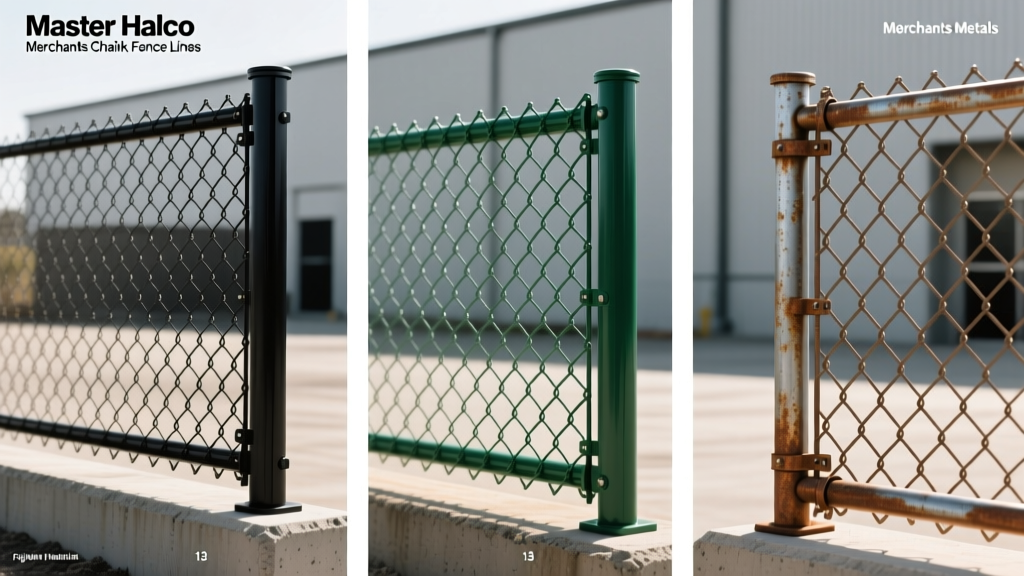
The Anatomy of a Commercial Chain Link Fence System
Specifying a high-security perimeter requires navigating a complex matrix of wire gauges, zinc coating classes, and framework schedules. Unlike residential installations that prioritize basic boundary demarcation, commercial and industrial security fence chain link fence systems must withstand physical impact, environmental degradation, and forced entry attempts. The difference between a system that fails in five years and one that lasts twenty-five lies entirely in the product line specifications chosen during the procurement phase.
This deep-dive analyzes the dominant product lines from industry leaders Master Halco and Merchants Metals, breaking down the exact material specifications, ASTM compliance standards, and real-world cost implications for modern perimeter installations.
Master Halco: Galv-Tech and Aqua-Tech Product Lines
Master Halco remains one of the largest wholesale distributors of fencing products in North America. Their proprietary manufacturing lines are segmented primarily by coating technology, which directly dictates the lifespan and maintenance requirements of the fabric.
Galv-Tech (Galvanized Systems)
The Galv-Tech line relies on hot-dip galvanization. However, not all galvanization is equal. Master Halco offers this fabric in two distinct zinc weight classes, governed by ASTM A392 standards:
- Class 1 Coating: Provides a minimum of 0.40 oz of zinc per square foot. This is the standard commercial grade, suitable for inland environments with moderate humidity. Expected lifespan is 12 to 15 years before surface oxidation begins.
- Class 3 Coating: Provides a minimum of 1.20 oz of zinc per square foot (three times the thickness of Class 1). This heavy-duty coating is mandatory for coastal installations, industrial zones with chemical off-gassing, or areas where de-icing salts are prevalent. Expected lifespan exceeds 25 years.
Aqua-Tech and Colorguard (Polymer-Coated Systems)
For facilities requiring color integration or enhanced corrosion resistance, the Aqua-Tech (PVC) and Colorguard (Polyolefin) lines wrap a galvanized core wire in a thermally bonded polymer sheath. According to the Chain Link Fence Manufacturers Institute (CLFMI), polymer-coated fabrics must meet ASTM F668 specifications for adhesion and UV stability. The polyolefin variant (Colorguard) is superior for high-UV environments, as it resists the chalking and fading that traditional PVC exhibits after 7 to 10 years of direct sun exposure.
Merchants Metals: Premium Framework and Fabric
While Master Halco dominates fabric distribution, Merchants Metals is highly regarded for its structural framework and heavy-gauge security fabrics. Their product line focuses heavily on the structural integrity of the fence skeleton—the posts, rails, and bracing that absorb wind loads and impact forces.
Merchants Metals manufactures their framework using high-tensile steel that is roll-formed and continuously galvanized. Their premium commercial lines utilize Schedule 40 pipe for all terminal (corner and end) posts, ensuring that the tension applied to the fabric does not bow or lean the structural anchors over time. Their fabric lines are notable for offering tight-tolerance 2-inch mesh weaves in 9-gauge wire, which is the baseline requirement for most Department of Defense and critical infrastructure perimeters.
Brand & Specification Comparison Matrix
When drafting material submittals for commercial projects, contractors must align the manufacturer's product line with the architect's performance specifications. The table below maps the core offerings across the top brands.
| Specification | Master Halco (Galv-Tech) | Master Halco (Aqua-Tech) | Merchants Metals (Standard) |
|---|---|---|---|
| Wire Gauge Options | 9, 11, 11.5 | 9, 11 | 6, 9, 11 |
| Core Zinc Class | Class 1 or Class 3 | Class 1 (Standard) | Class 2 or Class 3 |
| Polymer Coating | N/A | PVC (0.20" thickness) | N/A |
| Standard Mesh Size | 2" and 2-1/4" | 2" | 2" and 1" (High Security) |
| Best Application | Standard Commercial | Schools, Parks, Aesthetics | Industrial, High Security |
Decoding Framework: Schedule 20 vs. Schedule 40 Pipe
The most common point of failure in a chain link perimeter is not the fabric itself, but the framework. Contractors often value-engineer projects by downgrading framework from Schedule 40 to Schedule 20 pipe. Understanding the dimensional differences is critical for long-term stability.
Standard Framework Sizing Rules:
- Terminal Posts: Must be exactly two nominal pipe sizes larger than the line posts. If using 2-inch (OD 2.375") line posts, terminal posts must be 2.5-inch (OD 2.875") Schedule 40 pipe.
- Top Rails: Should be continuous, joined with internal sleeves rather than external couplings, which create snag points and weaken the lateral rigidity of the top line.
- Line Posts: Schedule 20 is acceptable for interior line posts in standard commercial applications, provided they are set in concrete to a depth of 30 inches or below the local frost line.
Real-World Cost Breakdown: Material vs. Labor
Budgeting for a commercial chain link fence requires separating fabric costs from structural framework and installation labor. Pricing fluctuates based on steel commodities, but the following ranges reflect current market averages for 2026 procurement.
Material Costs (Per Linear Foot)
- 11-Gauge Class 1 Galvanized Fabric (2" mesh): $8.50 - $11.00 / ft
- 9-Gauge Class 3 Galvanized Fabric (2" mesh): $16.00 - $21.50 / ft
- Polymer-Coated 9-Gauge Fabric: $19.00 - $26.00 / ft
- Schedule 40 Framework (Posts, Rails, Fittings): $12.00 - $18.00 / ft
Total Installed System Costs
When factoring in augering, concrete setting, fabric stretching, and labor, a standard 6-foot high commercial chain link fence (11-gauge, Class 1, Schedule 40 terminal posts, Schedule 20 line posts) typically ranges from $38 to $52 per linear foot. Upgrading to a 9-gauge Class 3 system with all-Schedule 40 framework will push the installed cost to $58 to $75 per linear foot. While the initial capital expenditure is 30-40% higher, the elimination of premature rust-out and structural leaning reduces the 20-year lifecycle cost significantly.
Edge Cases: Coastal and High-Wind Installations
Standard commercial specifications fail rapidly in marine environments. Salt spray accelerates the oxidation of zinc coatings, and high sustained winds increase the tensile load on the fabric and posts.
For installations within 1,500 feet of a saltwater coastline, specifying Class 1 galvanized fabric is a critical error. The salt environment will deplete the 0.40 oz zinc layer in less than five years, leading to red rust and structural degradation of the wire core. Class 3 zinc (1.20 oz) or a polymer-coated fabric over a Class 2 zinc core is mandatory for marine survival.
High-Wind Modifications:
In regions prone to hurricane-force winds or sustained gusts exceeding 70 mph, the standard 2-inch mesh acts as a partial wind sail. To reduce wind load without compromising security, specify a 1-inch mesh, 9-gauge wire. The smaller openings allow for higher wind permeability while making it impossible to climb or cut with standard bolt cutters. Additionally, reduce line post spacing from the standard 10 feet to 8 feet on center to prevent the fabric from billowing and tearing the tension bands under extreme lateral pressure.
Frequently Asked Technical Questions
Can I mix Schedule 20 and Schedule 40 pipe on the same project?
Yes, and it is standard industry practice to value-engineer this way. Use Schedule 40 for all terminal posts (corners, ends, gate posts) and Schedule 20 for the intermediate line posts. This provides structural integrity where tension is highest while saving 15-20% on overall pipe material costs.
What is the difference between knuckle and barb selvage?
The selvage refers to how the top and bottom edges of the fabric are finished. Knuckle (bent) selvage is safer and standard for residential and school applications. Barb (twisted and barbed) selvage provides a deterrent against climbing and is typically specified for industrial yards, correctional facilities, and secure perimeters. Most 9-gauge security fabrics are manufactured with barb selvage on both the top and bottom.
How much tension should be applied to the fabric during installation?
Fabric should be stretched using a fence puller until the tension wire is taut and the mesh cannot be easily compressed by hand. Over-tensioning is a common installer error that can pull terminal posts out of plumb or cause the top rail to bow. A properly tensioned 6-foot run of 9-gauge fabric requires approximately 1,200 to 1,500 pounds of pull force, which is why Schedule 40 terminal posts set in 30-inch concrete footings are non-negotiable.