Removable Mesh Safety Fence for Pools: Material Selection
Compare mesh fabrics, pole alloys, and deck hardware for removable mesh safety fences for pools. Expert material taxonomy and ASTM compliance guide.
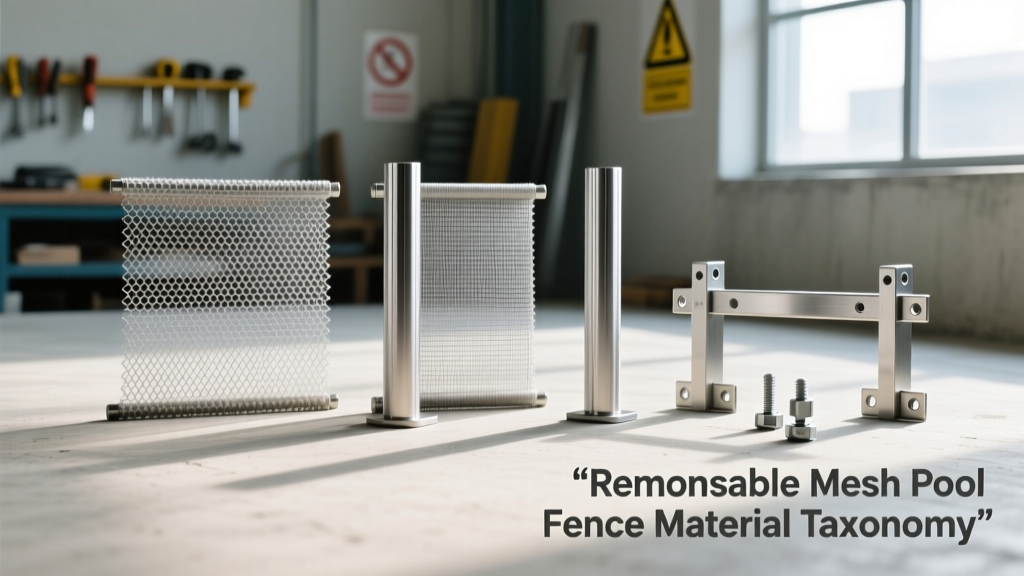
The Anatomy of a Removable Mesh Safety Fence for Pools
Selecting the correct removable mesh safety fence for pools requires looking past aesthetic preferences and evaluating the structural taxonomy of the materials involved. A high-performance pool barrier is an engineered system comprising three distinct material categories: the tension-bearing mesh fabric, the vertical support poles, and the permanent deck anchoring hardware. Failure in any single component compromises the entire safety envelope. This guide breaks down the material specifications, alloy grades, and polymer chemistries necessary to specify a barrier that meets ASTM F2286 standards while surviving harsh UV and chlorinated environments.
Mesh Fabric Taxonomy: Polymer Chemistry and Weave Density
The mesh is the primary tensile component of the fence. It must resist climbing, withstand prolonged UV exposure, and prevent tearing under impact. The market is dominated by three distinct polymer classes.
1. PVC-Coated Woven Polyester (Textilene-Style)
This is the industry gold standard for premium pool barriers. The core is a high-tenacity polyester yarn (typically 1000x1000 denier) that provides structural tensile strength, which is then encapsulated in a polyvinyl chloride (PVC) coating. The critical specification here is UV stabilization. In top-tier manufacturing, UV inhibitors are compounded directly into the PVC resin before extrusion, rather than applied as a topical post-treatment. A standard weave count for pool safety is 16x19 or 18x18 threads per square inch, providing a 90% to 95% blockage rate that prevents toddlers from gaining footholds while allowing wind to pass through, reducing lateral load on the poles.
2. High-Density Polyethylene (HDPE) Knitted Mesh
Often used in agricultural or construction shade cloths, HDPE is sometimes repurposed for budget pool fences. While HDPE offers excellent chemical resistance to pool chlorine, its tensile strength is significantly lower than polyester. Furthermore, knitted HDPE lacks the rigid dimensional stability of woven fabrics, leading to edge sagging over time unless supported by continuous top and bottom tension rods. It is not recommended for high-wind zones or permanent seasonal installations.
3. Polypropylene (PP) Extruded Netting
Polypropylene is the cheapest option on the market and the most prone to catastrophic UV degradation. Extruded PP netting becomes brittle after 12 to 18 months of direct sun exposure, leading to micro-fractures that fail under the 200-pound lateral load required by safety codes. Avoid any removable mesh safety fence for pools that utilizes uncoated polypropylene.
Pole Material Matrix: Structural Integrity and Flex Ratings
The vertical poles dictate the fence's ability to resist lateral pressure from wind and physical impact. The Outside Diameter (OD) and wall thickness are the primary metrics for structural grading. While 1-inch OD poles are common in big-box retail kits, professional-grade barriers utilize 1.25-inch OD poles to prevent bowing over long linear spans.
| Material Grade | Standard OD / Wall Thickness | Flex & Impact Profile | Cost Premium |
|---|---|---|---|
| 6061-T6 Aluminum | 1.25" OD / 0.083" wall | Highly rigid. Will dent upon severe impact but retains structural shape. Must be powder-coated to prevent oxidation. | Base Price |
| Marine-Grade Fiberglass | 1.25" OD / Solid core or 0.125" wall | High flex memory (returns to straight after bending). Will not dent, but cheap variants can splinter if the gel-coat is compromised. | +15% |
| 304 Stainless Steel | 1.00" OD / 0.065" wall | Maximum rigidity and corrosion resistance. Extremely heavy, making pole insertion/removal difficult for daily use. | +45% |
| Polycarbonate (Clear) | 1.25" OD / 0.120" wall | Aesthetically invisible. High impact resistance but susceptible to micro-scratching and eventual UV yellowing without specialized coatings. | +30% |
Deck Hardware and Anchoring Taxonomy
The connection point between the removable pole and the permanent deck surface is the most frequent site of installation failure. The anchoring system must be matched to the specific substrate of your pool deck.
Concrete and Gunite Decks
For solid concrete, core drilling is mandatory. Installers use a rotary hammer with a 1/2-inch or 5/8-inch masonry bit to drill 4-inch deep holes. The sleeves inserted into these holes should be heavy-wall brass or 316 marine-grade stainless steel. Avoid ABS plastic sleeves in concrete; the thermal expansion and contraction of the concrete will eventually crack the plastic, requiring destructive extraction to replace.
Paver and Travertine Decks
Drilling directly into pavers is highly discouraged, as the vibration shatters the stone and the sleeve lacks lateral support from the loose sand base beneath. The correct protocol involves lifting the paver, core drilling through the underlying concrete slab, installing an extended stainless steel sleeve that sits flush with the paver surface, and resetting the paver with polymeric sand.
Wood and Composite Decking
Wood decks require surface-mounted flange brackets rather than recessed sleeves. These brackets must be lag-bolted directly into the underlying structural joists, not just the deck boards, to achieve the necessary pull-out resistance.
In northern climates, water ingress into recessed deck sleeves will freeze and expand, causing 'sleeve heaving' that cracks the surrounding concrete. Always specify sleeves with integrated weep holes at the base and use compressible foam plugs when the fence is removed for the winter.
Gate Latch Mechanics and Failure Modes
The gate is the only moving part of a removable mesh safety fence for pools, making it the highest-risk component. According to the U.S. Consumer Product Safety Commission, a barrier is only as effective as its latching mechanism.
- Mechanical Hook-and-Eye: Relies on a spring-loaded hinge to force the hook into the eye. Prone to spring fatigue, rust, and misalignment. Not recommended for high-traffic pool gates.
- Magnetic Latches (e.g., MagnaLatch): Utilizes neodymium magnets to secure the gate automatically upon closure. The magnetic force does not degrade over time like mechanical springs, and the internal mechanism is sealed against pool chemicals and dust. This is the required standard for professional installations.
Regulatory Compliance and ASTM Standards
When specifying materials, ensure the complete assembled system is certified to ASTM F2286-21 (Standard Specification for Removable Mesh Fences). This standard dictates that the fence must be a minimum of 48 inches in height, the mesh must not have openings larger than 1.25 inches to prevent toe-holds, and the bottom of the mesh must be flush with the deck surface to prevent a child from crawling underneath. Furthermore, the National Drowning Prevention Alliance emphasizes that removable mesh fences must serve as an independent layer of protection, completely isolating the pool from the house and yard, rather than merely sectioning off a portion of the pool area.
Cost Framework and Procurement Strategy
Pricing for removable mesh safety fences for pools is calculated per linear foot, factoring in the material tier and deck complexity.
- Economy Tier (1" Aluminum, HDPE Mesh, Plastic Sleeves): $12 to $16 per linear foot (Materials only). Expected lifespan: 3-5 years.
- Professional Tier (1.25" Powder-Coated Aluminum, Textilene Mesh, Brass Sleeves, Magnetic Gate): $22 to $32 per linear foot (Fully installed). Expected lifespan: 10-15 years.
- Premium Tier (Fiberglass or Clear Polycarbonate Poles, Custom Color Matching): $35 to $45+ per linear foot (Fully installed).
When procuring materials, require the manufacturer to provide a UV-degradation warranty that specifically covers the mesh fabric against loss of tensile strength, not just color fading. A fence that retains its black color but tears upon impact is a critical safety failure.