Choosing the Right Epoxy Basement Floor: Resin Types & Selection
Compare water-based, solvent-based, and 100% solids epoxy basement floor systems. Learn how to select the right resin for moisture and durability.
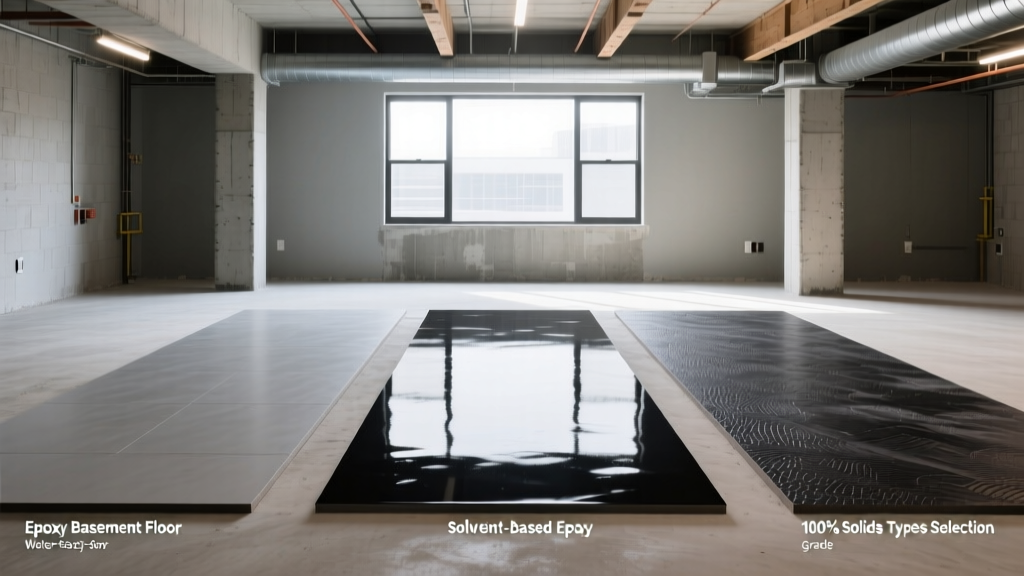
The Chemistry of Basement Epoxies: A Material Taxonomy
Selecting an epoxy basement floor requires understanding that "epoxy" is not a single product, but a category of thermosetting polymers with vastly different physical properties. Below-grade environments subject concrete to hydrostatic pressure, temperature fluctuations, and high humidity. The wrong resin chemistry will result in osmotic blistering, delamination, or amine blush. Here is the technical taxonomy of epoxy systems available for residential and commercial basements.
Water-Based Epoxy (The Budget Sealer)
Water-based epoxies use water as the primary carrier for the resin and hardener. They typically contain 40% to 60% solids by volume. When applied, they lay down a very thin film (3 to 5 mils). While they offer low VOC emissions and easy cleanup, their thin profile provides minimal abrasion resistance. They are strictly surface sealers and lack the structural thickness to bridge micro-cracks in basement slabs.
Solvent-Based Epoxy (The Penetrating Primer)
These systems use chemical solvents (like xylene or acetone) to thin the resin, allowing deep penetration into the concrete pores. Solids content ranges from 50% to 70%. They are frequently used as primer coats to establish a mechanical bond before applying a thicker topcoat. However, the high VOC content requires aggressive ventilation, making them problematic in enclosed basements without industrial exhaust systems. According to EPA guidelines on indoor VOCs, proper respiratory protection and airflow are mandatory when applying solvent-borne coatings in confined below-grade spaces.
100% Solids Epoxy (The Commercial Standard)
Containing zero solvents or water, 100% solids epoxy cures at the exact thickness it is applied (typically 10 to 16 mils per coat). This creates a highly durable, impermeable vapor barrier capable of withstanding heavy impact and chemical spills. Because there are no carriers to evaporate, there is zero shrinkage during curing. The primary limitation is temperature sensitivity; most 100% solids systems will not cure properly if the basement ambient temperature drops below 55°F (13°C).
Polyaspartic and Polyurea Hybrids (The Fast-Cure Upgrade)
While technically distinct from traditional epoxies, polyaspartics are heavily used in modern basement floor systems, usually as a topcoat over an epoxy base. They offer UV stability (preventing yellowing near basement walk-out doors or egress windows) and cure in under two hours, regardless of ambient temperature. They are highly flexible, allowing them to accommodate minor thermal expansion and contraction of the concrete slab.
Resin Comparison Matrix
| Resin Type | Solids Content | Dry Film Thickness | Cure Time (Walkable) | Material Cost (per sq ft) |
|---|---|---|---|---|
| Water-Based | 40% - 60% | 3 - 5 mils | 24 - 48 hours | $1.20 - $2.00 |
| Solvent-Based | 50% - 70% | 4 - 6 mils | 18 - 24 hours | $1.80 - $2.80 |
| 100% Solids Epoxy | 100% | 10 - 16 mils | 12 - 24 hours | $3.50 - $6.00 |
| Polyaspartic Topcoat | 80% - 100% | 6 - 10 mils | 2 - 4 hours | $4.00 - $7.50 |
Below-Grade Failure Modes: Why Basements Reject Epoxy
The most common cause of epoxy basement floor failure is not poor product quality, but a misunderstanding of below-grade concrete physics. Concrete is highly porous and acts like a sponge. When a basement slab is poured directly on earth without a proper polyethylene vapor barrier, groundwater migrates upward through the capillaries.
Epoxy is fundamentally a vapor barrier. If the Moisture Vapor Transmission Rate (MVTR) of your basement slab exceeds the tensile strength of the cured epoxy, water vapor will become trapped at the concrete-coating interface. This creates osmotic cells that manifest as bubbles or blisters, eventually tearing the epoxy off the floor. According to Penn State Extension's protocols for managing below-grade moisture, addressing exterior drainage and interior vapor barriers must precede any impermeable floor coating installation.
The Mandatory Testing Protocol
Before selecting an epoxy system, you must quantify the slab's moisture output. Do not rely on visual inspection or the outdated "plastic sheet test" (ASTM D4263), which only measures surface condensation. Use one of the following quantitative methods:
- Calcium Chloride Test (ASTM F1869): Measures the pounds of moisture emitted per 1,000 square feet over 24 hours. Standard epoxies require a reading of 3.0 lbs or less.
- In-Situ Relative Humidity Probes (ASTM F2170): Drilled into the slab at 40% depth. Standard epoxies require a reading of 75% RH or less.
Surface Profile: Abandon Acid Etching
Epoxy requires a mechanical bond, not a chemical one. The industry standard is to achieve a Concrete Surface Profile (CSP) of 2 or 3. Historically, DIYers used muriatic acid to etch the floor. This is now considered an obsolete and hazardous practice that leaves behind alkaline salts, which actively sabotage epoxy adhesion. The only acceptable method for basement prep is mechanical diamond grinding using a planetary grinder equipped with 30-grit or 40-grit metal-bond diamonds.
Selection Framework: Matching Resin to Basement Conditions
Use this decision matrix to select the correct epoxy basement floor system based on your specific environmental data.
Scenario A: High Moisture Slab (MVTR > 3 lbs / RH > 75%)
Solution: You cannot use standard 100% solids epoxy directly on the slab. You must first apply a Moisture Vapor Barrier (MVB) primer. Products like Sikafloor EpoCem or ArmorPoxy MVB Primer are specifically formulated to penetrate damp concrete and cure into a crystalline structure that blocks vapor transmission. Once the MVB primer cures, you can safely apply a 100% solids epoxy topcoat.
Scenario B: Unheated Basement (Ambient Temp < 55°F)
Solution: Standard 100% solids epoxies will remain tacky and fail to cross-link in cold temperatures. You must switch to a cold-curing polyamine epoxy or bypass epoxy entirely in favor of a pure polyaspartic/polyurea system, which cures via moisture and temperature-independent chemical reactions down to 20°F (-6°C).
Scenario C: Finished Living Space with High VOC Sensitivity
Solution: Avoid solvent-based primers entirely. Utilize a 100% solids epoxy base coat (which emits zero VOCs during application) paired with a water-based polyurethane or polyaspartic topcoat to maintain indoor air quality during and immediately after installation.
Basement floors are rarely perfectly level. A solid-color epoxy will highlight every trowel mark, dip, and imperfection in the concrete. Always broadcast vinyl color flakes (minimum 15% coverage, up to 100% full rejection) into the wet epoxy base coat. The flakes not only add immense tensile strength and slip resistance but also visually camouflage substrate imperfections.
2026 Cost Expectations and Product Specifications
Pricing for an epoxy basement floor varies significantly based on the required moisture mitigation and surface preparation. Below are current material and professional installation benchmarks.
- DIY Water-Based Kits (e.g., Rust-Oleum RockSolid): $2.50 - $4.00 per sq ft (materials only). Note that "polycuramine" kits are essentially high-solids water/solvent hybrids that offer better durability than standard water-based epoxies but still fall short of commercial 100% solids.
- Professional 100% Solids System (Grind + Prime + Base + Topcoat): $7.00 - $11.00 per sq ft. This includes diamond grinding, crack repair with polyurea caulk, a 100% solids base coat, full flake broadcast, and a polyaspartic clear topcoat.
- Moisture Mitigation Add-on: If an MVB primer is required, expect an additional $2.50 to $4.00 per sq ft added to the professional installation cost.
Troubleshooting Common Below-Grade Epoxy Failures
Even with the correct taxonomy selection, installation errors can compromise the floor. Here is how to diagnose and address the three most common below-grade epoxy failures.
1. Amine Blush (Sticky, Waxy Surface)
Cause: The epoxy hardener reacted with ambient moisture and carbon dioxide in the basement air during the curing process, forming a waxy film on top. This is highly common in humid basements using standard polyamine hardeners.
Fix: Wash the surface with warm water and a stiff bristle brush, then wipe dry. You must remove the blush before applying the topcoat, or the topcoat will delaminate. To prevent this, use cycloaliphatic amine hardeners which are highly resistant to blushing.
2. Edge Delamination (Peeling at the Walls)
Cause: The installer failed to create a "cove" or failed to leave an expansion gap. Concrete expands and contracts. If the epoxy is applied tightly into the corner where the floor meets the foundation wall, the lateral pressure will snap the epoxy bond at the edges.
Fix: Grind a 1/4-inch chamfer (bevel) at the floor-wall junction before application, and use a flexible polyurethane sealant in the corner joint after the epoxy has fully cured.
3. Fisheyes and Cratering
Cause: Silicone contamination or invisible oils on the concrete surface repelling the liquid epoxy. Basements often double as workshops where silicone sprays or motor oils are used.
Fix: Mechanical grinding usually removes surface contamination, but if oil has deeply penetrated the slab, you must use a specialized oil-stain blocking primer (like an aluminum-pigmented epoxy sealer) before applying the decorative base coat.