Vinyl Floor Installation Guide: SPC, WPC, and LVP Selection
Master vinyl floor installation by core type. Compare SPC, WPC, and flexible LVP taxonomies, subfloor prep, and click-lock vs glue-down methods.
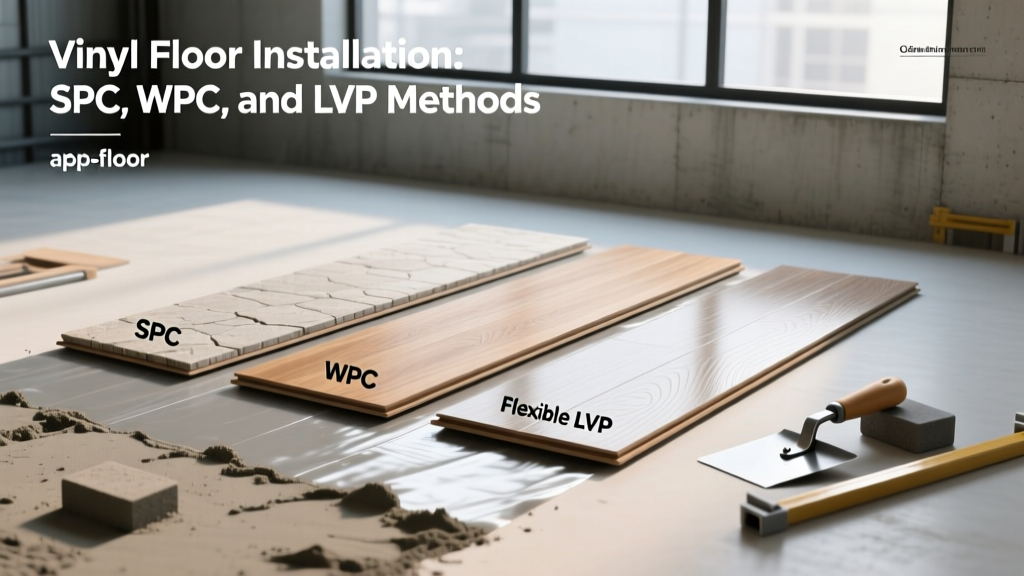
The Resilient Flooring Taxonomy: Core Types Defined
The term 'vinyl' encompasses a broad spectrum of polyvinyl chloride (PVC) based flooring, but treating all vinyl identically during installation guarantees premature failure. Modern resilient flooring is categorized by its core composition, which directly dictates dimensional stability, load-bearing capacity, and the required vinyl floor installation methodology. Understanding this taxonomy is the first step in selecting the right material for specific environmental conditions.
| Material Class | Core Composition | Typical Thickness | Dimensional Stability | Primary Install Method |
|---|---|---|---|---|
| SPC (Stone Plastic Composite) | Limestone powder, PVC, stabilizers | 4.0mm - 8.0mm | Extremely High | Floating Click-Lock |
| WPC (Wood Plastic Composite) | Wood pulp/flour, PVC, foaming agents | 5.0mm - 9.0mm | High | Floating Click-Lock |
| Flexible LVP/LVT | Solid PVC, plasticizers, fiberglass mesh | 2.0mm - 3.0mm | Moderate (Conforms to subfloor) | Full-Spread Glue-Down |
| Sheet Vinyl | Continuous PVC layers, felt or fiberglass backing | 2.0mm - 4.0mm | Low (Seamless expanse) | Modified Loose-Lay or Glue-Down |
Subfloor Preparation: Tolerances by Material Class
Subfloor prep is where 80% of vinyl flooring warranties are voided. The Resilient Floor Covering Institute (RFCI) mandates strict adherence to manufacturer flatness tolerances, which vary wildly depending on the core taxonomy.
Rigid Core (SPC & WPC) Flatness Requirements
Rigid core planks bridge minor subfloor voids, but they cannot bend. If installed over an uneven substrate, the click-lock mechanisms will bear the structural load of foot traffic, leading to joint separation. SPC and WPC require a flatness tolerance of 3/16-inch over a 10-foot radius. For concrete subfloors exceeding this tolerance, mechanical grinding or a Portland-cement-based self-leveling underlayment (SLU) like Mapei Novoplan Plus is mandatory. Gypsum-based levelers are generally prohibited under floating vinyl due to moisture reactivity.
Flexible LVP and Sheet Vinyl Flatness Requirements
Unlike rigid core, flexible LVP and sheet vinyl are entirely unforgiving of subfloor imperfections. Because the material is pliable, it will 'telegraph' every bump, divot, and trowel mark to the surface. The tolerance tightens to 1/8-inch over a 6-foot radius. Furthermore, any existing embossed tile or grout lines must be skim-coated with a feather-edge patching compound to prevent the vinyl from sinking into the recesses over time.
Vinyl Floor Installation Methods Dictated by Core
The physical properties of the vinyl core eliminate installer choice regarding the fastening method. You cannot glue down a standard click-lock SPC plank, and you cannot float a flexible LVP plank. The taxonomy dictates the technique.
Floating Click-Lock Systems (SPC & WPC)
Rigid core products utilize precision-milled tongue-and-groove locking mechanisms. There are two primary profiles in the 2026 market:
- Angle-Angle (Uniclic style): Requires the installer to angle the long side and short side simultaneously. This often requires lifting the entire assembled row to engage the short end, making it difficult for a single installer in large rooms.
- Drop-Lock (Valinge style): Features a mechanical locking tab on the short end. The long side is angled in, and the short end is simply folded down and pressed into place. This is the preferred profile for high-efficiency installation.
Critical Installation Detail: Never strike the locking mechanism of an SPC plank directly with a rubber mallet. The limestone composite core is highly brittle and will shatter or micro-fracture upon direct impact. Always use a dense tapping block to distribute the force, or a specialized pull bar for the perimeter boards.
Full-Spread Glue-Down (Flexible LVP/LVT)
Flexible luxury vinyl tile requires a permanent bond to the substrate to prevent shifting, gapping, and edge curling. The choice of adhesive and trowel notch is dictated by the subfloor porosity:
- Porous Subfloors (Concrete, Plywood, Approved SLUs): Use a standard acrylic pressure-sensitive adhesive (e.g., Roberts 2001) applied with a 1/16' x 1/16' x 1/16' square-notch trowel.
- Non-Porous Subfloors (Existing sealed tile, epoxy, terrazzo): Use a hard-set, wet-set acrylic adhesive applied with a 1/32' x 1/16' x 1/32' U-notch trowel to prevent adhesive starvation and ensure proper mechanical keying.
Adhesives must be allowed to 'flash off' (become tacky and transparent) before laying the tile. Installing flexible LVP into wet adhesive will trap solvents, leading to plasticizer migration and permanent adhesive failure. For comprehensive environmental and safety guidelines regarding adhesive off-gassing and VOC limits, refer to the EPA's Indoor Air Quality resources.
Real-World Failure Modes and Edge Cases
Even with perfect subfloor prep, environmental factors can compromise specific vinyl taxonomies. Recognizing these edge cases during the selection phase prevents costly callbacks.
Failure Mode 1: SPC Joint Separation in Direct Sunlight
The Cause: While SPC is dimensionally stable regarding moisture, it is highly reactive to thermal expansion. South-facing rooms with un-tinted, low-E glass can create surface temperatures exceeding 110°F. The thermal expansion force exceeds the tensile strength of the click-lock joint, causing the planks to pull apart.
The Fix: In high-solar-gain areas, specify an SPC product with a continuous fiberglass reinforcement layer embedded in the core, or transition to a full-spread glue-down flexible LVT which lacks rigid joints to separate.
Failure Mode 2: WPC Point-Load Denting
The Cause: WPC cores contain foaming agents to create a thicker, warmer, and quieter plank. However, this aerated structure reduces compressive strength. Heavy point loads (e.g., the narrow casters of a heavy kitchen island or a commercial server rack) will permanently crush the core.
The Fix: Use non-staining, flat-bottomed furniture glides with a minimum 2-inch diameter footprint. For commercial environments with heavy rolling loads, WPC must be entirely avoided in favor of high-density SPC or glue-down LVT.
Failure Mode 3: Radiant Heat Delamination
The Cause: Installing thick WPC (8mm+) over embedded hydronic radiant heating systems creates a thermal barrier. The heat gets trapped beneath the dense core, causing the heating system to overwork and potentially delaminating the decorative wear layer from the core due to prolonged excessive heat.
The Fix: Limit WPC thickness to 5mm over radiant systems, ensure the surface temperature never exceeds 85°F (29°C) as verified by an in-floor thermistor, and prefer SPC which transfers heat more efficiently due to its mineral density.
2026 Cost and Material Breakdown
Budgeting for vinyl floor installation requires separating the material cost from the mandatory prep and labor variables. Below is the current market pricing matrix for professional installation in a standard 500 sq. ft. residential space.
| Vinyl Taxonomy | Material Cost (per sq. ft.) | Prep & Adhesive/Underlayment | Labor Cost (per sq. ft.) | Total Installed Estimate |
|---|---|---|---|---|
| Entry-Level SPC (4mm) | $2.10 - $3.20 | $0.40 (Foam pad) | $1.75 - $2.50 | $4.25 - $6.10 |
| Premium SPC (6mm+ Pad) | $4.50 - $6.80 | $0.00 (Attached pad) | $1.75 - $2.50 | $6.25 - $9.30 |
| Commercial Glue-Down LVT | $2.80 - $4.50 | $0.85 (Acrylic adhesive) | $2.50 - $3.75 | $6.15 - $9.10 |
| Sheet Vinyl (Residential) | $1.50 - $3.00 | $0.60 (Modified loose-lay tape) | $1.25 - $2.00 | $3.35 - $5.60 |
Note: Subfloor leveling (SLU application) is excluded from this matrix as it is highly variable, typically adding $2.50 to $4.50 per square foot depending on the depth of the pour required.
Expert Selection Framework
To finalize your vinyl floor installation strategy, apply this decision matrix based on the specific demands of your space:
- High Moisture / Below Grade (Basements, Bathrooms): Select SPC. Its limestone core is 100% impervious to water and will not harbor mold or swell if a plumbing leak occurs. Ensure a floating installation with a 6-mil polyethylene vapor barrier if installing over a concrete slab without an epoxy seal.
- High Foot Traffic / Commercial / Rolling Loads: Select Glue-Down Flexible LVT. The permanent adhesive bond prevents the planks from shifting under heavy lateral friction (like shopping carts or hospital beds), and the lack of a rigid click-lock joint eliminates the weakest point of failure.
- Above-Grade Residential / Comfort Priority: Select WPC. If the space is a bedroom or living area where underfoot comfort and acoustic dampening are prioritized over extreme impact resistance, the aerated core of WPC provides superior sound absorption (IIC ratings often exceeding 70) without requiring a secondary acoustic underlayment.
- Uneven Subfloors / Renovation Over Existing Tile: Select Thick SPC (6mm+). The rigidity of a thick stone-plastic core will bridge wide grout lines and minor lippage in existing tile floors without telegraphing, provided the overall flatness tolerance of 3/16' over 10' is met. Avoid flexible LVP in this scenario entirely.
By aligning the material taxonomy with the environmental realities of the space and the precise subfloor conditions, you ensure a resilient floor that performs to its engineered specifications for decades. For further technical bulletins on substrate prep and adhesive compatibility, consult the comprehensive installation guidelines provided by major retailers and manufacturers.