Stainmaster Carpet Review 2026: PetProtect & Luxury Lines Compared
A 2026 deep-dive into Stainmaster carpet lines. Compare PetProtect, TruSoft, and Active Family specs, pricing, and warranty edge cases before you buy.
The Anatomy of Stainmaster: Why Nylon 6,6 Still Rules
Despite the influx of polyester (PET) and triexta fibers in the residential market, Stainmaster maintains its market dominance by relying almost exclusively on advanced continuous filament Nylon 6,6. The molecular distinction is critical for long-term performance. While standard Nylon 6 is formed from a single monomer, Nylon 6,6 is synthesized from two (hexamethylenediamine and adipic acid). This dual-monomer structure creates a tighter, more crystalline polymer chain that inherently resists crushing and matting under heavy foot traffic.
Furthermore, Stainmaster utilizes Bulk Continuous Filament (BCF) manufacturing. Unlike staple fibers—which are cut to short lengths, spun together, and inevitably shed for the first six months—BCF fibers are extruded in continuous miles-long strands. This eliminates shedding entirely and results in a denser, more uniform pile.
Many budget carpets rely on topical fluoropolymer sprays (like aftermarket Scotchgard) to repel stains. These coatings degrade with friction and alkaline cleaning agents. Stainmaster’s stain resistance is engineered at the molecular level. The open dye sites in the nylon are permanently occupied by colorless, stain-blocking molecules. Because acidic spills (like pet urine, coffee, or red wine) cannot find an empty dye site to bond with, the stain remains on the surface where it can be blotted away, even years after installation.
2026 Product Line Matrix: PetProtect, TruSoft, and Active Family
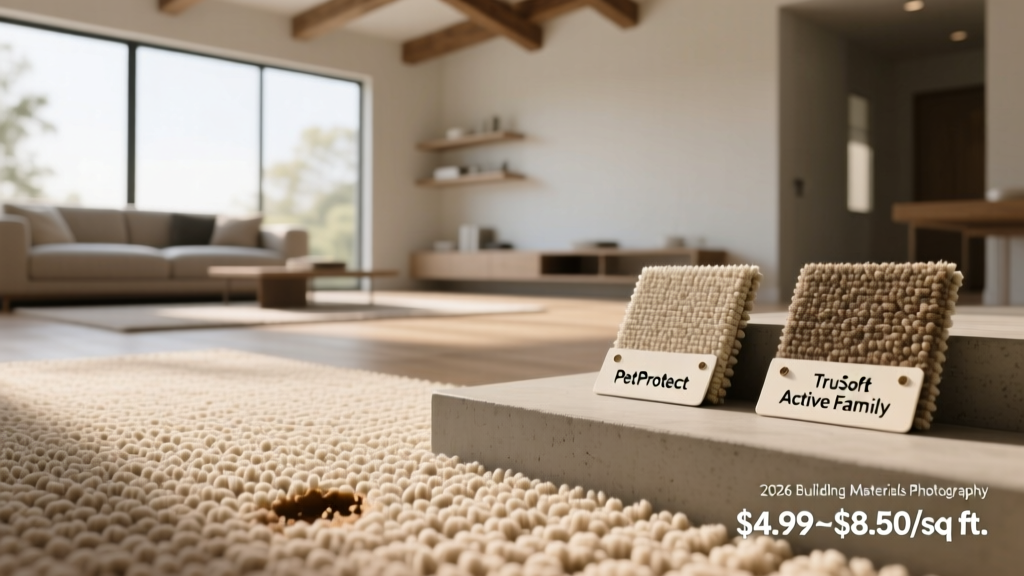
Stainmaster segments its residential offerings into distinct performance tiers. Selecting the wrong line for a specific traffic zone is the most common cause of premature wear complaints. Below is the technical breakdown of the three primary 2026 product lines available through retail partners.
| Product Line | Core Technology | Best Application | Material Cost (per sq. ft.) |
|---|---|---|---|
| PetProtect | Conductive fibers for static reduction; liquid-blocking backing. | Homes with dogs/cats; high-traffic living areas. | $5.50 - $8.50 |
| TruSoft | Lower denier-per-filament (DPF) for extreme softness; higher pile height. | Master bedrooms, low-traffic formal sitting rooms. | $6.00 - $9.50 |
| Active Family | High twist level (5.5+ TPI); dense stitch rate for crush resistance. | Playrooms, hallways, stairs, and family rooms. | $4.50 - $7.00 |
The PetProtect line deserves specific attention for pet owners. The inclusion of conductive fibers mitigates static electricity buildup, which is the primary reason pet hair clings to carpet. By reducing static, hair and dry debris are easily vacuumed rather than embedded. Additionally, PetProtect models feature a proprietary moisture barrier backing that prevents liquid accidents from penetrating into the carpet pad and subfloor, effectively neutralizing the sub-surface bacterial growth that causes permanent odors.
Decoding the Spec Sheet: The 'Rule of 35' and Density Math
Marketing terms like 'luxurious' or 'heavy-duty' are meaningless without verifiable metrics. When evaluating Stainmaster spec sheets, you must calculate the Carpet Density Number to determine true longevity.
How to Calculate Carpet Density
Use the industry-standard formula:
Density = (Face Weight × 360) ÷ Pile Height (in inches)
For example, a Stainmaster Active Family carpet with a 60 oz face weight and a 0.5-inch pile height yields a density of 43,200. As a general rule, a density rating below 20,000 is unsuitable for residential use. Ratings between 20,000 and 30,000 are adequate for bedrooms, while high-traffic zones and stairs demand a density exceeding 35,000. Always request the face weight and pile height from the retailer to run this calculation before purchasing.
Real-World Pricing and the 'Hidden' Pad Costs
A common mistake in 2026 carpet budgeting is pricing the material in isolation. The total installed cost is heavily influenced by the carpet pad and subfloor preparation. Stainmaster’s warranty strictly dictates the type of pad you must use; failing to comply will void your coverage.
2026 Cost Breakdown per Square Foot
- Carpet Material: $4.50 - $9.50
- Required Carpet Pad: $0.75 - $1.50 (Must be CRI-certified, 6-8 lb density, max 7/16-inch thickness)
- Professional Installation: $1.25 - $2.25 (Includes power stretching and basic prep)
- Subfloor Leveling/Prep: $0.50 - $1.50 (If plywood squeaks or concrete requires patching)
- Total Installed Cost: $7.00 - $14.75 per sq. ft.
Many retailers upsell 'moisture barrier' pads for pet owners. While these pads prevent urine from reaching the subfloor, they also trap ambient moisture rising from concrete slabs. If installed over a below-grade concrete basement without a prior vapor transmission test, the trapped moisture will cause mold growth beneath the pad. For concrete subfloors, use a breathable, high-density rebond pad and rely on the Stainmaster PetProtect carpet's built-in backing for liquid protection.
Warranty Voids: 3 Mistakes That Kill Your Coverage
Stainmaster offers robust 10- to 20-year warranties on stain resistance, texture retention, and pet accidents. However, claims are frequently denied due to three specific installation and maintenance failures:
- Improper Stretching (CRI 104 Violation): The Carpet and Rug Institute mandates the CRI 104 installation standard, which requires the use of a power stretcher for all rooms larger than a closet. Installers who rely solely on a knee-kicker will cause the carpet to ripple within 12 to 18 months. Stainmaster will deny texture retention claims if ripples are caused by inadequate stretching.
- Alkaline Cleaning Agents: Using carpet shampoos or spot cleaners with a pH higher than 10.0 will strip the molecular stain-blocking properties over time. Always use neutral-pH (6.0 to 8.0) cleaning solutions specifically formulated for nylon fibers.
- Incorrect Pad Thickness: Using a pad thicker than 7/16-inch, regardless of its density, compromises the carpet backing's structural integrity and immediately voids the texture retention warranty.
Subfloor Prep and Indoor Air Quality
Carpet acts as a massive air filter, trapping dust, allergens, and volatile organic compounds (VOCs). To maintain healthy indoor air quality, ensure your new carpet and pad carry independent certifications for low VOC emissions, as outlined by the Environmental Protection Agency's indoor air quality guidelines. Stainmaster products generally meet the CRI Green Label Plus standards, but the adhesives and seam tapes used by your installer must also be low-VOC.
Before installation, wood subfloors must be secured with deck screws to eliminate deflection (squeaks), which causes premature wear at the carpet backing. Concrete subfloors must be tested for moisture. If a calcium chloride test reveals moisture vapor emission rates (MVER) exceeding 5 lbs per 1,000 sq. ft. per 24 hours, a penetrating concrete sealer must be applied before any carpet pad is laid down. Skipping this step guarantees mold proliferation and adhesive failure, regardless of the carpet brand you choose.