White Subway Tile Backsplash: Material Taxonomy and Selection
Master white subway tile backsplash selection with our material taxonomy guide. Compare ceramic, porcelain, glazes, and PEI ratings for optimal results.
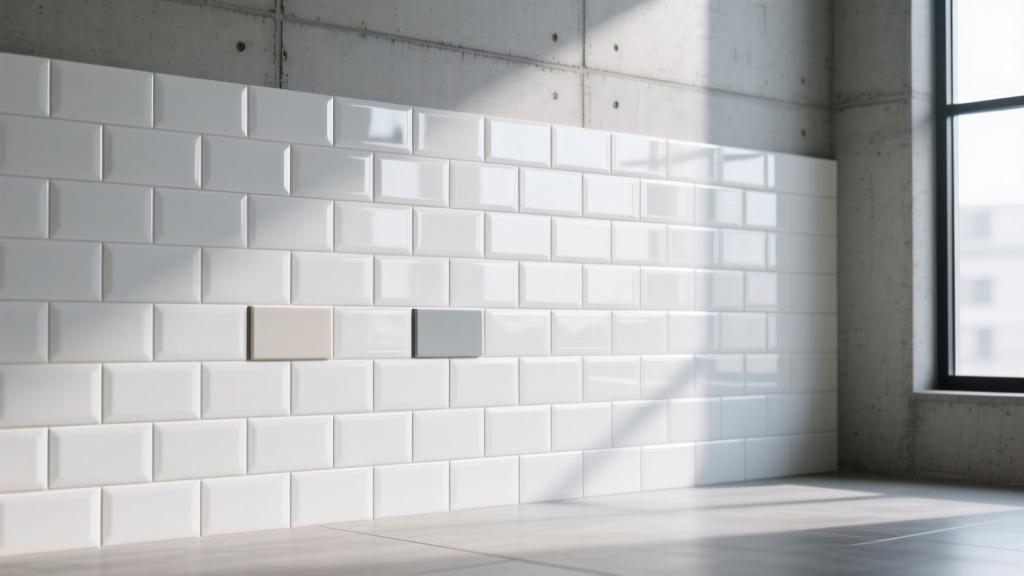
The Core Material Divide: Ceramic vs. Porcelain Subway Tile
Selecting a white subway tile backsplash requires navigating a complex material taxonomy. While often treated as a simple aesthetic choice, the underlying clay body, extrusion method, and glaze composition dictate long-term performance, maintenance requirements, and installation viability. The fundamental bifurcation in this category is between traditional ceramic and modern porcelain bodies.
Standard ceramic subway tiles are typically dust-pressed from red or white earthenware clay and fired at lower temperatures (around 1,000°C to 1,150°C). This results in a more porous bisque. According to ASTM C373 standards for water absorption, non-vitreous ceramic tiles can absorb upwards of 7% of their weight in water. For a vertical backsplash application away from direct, constant water immersion, this porosity is structurally acceptable, provided the surface glaze remains intact.
Porcelain subway tiles, conversely, are extruded or pressed from refined kaolin clays and fired at extreme temperatures (exceeding 1,200°C). This vitrification process yields a water absorption rate of 0.5% or less. While porcelain is technically superior in density and impact resistance, its extreme hardness makes it more difficult to cut and score on-site, particularly when executing intricate cuts around electrical outlets or plumbing fixtures in a backsplash layout.
The PEI Rating Trap: Why Backsplash Tiles Fail on Floors
Because our platform specializes in flooring, it is critical to address a common procurement error: utilizing wall-rated white subway tile on kitchen floors. Tile durability is measured by the Porcelain Enamel Institute (PEI) scale. Most white ceramic subway tiles designed for backsplashes carry a PEI Class 0 or Class I rating, meaning their glaze is engineered strictly for zero foot traffic. If installed on a floor, the glaze will scratch, dull, and expose the porous bisque within months. Always verify that floor-bound subway tiles carry a minimum PEI Class III rating and a Dynamic Coefficient of Friction (DCOF) of 0.42 or higher, as outlined by the Tile Council of North America (TCNA).
Glaze Taxonomy and Surface Engineering
The visual and tactile character of a white subway tile backsplash is determined by its glaze chemistry. The glaze is a glass-like coating fused to the bisque during firing, and its formulation drastically alters maintenance protocols.
High-Gloss vs. Matte Finishes
High-gloss white glazes contain higher concentrations of silica and fluxes, creating a highly reflective, impermeable surface. This is the most practical choice for heavy cooking zones, as the non-porous glass surface repels grease and allows for effortless wiping. Matte glazes, achieved by reducing silica and adding matting agents like zinc or titanium, diffuse light to hide surface imperfections and water spots. However, unglazed matte porcelain or lightly glazed matte ceramics can possess microscopic surface pitting that traps cooking oils, requiring more aggressive cleaning agents.
The Crackle Glaze Complication
Crackle (or crazed) glazes are engineered to cool faster than the clay body, intentionally creating a network of microscopic fissures for a vintage aesthetic. Critical Installation Rule: Crackle glaze is inherently porous. If you install a white crackle subway tile backsplash using standard gray or colored grout without pre-sealing, the grout pigment will bleed into the fissures, permanently staining the white tile with a muddy halo. You must apply a high-quality penetrating sealer (such as Miracle Sealants 511 Porous Plus) to the raw tile before grouting, and re-seal annually.
Dimensional Variations and Aspect Ratios
The term 'subway tile' has expanded far beyond the historic 3x6 inch format. The aspect ratio (the proportional relationship between width and length) dictates the visual rhythm of the backsplash and the viable installation patterns.
| Nominal Size | Aspect Ratio | Optimal Layout Pattern | Design Impact |
|---|---|---|---|
| 3" x 6" | 1:2 | 50% Offset (Running Bond) | Classic, traditional, highly forgiving of wall irregularities. |
| 2" x 8" | 1:4 | Stacked Bond (Vertical or Horizontal) | Modern, elongated, emphasizes ceiling height or counter length. |
| 4" x 12" | 1:3 | 33% Offset or Herringbone | Contemporary, larger scale reduces grout lines for easier cleaning. |
| 4" x 16" | 1:4 | Stacked Bond | Ultra-modern, requires exceptionally flat substrate due to length. |
Lippage and Offset Limits
When installing elongated formats (like 4x12 or 4x16) in a running bond pattern, avoid a 50% offset. Extruded tiles naturally bow slightly in the center. A 50% offset places the highest point of one tile directly next to the lowest point of the adjacent tile, causing severe lippage. Per ANSI A108.02 standards, tiles longer than 15 inches should never exceed a 33% offset.
Grout Chemistry: Protecting the White Canvas
White subway tile acts as a high-contrast canvas; any discoloration in the grout joints becomes immediately obvious. Selecting the correct grout chemistry is arguably more important than the tile selection itself.
- Standard Cementitious Grout: The most economical option, but highly porous. It will absorb tomato sauce, coffee, and grease, leading to dark, stained joints that ruin the crisp white aesthetic. Avoid this in active kitchens.
- High-Performance Cementitious Grout: Products like Mapei Ultracolor Plus FA utilize fine aggregates and polymer modifiers to create a denser, less absorbent joint. They offer excellent color consistency and resist staining better than standard grout, but still require periodic sealing.
- Epoxy Grout: The gold standard for white backsplashes. Two-part epoxy systems (such as Laticrete SpectraLOCK) are virtually impervious to water, grease, and acids. They do not require sealing and will not stain. The trade-off is a higher material cost and a more difficult, time-sensitive installation process that requires experienced applicators.
Cost Breakdown and Procurement Strategy
Budgeting for a white subway tile backsplash requires separating material costs from the specialized labor required for precise installations. Prices reflect current market averages for mid-to-high-tier materials.
- Standard Ceramic 3x6 (Gloss): $2.50 – $5.00 per sq. ft. (Material only)
- Porcelain Beveled or Handcrafted Ceramic: $8.00 – $18.00 per sq. ft. (Material only)
- Epoxy Grout Additive: Adds approximately $3.00 – $5.00 per sq. ft. to material costs.
- Professional Installation Labor: $12.00 – $28.00 per sq. ft., scaling upward for complex patterns (herringbone, vertical stack) or difficult cuts around extensive outlet arrays.
Procurement Tip: Always purchase 10% to 15% overage for standard patterns, and 20% for herringbone or diagonal layouts. Furthermore, ensure all boxes of white tile share the same dye lot and caliber code printed on the packaging. White glazes are notorious for slight warm/cool undertone shifts between different production runs, which will be glaringly obvious once installed under kitchen LED lighting.
Frequently Asked Material Questions
Can I use sanded grout on a glossy white subway tile?
Yes, but with a caveat. Modern high-performance sanded grouts use very fine, rounded quartz aggregates that will not scratch high-gloss glazes. However, if you are using a soft, matte, or crackle glaze, you must use an unsanded grout to prevent micro-scratches that will trap dirt over time. For joints 1/8-inch or smaller, unsanded is mandatory regardless of glaze type to ensure proper joint packing.
Do I need to seal the white tile itself?
If the tile has an intact, glossy, or matte glaze, the surface is impervious and does not require sealing. The only exception is unglazed porcelain, natural stone mimicking subway formats (like white marble), or intentional crackle glazes. In those cases, a penetrating impregnating sealer is mandatory to prevent staining.