Cork Flooring Cost Calculator: Plan Your Flooring Budget
Calculate exact cork flooring costs for 2026. Get material quantities, adhesive coverage, waste factors, and labor rates for floating and glue-down installs.
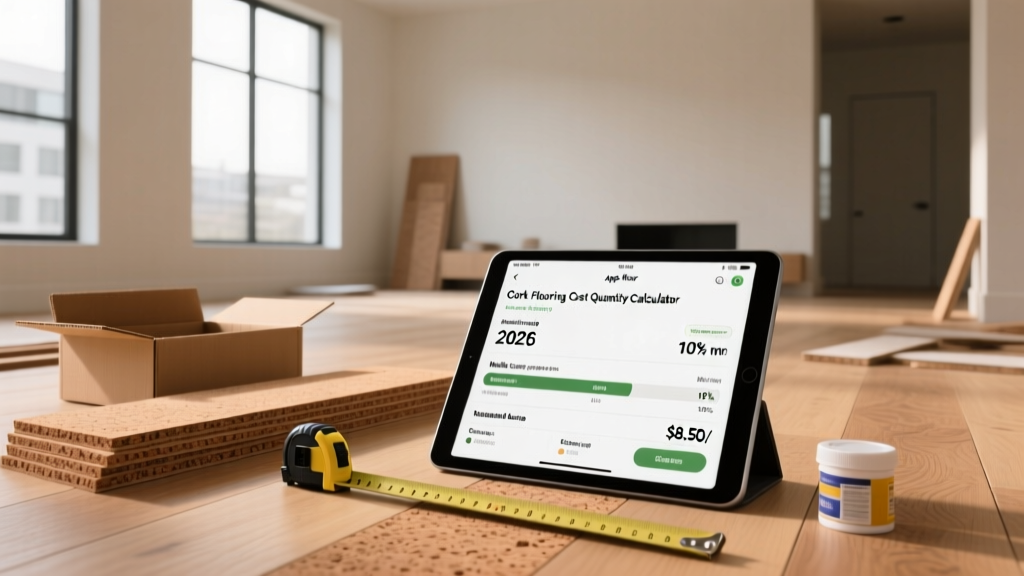
The True Cost of Cork Flooring: 2026 Market Rates
When evaluating sustainable flooring, cork flooring offers unmatched acoustic dampening, thermal insulation, and underfoot comfort. However, accurately estimating the total project cost requires moving beyond simple square-footage material pricing. The final budget hinges on whether you choose a floating click-lock system or a traditional glue-down tile installation, as the ancillary materials and labor profiles for these two methods diverge significantly.
2026 National Average Cost Baselines
- Floating Cork Planks (Material Only): $4.50 – $8.50 per sq. ft.
- Glue-Down Cork Tiles (Material Only): $3.00 – $6.50 per sq. ft.
- Professional Installation (Labor): $2.50 – $5.00 per sq. ft.
- Total Installed Cost Range: $6.50 – $13.50 per sq. ft.
According to industry data tracked by HomeGuide, the national average to install cork flooring sits at approximately $8.00 per square foot. However, this average obscures the critical cost variables related to subfloor preparation, specialized adhesives, and acclimation requirements that can inflate a budget by 15% to 20% if not calculated upfront.
Material Quantity Calculator: Floating vs. Glue-Down
Calculating the exact quantity of cork required involves more than multiplying length by width. Cork is a natural, hygroscopic material that expands and contracts. Proper quantity estimation must account for layout complexity, waste factors, and the specific installation method.
Step 1: Calculate Gross Square Footage
Measure the maximum length and width of the room. For irregular spaces, break the room into smaller rectangles, calculate the area of each, and sum them. Do not deduct space for kitchen islands or built-in cabinetry; the flooring should ideally run under these elements to prevent shifting and allow for future renovations.
Step 2: Apply the Correct Waste Factor
| Installation Scenario | Waste Factor | Multiplier |
|---|---|---|
| Standard square/rectangular room (parallel lay) | 7% | 1.07 |
| Hallways or narrow corridors | 9% | 1.09 |
| Diagonal layout or herringbone pattern | 12% - 15% | 1.12 - 1.15 |
| Rooms with multiple doorways, closets, and jogs | 10% | 1.10 |
Calculation Example: For a 200 sq. ft. living room with a diagonal layout, the calculation is 200 x 1.15 = 230 sq. ft. of material required. Always round up to the nearest full box (typically 18-22 sq. ft. per carton for floating planks).
The Adhesive Equation: Glue-Down Cork Requirements
Glue-down cork tiles (typically 3/16" or 1/4" thick) require a flawless bond to the subfloor. Using the wrong adhesive or miscalculating coverage is the leading cause of edge-curling and tile failure in cork installations. Standard construction adhesives or generic flooring glues will fail due to cork's dimensional movement.
Adhesive Coverage and Cost Calculation
Wakol D3540 requires a two-coat application: one coat on the subfloor and one coat on the back of the cork tile. Both coats must dry to the touch (clear and tacky) before mating.
- Coverage Rate: Approximately 150 sq. ft. per gallon, per coat.
- Effective Coverage (Two Coats): 75 sq. ft. per gallon.
- Cost per Gallon (2026): ~$85.00.
- Adhesive Cost per Sq. Ft.: $1.13.
For a 250 sq. ft. room, you will need 3.33 gallons. Always purchase 4 gallons to account for roller absorption and spillage, adding roughly $340 to your material budget strictly for adhesive.
Hidden Costs & Subfloor Failure Modes
Cork is highly susceptible to moisture vapor transmission and subfloor telegraphing. Because glue-down cork is thin and flexible, every minor imperfection in the concrete or plywood subfloor will telegraph through the finished surface. Budgeting for subfloor preparation is non-negotiable.
Moisture Testing and Mitigation
Before installing cork over concrete, you must conduct moisture testing per ASTM F2170 (Relative Humidity probe testing) or ASTM F1869 (Calcium Chloride test). Concrete must exhibit an RH of 75% or less. If levels exceed this, you must budget for a moisture mitigation system.
- In-situ RH Probe Test Kit: $45 - $60 (includes 3 probes and a digital meter).
- Epoxy Moisture Barrier (e.g., Bona D501 or Mapei Primer MF): $2.50 - $3.50 per sq. ft. applied.
Subfloor Leveling
Glue-down cork requires a subfloor flatness tolerance of 1/8" over a 6-foot radius. If your concrete slab has dips or cracks, you must use a self-leveling underlayment (SLU).
- Self-Leveling Compound (e.g., Henry 565 FloorPro): ~$35 per 40 lb bag.
- Coverage: ~40 sq. ft. per bag at 1/8" depth.
- Primer Requirement: SLU requires an acrylic primer (~$40/gallon) to prevent the concrete from absorbing the water out of the leveling compound too quickly, which causes cracking.
Regional Labor Rates & Installation Timelines
Labor costs for cork flooring vary significantly by region and the specific installation method. Glue-down installations are highly labor-intensive, requiring back-rolling every tile and managing open times for contact cement. As noted by Bob Vila's expert home guides, professional installation is highly recommended for glue-down cork to avoid irreversible adhesive mistakes.
| Region | Floating Install (per sq. ft.) | Glue-Down Install (per sq. ft.) | Avg. Timeline (300 sq. ft.) |
|---|---|---|---|
| Northeast / Mid-Atlantic | $3.50 - $4.50 | $5.50 - $7.00 | 2 - 3 Days |
| Midwest | $2.50 - $3.50 | $4.50 - $5.50 | 2 - 3 Days |
| South / Sunbelt | $2.75 - $3.75 | $4.75 - $6.00 | 2 - 3 Days |
| West Coast / Pacific | $4.00 - $5.50 | $6.50 - $8.50 | 2 - 4 Days |
Step-by-Step Budgeting Framework: 250 Sq. Ft. Room
To provide a concrete estimation model, here is a comprehensive breakdown for a 250 sq. ft. bedroom utilizing a mid-grade floating cork plank system (e.g., Wicanders Wood Essence or USFloors Cork) with a parallel layout, installed over a wood subfloor in the Midwest.
- Base Material (250 sq. ft. x 1.07 waste factor = 268 sq. ft.): 14 cartons @ $6.00/sq. ft. = $1,608.00
- Cork Underlayment (1/4" acoustic barrier): 270 sq. ft. roll @ $1.25/sq. ft. = $337.50
- Transition Moldings (T-moldings and end caps): 2 pieces @ $45.00 = $90.00
- Consumables & Spacers: Tapping block, pull bar, spacers = $35.00
- Subfloor Prep (Minor sanding and screw securing): $120.00
- Professional Labor (Floating install @ $3.00/sq. ft.): 250 sq. ft. x $3.00 = $750.00
- Furniture Removal & Baseboard Reinstallation: $250.00
Total Estimated Project Cost: $3,190.50
Effective Cost Per Square Foot: $12.76 (Fully installed, including prep, underlayment, and waste). This highlights why relying solely on the $6.00/sq. ft. material price tag leads to severe budget underestimation.
Acclimation and Climate Control Requirements
A frequently overlooked cost factor in cork flooring estimation is the time and energy required for proper acclimation. Cork must acclimate in the installation environment for a minimum of 48 to 72 hours prior to installation. The room must be maintained at a temperature between 65°F and 75°F, with a relative humidity between 35% and 65%. If the HVAC system is not yet operational in a new build, you must budget for temporary climate control (portable heaters or dehumidifiers) to prevent post-installation gapping or buckling.
Frequently Asked Cost Questions
Can I install glue-down cork over existing vinyl or tile?
Generally, no. Glue-down cork requires a porous, structurally sound, and perfectly flat substrate. Non-porous surfaces like ceramic tile or sheet vinyl prevent water-based contact adhesives from curing properly. You must budget for demolition ($1.50 - $3.00 per sq. ft.) or the installation of a 1/4" lauan or plywood underlayment over the existing floor to provide a proper nailing and gluing surface.
Does cork flooring require expensive ongoing maintenance?
Maintenance costs for cork are exceptionally low. Routine cleaning requires only a pH-neutral hardwood floor cleaner (e.g., Bona Hardwood Floor Cleaner, ~$12 per 32oz bottle). Floating cork floors come with factory-applied polyurethane or ceramic micro-scratch finishes that typically last 10 to 15 years before requiring a screen-and-recoat, which costs roughly $1.50 to $2.50 per square foot professionally.