How Long Does a Glass Door with Dog Door Last? Durability Analysis
Discover the true lifespan of a glass door with dog door. We analyze material durability, flap wear, and structural integrity for long-term performance.
The Structural Reality of Pet-Integrated Glass
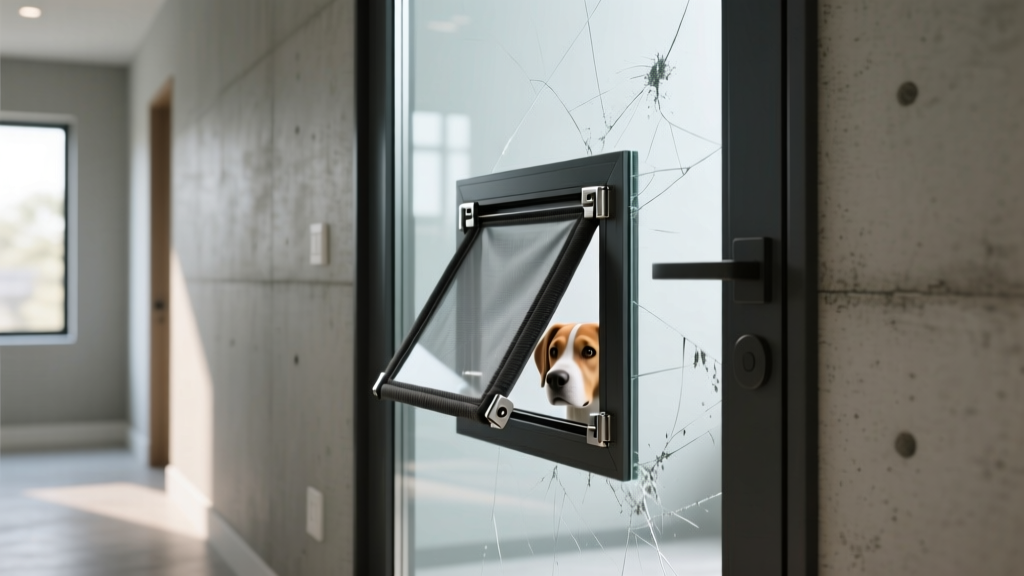
Integrating a pet portal into a glazed entryway fundamentally alters the structural and thermal dynamics of the opening. When evaluating the lifespan of a glass door with dog door, you are not assessing a single material, but a composite system. The longevity of this system depends on three distinct failure points: the safety glass panel, the insulating seal (if double-paned), and the mechanical pet flap assembly. While a standard tempered glass patio door can easily last 25 to 30 years, the introduction of a pet door creates stress concentrations and thermal bridges that can reduce the overall functional lifespan if not engineered correctly.
A critical misconception among homeowners is that a pet door can be cut into an existing tempered glass door. According to the U.S. Consumer Product Safety Commission (CPSC), architectural glazing in doors must meet strict impact-resistance standards (16 CFR 1201). Because tempered glass is heat-treated to create surface compression, attempting to cut it post-manufacturing will cause it to instantly shatter into thousands of pebbles. Therefore, a true glass door with dog door must be custom-manufactured, with the cutout made prior to the tempering furnace, or constructed as an Insulated Glass Unit (IGU) with the pet portal sandwiched between the panes.
Tempered vs. Laminated Glass Panels
The choice of glass dictates the baseline structural durability. Tempered glass is the industry standard for patio doors due to its safe breakage pattern. However, laminated glass—comprising two layers of glass bonded with a polyvinyl butyral (PVB) interlayer—offers superior durability against blunt force impacts from large, energetic dogs. If a 90-pound Labrador repeatedly crashes into the lower third of the door, laminated glass will absorb the kinetic energy without compromising the structural envelope, whereas tempered glass, while strong, lacks the same flexibility and tear-resistance.
Flap and Frame Durability: The Weakest Links
The glass itself will almost certainly outlast the pet door mechanism. The flap and its surrounding frame represent the primary maintenance bottleneck. The lifespan of the flap is dictated by its polymer composition and the closure mechanism.
Standard flexible PVC (polyvinyl chloride) flaps are highly susceptible to ultraviolet degradation. In south-facing or west-facing installations, UV exposure will cause PVC flaps to yellow, stiffen, and crack within 3 to 5 years. For exterior glass doors receiving direct sunlight, rigid polycarbonate or K9 Composite flaps are mandatory for achieving a 10+ year lifespan.
The closure mechanism is equally critical. Economy models rely on ceramic magnets or simple gravity flaps. Ceramic magnets lose their magnetic flux density over time when exposed to temperature fluctuations, leading to a flap that fails to seal. High-end integrated units utilize neodymium rare-earth magnets embedded within the flap edges. Neodymium magnets retain their magnetic strength indefinitely under normal environmental conditions, ensuring the thermal seal remains intact for the life of the flap.
Lifespan Comparison Matrix
The following matrix breaks down the expected longevity of various components within a glass door with dog door, highlighting the specific failure modes that dictate replacement cycles.
| Component | Material Specification | Expected Lifespan | Primary Failure Mode |
|---|---|---|---|
| Glass Panel | Tempered / Laminated | 25 - 40 Years | Edge chipping, severe blunt-force impact |
| IGU Seal (Dual Pane) | Butyl / Polysulfide | 15 - 20 Years | Argon gas leakage, interior condensation |
| Pet Flap (Economy) | Flexible PVC | 3 - 5 Years | UV yellowing, tearing, warping |
| Pet Flap (Premium) | Rigid Polycarbonate / K9 | 10 - 15 Years | Deep scratching, hinge pin wear |
| Extruded Frame | Anodized Aluminum | 20+ Years | Pitting from salt air, finish oxidation |
Environmental Stressors and Thermal Degradation
When a pet door is integrated into a dual-pane Insulated Glass Unit (IGU), the thermal efficiency of the door is inherently challenged. The U.S. Department of Energy notes that the longevity of energy-efficient windows relies heavily on the integrity of the hermetic seal that traps insulating gases like argon or krypton between the panes.
The IGU Sandwich Method and Seal Complexity
In premium glass doors with dog doors, the pet portal is built into the spacer system between the two panes of glass. This creates a highly complex perimeter seal. The inner pane and outer pane must both be sealed to the aluminum or composite pet door frame. Over a 15-year period, the daily expansion and contraction of the aluminum frame (which has a higher coefficient of thermal expansion than glass) puts immense shear stress on the butyl and polysulfide sealants. If this seal fails, argon gas escapes, and the U-factor of the door degrades, leading to interior condensation and increased HVAC loads.
To mitigate this, specify IGUs that utilize warm-edge spacer technology and dual-seal systems (a primary polyisobutylene seal for gas retention and a secondary structural silicone seal for mechanical strength). This configuration can extend the hermetic seal lifespan to 20 years or more, matching the lifespan of the pet flap mechanism.
Maintenance Framework for Maximum Longevity
Extending the operational life of your glass door with dog door requires a targeted maintenance protocol focused on the mechanical and sealing components, rather than the glass itself.
- Bi-Annual Track and Hinge Lubrication: For rigid polycarbonate flaps that operate on a top-hinge or sliding track, apply a dry PTFE (Teflon) lubricant every six months. Avoid silicone sprays, which attract dust and dog hair, creating an abrasive paste that accelerates hinge pin wear.
- Magnetic Seal Calibration: Test the neodymium magnetic closure annually. If the flap fails to snap shut against light wind (5-10 mph), the weatherstripping surrounding the flap has likely compressed. Replace the EPDM rubber weatherstripping rather than replacing the entire flap assembly.
- IGU Seal Inspection: Every spring, inspect the interior perimeter of the glass where it meets the pet door frame. Look for micro-fogging or mineral deposits between the panes. Early detection of seal failure allows for warranty claims before the Low-E coating degrades from moisture exposure.
- UV Protectant Application: If your installation utilizes a flexible PVC flap in a high-sunlight area, apply a marine-grade UV protectant (such as 303 Aerospace Protectant) quarterly to delay polymer chain breakdown and prevent brittleness.
When to Repair vs. Replace the Entire Unit
Understanding the modularity of your specific glass door with dog door is essential for long-term cost management. In modular systems (such as those manufactured by Hale or PlexiDor), the pet door frame is mechanically bolted through a pre-cut hole in a single pane of tempered glass. When the flap wears out, you simply unbolt the frame, swap the flap, and reassemble. The glass remains untouched.
However, in fully fused IGU systems where the pet door is hermetically sealed between dual panes of glass, a flap replacement is rarely possible without breaking the vacuum seal. In these units, when the flap fails or the interior seal fogs, the entire glass cassette must be replaced. While the initial cost of a fused IGU pet door is higher (often ranging from $1,200 to $2,500 for the glass unit alone), it provides superior insulation and a cleaner aesthetic. When budgeting for a glass door with dog door, always verify with the manufacturer whether the flap is field-replaceable or if it requires a full IGU swap at the end of its lifecycle.