Choosing the Right Brick Wall Brick: Top Brands & Lines Compared
Compare top brick wall brick brands and product lines for 2026. Expert analysis of Acme, Glen-Gery, and General Shale specifications, costs, and ASTM grades.
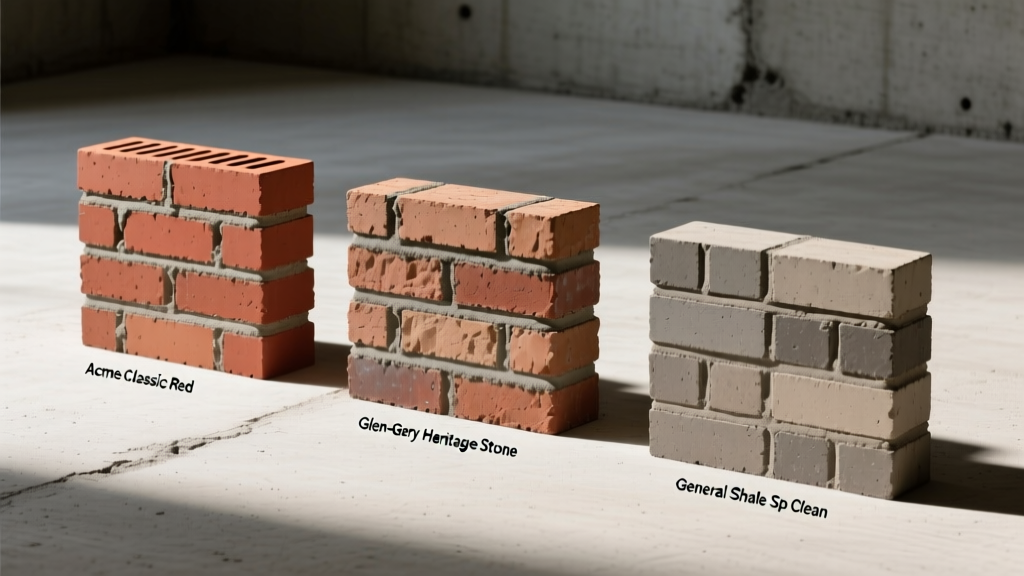
Defining the Brick Wall Brick: Beyond the Paver
When sourcing materials for vertical masonry assemblies, the distinction between a paving unit and a proper brick wall brick is critical to structural longevity. The phrase 'brick wall brick' distinguishes vertical masonry units—governed by stringent freeze-thaw and compressive strength standards—from horizontal pavers or refractory fire bricks. In 2026, architects and masonry contractors must specify units that comply with ASTM C216 (Standard Specification for Facing Brick) or ASTM C62 (Building Brick), depending on whether the unit serves as an exposed aesthetic wythe or a concealed structural backup.
A standard modular brick wall brick measures 3-5/8 in. x 2-1/4 in. x 7-5/8 in., yielding approximately 6.86 units per square foot of wall area with a standard 3/8 in. mortar joint. However, selecting the right product line requires navigating the diverse portfolios of major manufacturers, balancing aesthetics, severe weathering (SW) ratings, and project budgets.
Brand Deep-Dive: Acme Brick Company
Acme Brick remains a dominant force in the North American market, offering high-volume extruded and molded lines that serve as the backbone for both residential and commercial brick wall brick applications. Their manufacturing footprint allows for regional availability, minimizing freight costs—a crucial factor in 2026 masonry estimating.
Featured Line: Acme Traditional & Modular Series
The Traditional series focuses on classic wire-cut and sand-struck faces. These units are universally graded SW (Severe Weathering), meaning they possess a minimum average compressive strength of 3,000 psi and a maximum water absorption of 17.0% by weight, making them suitable for any climate zone in the United States.
- Compressive Strength: 3,500 psi average (exceeds ASTM C216 SW minimums).
- Initial Rate of Absorption (IRA): Typically 15-25 g/30 sq in., requiring no wetting prior to laying in standard conditions.
- 2026 Pricing Estimate: $680 - $820 per thousand units (FOB plant).
- Best Application: High-volume residential subdivisions, commercial veneers, and structural cavity walls.
Brand Deep-Dive: Glen-Gery Corporation
For projects demanding artisanal aesthetics, Glen-Gery’s portfolio provides a stark contrast to high-volume extruded bricks. Their focus on handcrafted, tumbled, and specialty-glazed units makes them a premier choice for custom residential and high-end commercial facades.
Featured Line: Glen-Gery Handcrafted & Romano Series
The Handcrafted line features bricks that are individually molded and fired to replicate historical, pre-industrial masonry. The Romano series offers an elongated format (often 2-3/4 in. x 11-5/8 in.), which dramatically alters the visual proportions of a brick wall brick installation, creating sweeping horizontal shadow lines.
"The elongated dimensions of the Romano line require a shift in standard coursing calculations. Masons must adjust story poles to account for the unique bed joint thicknesses preferred by architects specifying these premium units."
- Dimensional Tolerances: Wider variances allowed by design to enhance the rustic aesthetic; requires skilled masons to maintain plumb lines.
- Efflorescence Rating: Non-effloresced, achieved through strict kiln atmosphere controls and low-soluble-salt clay sourcing.
- 2026 Pricing Estimate: $1,150 - $1,600 per thousand units.
- Best Application: Custom luxury homes, historical restorations, and architectural feature walls.
Brand Deep-Dive: General Shale
General Shale bridges the gap between premium aesthetics and commercial-scale production. Their product catalog is heavily integrated with modern BIM (Building Information Modeling) libraries, allowing architects to specify exact brick wall brick textures and colors directly into digital twins before procurement.
Featured Line: Cottage & Premier Collections
The Cottage collection utilizes specialized sand-coating and tumbling processes applied post-extrusion. This yields a unit with the dimensional consistency of a machine-made brick but the tactile, weathered appearance of a reclaimed brick wall brick.
- Core Configuration: Available in both solid and 3-core hollow configurations (ASTM C652), reducing unit weight by 15% and improving thermal mass properties when cores are filled with insulating grout.
- Color Blending: Factory-palletized in 4-color blends to prevent on-site sorting bottlenecks.
- 2026 Pricing Estimate: $850 - $1,050 per thousand units.
- Best Application: Mid-tier custom homes, multi-family residential exteriors, and retail storefronts.
Specification Matrix: Comparing Top Brick Wall Brick Lines
The following matrix provides a rapid-decision framework for masonry estimators and architects comparing these primary product lines.
| Brand & Line | ASTM Grade | Avg. PSI | Est. Cost / 1,000 | Lead Time (2026) |
|---|---|---|---|---|
| Acme Traditional | SW | 3,500 | $680 - $820 | 2 - 4 Weeks |
| General Shale Cottage | SW | 3,200 | $850 - $1,050 | 4 - 6 Weeks |
| Glen-Gery Handcrafted | SW | 3,000 | $1,150 - $1,600 | 8 - 12 Weeks |
The Mortar-Brick Compatibility Framework
Selecting the brick wall brick is only half the equation; pairing it with the correct mortar per Brick Industry Association (BIA) Technical Notes is mandatory for structural integrity. The fundamental rule of masonry design is that the mortar must be weaker (lower compressive strength) and more permeable than the brick itself. This ensures that any micro-cracking or moisture movement occurs in the sacrificial mortar joint rather than fracturing the masonry unit.
Type N Mortar (750 psi)
Best for: Acme and General Shale standard face bricks. Provides excellent flexibility and accommodates standard thermal expansion without spalling the brick face.
Type S Mortar (1,800 psi)
Use with Caution: Only specify for below-grade foundation walls or high-load structural brick. Using Type S above grade with soft, handcrafted bricks can lead to severe face spalling during freeze-thaw cycles.
Procurement & Specification Checklist for 2026
To ensure your brick wall brick specification translates seamlessly from the blueprint to the job site, follow this procurement sequence:
- Verify Grade Requirements: Confirm local building codes. While SW (Severe Weathering) is standard for exterior walls, MW (Moderate Weathering) may be permitted for interior backup wythes or protected veneers in southern climate zones, reducing material costs by up to 12%.
- Request Physical Range Panels: Digital renderings fail to capture the color variance of fired clay. Require the manufacturer to ship a 16-square-foot physical range panel to the site for architect approval before bulk pallets are dispatched.
- Calculate Waste Factors Accurately: Standard modular brick wall brick installations require a 5% waste factor for field work. Add an additional 3-5% for complex detailing, corbeling, or running bond patterns intersecting with multiple fenestrations.
- Secure Storage Protocols: Upon delivery, pallets must be elevated on dunnage and covered with breathable, waterproof tarpaulins. Ground moisture wicking into the bottom courses prior to installation is a primary cause of early-stage efflorescence.
By rigorously evaluating the ASTM specifications, IRA profiles, and aesthetic tolerances of these top product lines, builders can ensure their chosen brick wall brick delivers both the structural resilience and architectural vision required for modern masonry construction. For comprehensive design standards, always cross-reference your specifications with The Masonry Society's latest code provisions.