Fire Brick Guide: Matching Refractory Types to High-Heat Scenarios
Match the right fire brick to your high-heat project. Compare dense vs. insulating refractory bricks for pizza ovens, forges, and fireplaces.
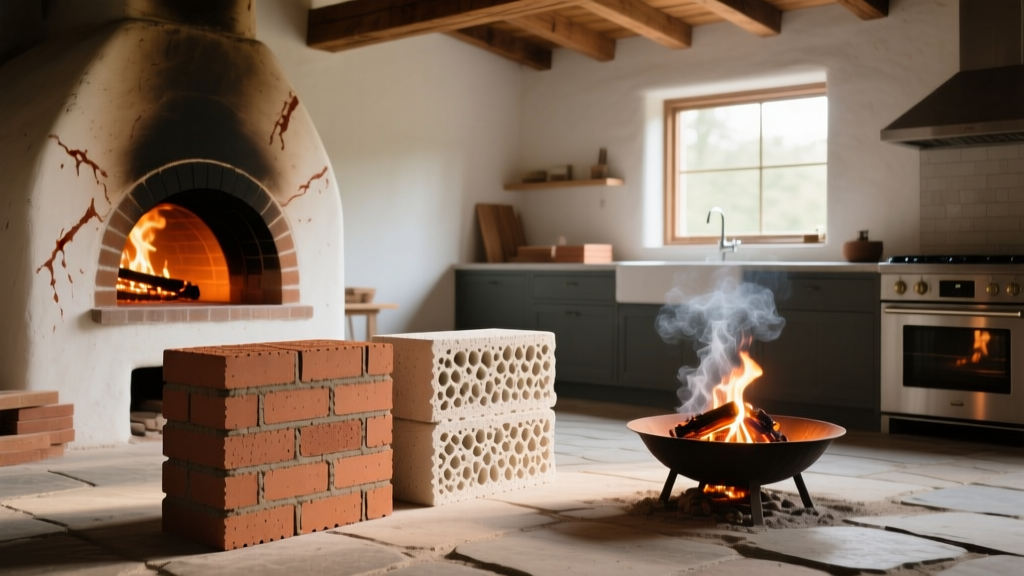
The Physics of Refractory Failure: Why Standard Brick Explodes
Standard clay building brick is fundamentally unsuited for high-heat environments. When exposed to temperatures exceeding 1,200°F, standard brick undergoes rapid thermal expansion while trapped internal moisture flashes into steam. Because standard clay is highly dense and lacks engineered porosity, the steam cannot escape, resulting in explosive spalling. Fire brick, technically known as refractory brick, solves this through precise alumina-silica ratios and controlled manufacturing processes that either increase thermal mass or introduce micro-porosity for insulation.
Dense vs. Insulating Fire Brick: The Core Decision Matrix
The most common mistake in refractory design is selecting the wrong class of fire brick for the thermal profile of the application. Refractory bricks are broadly divided into two categories: Dense (Hard) Fire Brick and Insulating Fire Brick (IFB). Understanding the thermal behavior of each is mandatory for scenario matching.
| Property | Dense Fire Brick (Hard) | Insulating Fire Brick (IFB) |
|---|---|---|
| Primary Function | Heat absorption, thermal mass retention, and abrasion resistance. | Heat reflection, rapid temperature ramp-up, and thermal containment. |
| Thermal Conductivity | High (Absorbs and holds heat for hours) | Low (Keeps heat inside the chamber) |
| Structural Integrity | Extremely high; withstands physical impact and chemical abrasion. | Low; soft, friable, and easily damaged by physical impact. |
| Common Grades | Low, Medium, High, and Super Duty (25% to 70%+ Alumina) | K-20, K-23, K-26, K-30 (Rated up to 3,000°F) |
| Weight (per 9x4.5x2.5" brick) | 6.5 to 8.5 lbs | 2.5 to 4.0 lbs |
Scenario Matching: Which Fire Brick for Which Application?
Choosing the correct refractory material requires analyzing the heat source, the required thermal mass, and the physical environment inside the chamber. Below is an application-fit breakdown for the most common high-heat projects.
Scenario 1: Wood-Fired Pizza and Bread Ovens
The Requirement: High thermal mass to absorb heat from the fire and radiate it evenly into the food, combined with resistance to chemical attack from wood ash.
The Match: Medium-Duty Dense Fire Brick (approx. 30-35% alumina content).
Expert Insight: Many builders mistakenly purchase Super-Duty High-Alumina brick (50%+ alumina) for pizza ovens, assuming higher specs equal better performance. This is a critical error. Wood ash contains high levels of potassium and sodium alkalis. At high temperatures, these alkalis act as powerful fluxes that chemically attack high-alumina refractories, causing severe slagging and premature melting. Medium-duty brick, which has a higher silica content, is vastly more resistant to wood ash fluxing. According to technical guidelines from Morgan Thermal Ceramics, matching the chemical environment to the refractory composition is just as vital as matching the temperature rating.
Scenario 2: Blacksmithing Forges and Knife-Making Kilns
The Requirement: Rapid heat-up times, extreme temperature containment (up to 2,400°F for forge welding), and high fuel efficiency.
The Match: Insulating Fire Brick (IFB), specifically K-23 or K-26 grades, for the walls and roof.
Expert Insight: IFB is incredibly soft—it can be cut with a standard wood saw and shaped with a rasp. However, its structural fragility is its Achilles' heel. Never use IFB for the floor of a coal or gas forge where heavy steel billets are repeatedly dropped. The impact will pulverize the brick. The optimal forge design uses a dense castable refractory floor (like Heatcrete 24) paired with K-23 IFB walls and an IFB arch roof to trap heat without adding unnecessary thermal mass that would slow down the heating process.
Scenario 3: Residential Fireplaces and Hearth Extensions
The Requirement: Moderate heat resistance, high durability against metal fire grates and tools, and aesthetic compatibility.
The Match: Low-Duty Dense Fire Brick (approx. 23-25% alumina, rated to 2,500°F).
Expert Insight: Residential fireboxes rarely exceed 1,500°F under normal operation. Low-duty fire brick provides more than enough thermal protection for the firebox lining while offering the physical hardness required to withstand the impact of iron fire pokers, steel grates, and falling firewood. For the hearth extension (the floor area outside the firebox), standard clay brick or stone is acceptable, provided it is set on a non-combustible substrate and meets local building codes for clearance.
Mortar Selection: The Weak Link in Refractory Assemblies
A refractory lining will fail at the joints long before the bricks themselves degrade. Standard Portland cement mortar will calcine, crack, and turn to dust at temperatures above 800°F. You must use specialized refractory mortar, categorized by its setting mechanism.
- Air-Setting Mortar (e.g., Sairset): Based on sodium silicate chemistry. It remains pliable in the bucket until exposed to air, and chemically bonds to the brick as it dries. It shrinks slightly during curing, which requires tight joints (1/16" to 1/8"). Rated up to 3,000°F. Ideal for IFB and precision forge linings.
- Water-Setting (Hydraulic) Mortar: Based on calcium aluminate cement. It sets via a chemical hydration reaction, much like concrete. It does not shrink, allowing for thicker joints (up to 1/4"), making it ideal for uneven dense fire bricks in pizza oven domes. Products like Rutland Castable Cement are industry standards for this application.
- Non-Setting (Drying) Mortar: Often clay-based, these mortars never fully cure into a rigid state. They are used exclusively for flue liners and stovepipe connections where thermal expansion requires the joint to remain slightly flexible.
Cost & Sourcing: 2026 Market Pricing for Refractory Materials
Refractory materials command a premium over standard masonry due to the specialized kiln-firing processes and high-purity raw materials required. When budgeting for a 2026 project, factor in the following baseline material costs:
| Material Type | Unit Size | Estimated 2026 Cost |
|---|---|---|
| Low/Medium Duty Dense Fire Brick | Standard (9" x 4.5" x 2.5") | $3.50 - $5.00 per brick |
| High Duty / Super Duty Dense Brick | Standard | $6.00 - $9.50 per brick |
| Insulating Fire Brick (K-23 / K-26) | Standard | $5.50 - $8.00 per brick |
| Air-Setting Refractory Mortar (Sairset) | 50 lb Bucket | $85.00 - $110.00 |
| Calcium Aluminate Castable Cement | 55 lb Bag | $60.00 - $80.00 |
Sourcing Strategy: Avoid purchasing IFB from general-purpose hardware stores, which often stock mislabeled or low-grade pumice blocks that degrade rapidly above 1,800°F. Source your K-Factor IFB and high-duty dense bricks directly from authorized industrial ceramic distributors or specialized kiln-supply companies to guarantee the alumina-silica specifications match your thermal requirements. For dense fire brick, local masonry supply yards often carry medium-duty stock intended for commercial boiler linings, which can save significantly on freight costs compared to ordering pallets online.