Matching Masonry Screws to Brick, Block, and Mortar Scenarios
Learn how to match masonry screws to specific brick, CMU, and mortar joint scenarios. Compare drill sizes, embedment depths, and corrosion ratings.
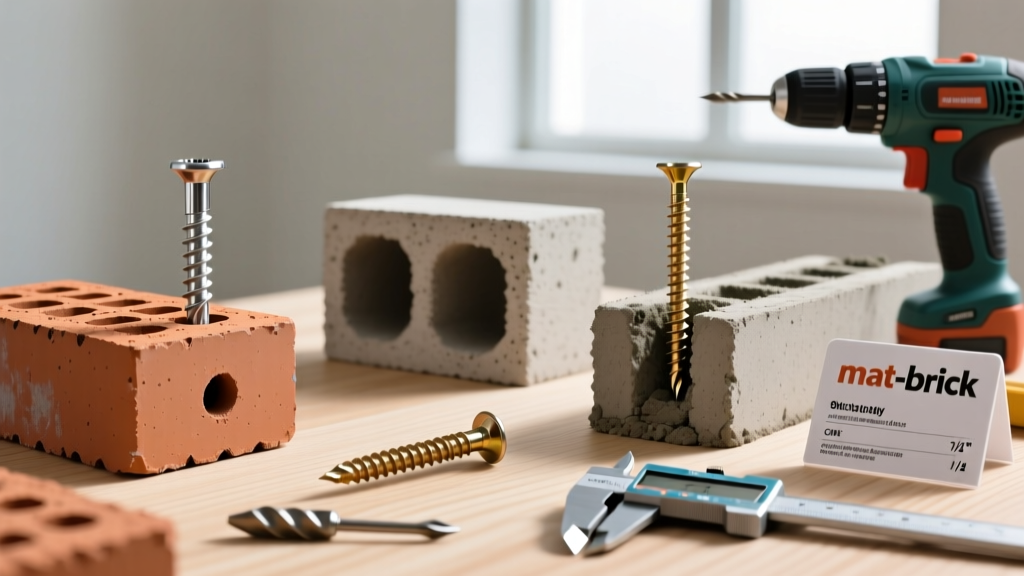
The Mechanics of Masonry Fastening
Unlike expansion anchors that rely on outward radial pressure, masonry screws function by cutting mating threads directly into the base material. This mechanical interlock provides immediate load-bearing capacity without the curing time required by epoxy or the expansion forces that can crack brittle substrates. However, this cutting action demands precise hole tolerances, strict embedment depths, and specific bit geometries. Using a standard wood screw or an improperly sized drill bit will result in stripped threads, spun screws, or catastrophic head shearing under torque.
According to technical guidelines from ITW Tapcon, the drill hole diameter must be exactly matched to the screw's minor diameter to allow the threads to cut into the masonry while the core of the screw passes through freely. For a standard 3/16-inch masonry screw, the required carbide drill bit size is 5/32-inch. This 1/32-inch differential is non-negotiable; a 3/16-inch bit will yield a hole too large for the threads to engage, while a 1/8-inch bit will cause the screw core to bind and snap.
Scenario Matching Matrix: Base Material vs. Fastener
The holding power of a masonry screw is entirely dependent on the compressive strength and density of the substrate. The following matrix outlines the optimal fastener selection and dimensional limits for common masonry scenarios.
| Base Material | Recommended Screw Type | Min Embedment | Max Embedment | Drill Bit (for 3/16" screw) |
|---|---|---|---|---|
| Solid Face Brick | Standard Carbon Steel (Climacoat) | 1.0" | 1.75" | 5/32" ANSI B212.15 |
| Engineering / Hard Brick | High-Load (e.g., Tapcon+) or 410 SS | 1.0" | 1.75" | 5/32" Solid Carbide |
| Hollow CMU (Face Shell) | Standard or Ultraplate | 0.75" | 1.0" | 5/32" ANSI B212.15 |
| Mortar Joint (Type S) | Large Diameter (1/4" or 3/8") | 1.5" | 1.75" | Corresponding to screw |
Scenario 1: Solid Brick and High-Density Clay
Solid brick presents a uniform substrate, but its hardness varies wildly depending on the firing process. Standard extruded face brick (typically 3,000 to 5,000 PSI compressive strength) accepts standard blue masonry screws easily. However, engineering brick or wire-cut brick can exceed 10,000 PSI. In these high-density scenarios, standard carbon steel screws often fail during installation because the cutting threads dull or the screw core snaps before reaching the target embedment depth.
Hard Brick Installation Protocol
- Bit Selection: Use a solid carbide-tipped bit that meets ANSI B212.15 standards. Standard percussion bits will wander and create oversized, out-of-round holes in hard brick.
- Hammer Drill Settings: Switch the drill to rotary-only mode once the bit penetrates the hard outer crust. Hammering through the entirety of the hole in hard brick causes micro-fractures in the substrate, reducing the thread-cutting friction and ultimate pull-out strength.
- Thread Design: Opt for advanced thread geometries like the Simpson Strong-Tie Strong-Drive masonry screws or ITW Tapcon+, which feature alternating high-low threads designed to reduce installation torque by up to 30% in high-PSI masonry.
Scenario 2: Hollow CMU (Concrete Masonry Units)
Anchoring into hollow block is the most common failure point for masonry screws. The structural integrity of a standard 8x8x16 inch CMU relies on its face shell, which is typically only 1.25 inches thick. If you drill through the face shell and into the hollow void, the screw has nothing to cut into, resulting in zero holding power.
Because the face shell is 1.25 inches thick, your absolute maximum embedment depth in hollow CMU is 1 inch. If you use a 2.75-inch screw to attach a 1/2-inch fixture, the screw will penetrate 2.25 inches into the block, bypassing the face shell entirely. Always calculate: Fixture Thickness + Max 1" Embedment = Total Screw Length.
For heavier loads on hollow CMU where the face shell is insufficient, abandon masonry screws entirely. Transition to epoxy-set threaded rods or toggle-style hollow wall anchors that deploy behind the block web, as recommended by the National Concrete Masonry Association (NCMA) for structural attachments.
Scenario 3: Anchoring into Mortar Joints
Mortar is the weakest link in any masonry assembly. While it is softer and easier to drill into than brick or block, its compressive and shear strengths are significantly lower. Type N mortar (common in residential veneer) is softer than Type S (common in structural and commercial walls).
When to use mortar joints: Only for light-duty, non-structural attachments (e.g., lightweight trellises, small exterior lighting, house numbers) where drilling into the adjacent brick risks cracking historic or fragile masonry.
When to avoid mortar joints: Never anchor structural loads, heavy shelving, or safety equipment (like handrails or TV mounts) into mortar. The mortar can crumble under dynamic loads, and repointing the joint later will compromise the anchor. If you must use a mortar joint, increase the screw diameter to 1/4-inch or 3/8-inch to maximize the thread surface area engaging the softer material, and ensure a full 1.75-inch embedment.
Environmental Fit: Corrosion Ratings and Coatings
Masonry is inherently alkaline and retains moisture. A standard zinc-plated wood screw will corrode rapidly when embedded in brick or mortar. Selecting the correct coating or alloy is critical for long-term structural integrity.
- Blue Climacoat / Zinc-Epoxy: The industry standard for interior and protected exterior applications. The dual-layer coating provides excellent corrosion resistance and acts as a dry lubricant during installation, reducing driving torque. Not suitable for continuous moisture exposure.
- 410 Stainless Steel: The optimal choice for exterior brick facades and retaining walls. 410 SS is a martensitic stainless steel, meaning it is heat-treated and hard enough to cut its own threads into masonry without the cutting edges deforming. It offers good corrosion resistance for most inland environments.
- 316 Stainless Steel: Required for coastal environments (salt spray) or when anchoring into masonry that is in direct contact with ACQ or MCQ pressure-treated lumber. Note: 316 SS is austenitic and softer than 410 SS. It is prone to galling (cold welding) during installation. Pre-drilling the hole slightly deeper and using a slower drive speed is mandatory to prevent the screw from seizing in the hole.
Installation Failure Modes and Troubleshooting
The "Spinning Screw" Syndrome
If a masonry screw spins freely without advancing, the hole is oversized, or the masonry dust was not cleared from the bottom of the hole. The dust packs at the base, preventing the screw from reaching its cutting depth, causing the threads to strip the upper portion of the hole. Fix: Always use a vacuum or compressed air to blow out the hole after drilling. If the hole is already stripped, abandon it, move 2 inches laterally (maintaining minimum edge distances), and use a larger diameter screw (e.g., step up from 3/16" to 1/4").
Head Shearing from Over-Embedment
Masonry screws are designed with a specific thread length. If you drill a 3-inch hole for a 2.75-inch screw, the unthreaded shank will reach the bottom of the hole before the head seats against the fixture. Continued torque will twist the steel core until the head snaps off. Fix: The hole depth must be exactly the screw embedment depth plus 1/4 inch to 1/2 inch for dust clearance. Use the depth stop on your hammer drill to ensure uniform hole depths across the job site.