German Smear Brick: Top Mortar Brands, Mix Ratios & Pro Tips
Master the German smear brick technique with our deep dive into the best mortar brands, exact mix ratios, and professional application tips for lasting results.
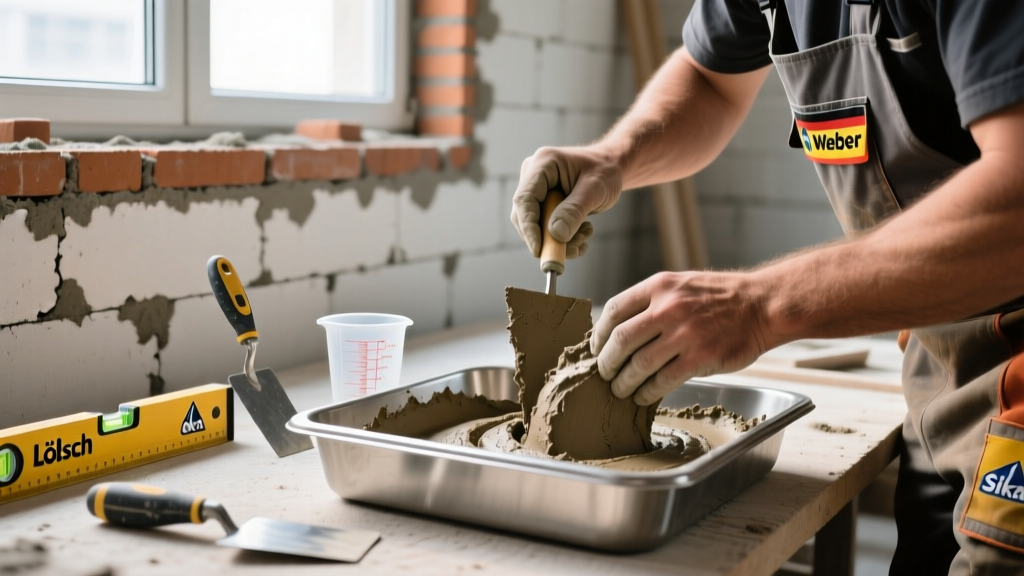
The Anatomy of a Perfect German Smear (Schlämme)
The German smear technique, traditionally known as Schlämme or slurry wash, is a centuries-old masonry finishing method that bridges the gap between exposed brick and solid paint. Unlike limewash (which penetrates and chemically binds) or whitewash (which sits as a thin paint film), a true German smear relies on a cementitious mortar slurry dragged across the brick face. This leaves the mortar lodged deeply in the joints and textured across the brick surface, allowing the natural clay color to bleed through in a highly organic, tactile pattern.
Executing this finish flawlessly requires more than just thinning down leftover bricklaying mortar. It demands precise control over aggregate size, water retention, and substrate suction. In 2026, professional masonry contractors rely on specific pre-blended product lines and exact volumetric ratios to ensure the slurry cures without flaking, chalking, or delaminating.
Mortar Selection: Brand Deep-Dive & Product Lines
The foundation of a durable German smear is the mortar base. You must use a mix that adheres aggressively but remains flexible enough to accommodate thermal expansion. According to ASTM C270 Standard Specification for Mortar for Unit Masonry, selecting the correct mortar type is critical for both structural integrity and aesthetic longevity.
SPEC MIX: The Professional Standard
For commercial and high-end residential projects, SPEC MIX Brick Mortar Type N is the industry benchmark. Because it is factory-pre-blended, the sand aggregate is uniformly graded and consistently coated with Portland cement and lime. This eliminates the batch-to-batch color variations common in site-mixed mortars. An 80-lb bag yields approximately 0.85 cubic feet of slurry, covering roughly 45 to 55 square feet of brick face when applied at a 1/16-inch thickness.
Quikrete & Sakrete: Retail Accessibility
Quikrete Mortar Mix and Sakrete Mortar Mix are widely available Type S and Type N formulations. However, their retail sand aggregate is often coarser (up to 3/16-inch) to accommodate structural bricklaying. For a German smear, this coarse sand creates an overly gritty, uneven texture. Pro workaround: Pass retail mortar through a 1/16-inch mesh screen before mixing to remove the largest silica grains, ensuring a smoother, more controllable slurry drag.
Crucial Distinction: Type N vs. Type O Mortar
Type N (750 - 1,500 psi): The default choice for exterior German smear. It offers the ideal balance of adhesion, weather resistance, and flexibility.
Type O (350 psi): A high-lime, low-cement mix. Use Type O exclusively for interior, climate-controlled applications or when smearing historic, soft-molded brick that cannot handle the compressive strength of Type N without spalling.
Exact Mix Ratios & Slurry Formulations
Transforming standard mortar into a Schlämme slurry requires altering the water-to-cement ratio and introducing a bonding agent. The goal is a viscosity similar to heavy pancake batter (roughly 1,500 to 2,000 centipoise). As noted by the Portland Cement Association, excess water in cementitious mixes increases shrinkage and reduces bond strength, making chemical hydration control vital.
| Formulation Type | Base Mortar | Additives & Ratios | Best Application |
|---|---|---|---|
| Standard Exterior Slurry | Type N Pre-blended | 1 part acrylic fortifier to 3 parts water | Exterior facades, exposed to freeze-thaw |
| High-Workability Smear | Type N Pre-blended | Add 1 part Type S hydrated lime per 4 parts mortar | Complex architectural details, deep raked joints |
| Interior Historic Wash | Type O Pre-blended | Clean water only (no acrylics) | Interior fireplaces, soft historic clay brick |
Pigment Integration: Achieving Custom Tones
While standard gray Portland cement creates a traditional, slightly cool-toned smear, modern design often calls for warm whites, creams, or charcoal washes. Do not use liquid concrete tints from big-box stores; they lack the UV stability required for exterior masonry. Instead, use synthetic iron oxide pigments.
- Davis Colors / Solomon Colors: The industry standard for integral masonry coloring. For a warm, creamy 'French Vanilla' smear, mix 2 lbs of 'Buff' oxide pigment per 80-lb bag of Type N white mortar. For a stark, modern white, use a white Portland cement base mortar and add 1 lb of 'Titanium White' oxide.
- Mixing Protocol: Always blend the dry pigment into the dry mortar powder for a minimum of 3 minutes before adding any liquids. Adding pigment to the water phase results in severe streaking and inconsistent curing tones.
Application Protocol: Step-by-Step Execution
The physical application of German smear is where the technique succeeds or fails. The primary enemy of a cementitious slurry is rapid moisture loss due to brick suction.
- Substrate Preparation (The SSD State): Brick must be brought to a Saturated Surface Dry (SSD) state. Spray the wall with a garden hose 30 minutes before application. The brick should be dark and damp, but with no standing water or glossy sheen on the surface. If the brick is dry, it will flash-pull the water from your slurry, resulting in a powdery, unbonded finish.
- Mechanical Mixing: Use a 1/2-inch heavy-duty drill with a jiffler paddle. Mix at a low RPM (300-450) to avoid whipping air bubbles into the slurry, which will leave pinholes in the finished smear.
- The 'Magic Trowel' Drag: Apply the slurry using a 14-inch or 18-inch flexible foam squeegee (widely known in the trade as a magic trowel). Scoop the slurry from the hawk and pull it diagonally across the brick face. The flexibility of the foam forces the mortar deep into the joints while leaving a thin, textured film on the brick.
- Knock-Down and Wiping: Within 10 to 15 minutes (depending on ambient humidity), the slurry will begin to matte. Use a damp masonry sponge or a piece of burlap to lightly wipe the high points of the brick. This removes the film from the center of the brick while leaving the joints and the textured edges heavily coated.
Sealing and Maintenance: Protecting the Finish
A German smear finish is highly porous. Without a proper sealer, it will absorb rainwater, leading to efflorescence (white salt deposits) and freeze-thaw spalling in colder climates. However, you must never use a film-forming sealer (like standard acrylics or polyurethanes), as these trap moisture inside the brick wall, causing the brick face to pop off.
| Sealer Type | Brand / Product Example | Breathability | Lifespan & Cost (2026) |
|---|---|---|---|
| Silane/Siloxane Penetrating | PROSOCO Siloxane PD | Excellent (100% vapor permeable) | 7-10 years | $0.25 - $0.40 / sq ft |
| Acrylic Film-Forming | Rainguard Micro-Seal (Avoid) | Poor (Traps vapor) | 1-2 years | High failure risk |
| Masonry Wax / Paste | SC Johnson Paste Wax | Moderate | 1-3 years | Interior use only |
Application Tip: Wait a full 28 days for the mortar slurry to fully cure and off-gas moisture before applying a Siloxane penetrating sealer. Apply the sealer using a low-pressure HVLP sprayer to avoid disturbing the delicate smear texture.
Troubleshooting Common Failure Modes
- Flaking and Delamination: Caused by applying the slurry to dry, highly absorptive brick. The brick steals the hydration water before the cement can cure. Fix: Wire-brush the failed areas, re-wet the brick to SSD, and reapply.
- Chalking / Powdery Surface: Indicates the mix was too wet, or the ambient temperature dropped below 40°F (4°C) during curing, halting the hydration process. Fix: Apply a silicate-based masonry densifier to harden the surface, followed by a Siloxane sealer.
- Severe Efflorescence: White, crusty salt blooms appearing weeks after application. This happens when unbuffered water pushes soluble salts from the clay brick to the surface. Fix: Dry-brush the salts away. Do not use muriatic acid, as it will dissolve the lime in your smear and destroy the finish. Treat with a dedicated efflorescence cleaner and seal immediately.