When to Lay Brick or Tile: A Durability Analysis for Patios
Compare the long-term durability of brick vs. porcelain tile for patios. Analyze freeze-thaw resistance, load capacity, and failure modes.

The Material Science of Exterior Hardscaping
Deciding whether to lay brick or tile for an exterior patio, walkway, or heavy-traffic commercial floor requires looking past aesthetic preferences and analyzing material science. Both clay brick pavers and through-body porcelain tiles offer exceptional lifespans when installed correctly, but their failure modes, load-bearing capacities, and environmental tolerances differ drastically. This durability analysis breaks down the exact specifications, stress tolerances, and long-term degradation patterns of both materials to help you engineer a surface that survives decades of use.
Core Durability Metrics: Brick vs. Porcelain
Not all bricks or tiles are rated for exterior or heavy-traffic use. Standard interior ceramic tile will shatter under point loads, while non-rated face brick will spall after three freeze-thaw cycles. When sourcing materials, you must specify the correct grades: ASTM C902 Class SX for clay brick pavers and ANSI A137.1 for exterior-grade porcelain pavers (minimum 20mm thick).
| Metric | Clay Brick Paver (ASTM C902 Class SX) | Porcelain Paver (ANSI A137.1, 20mm+) |
|---|---|---|
| Compressive Strength | 10,000 - 14,000 psi | 35,000 - 45,000+ psi |
| Water Absorption Rate | < 6.0% (Typically 3-5%) | < 0.5% (Impervious) |
| Freeze-Thaw Resistance | Excellent (with proper drainage base) | Superior (virtually immune to internal spalling) |
| Surface Abrasion (Mohs) | 6 - 7 (Unglazed, consistent throughout) | 7 - 8 (Highly scratch resistant) |
| UV Color Stability | 100% (Fired mineral oxides) | 100% (Inorganic pigments) |
| Impact Resistance (Point Load) | Moderate (May chip on edges) | Low to Moderate (Brittle; prone to cracking) |
Brick Paver Failure Modes and Mitigation
Clay brick pavers possess high compressive strength and a slight flexibility when laid in a sand-set bed, allowing them to handle minor subgrade shifting without cracking. However, they are porous. The Brick Industry Association emphasizes that moisture management is the single most critical factor in brick durability.
Primary Failure Mode: Spalling and Efflorescence
When water penetrates the brick matrix and freezes, it expands by 9%. If the brick's absorption rate exceeds its capacity to shed water, the face of the brick will pop off (spall). Furthermore, water moving through the brick dissolves soluble salts, depositing them on the surface as a white, powdery residue known as efflorescence.
- Mitigation: Never lay face brick on a patio. You must specify solid clay pavers rated for Severe Weathering (SX). Ensure the sub-base consists of 4 to 6 inches of compacted crushed aggregate (ASTM No. 57) to promote rapid drainage away from the paver bed.
- Sealing Warning: Avoid film-forming acrylic sealers on exterior brick. They trap moisture inside the masonry unit, accelerating freeze-thaw spalling. If sealing is required for stain resistance, use only penetrating silane/siloxane water repellents that allow the brick to breathe.
Porcelain Tile Failure Modes and Mitigation
Exterior porcelain pavers (typically 20mm or 3/4-inch thick) are manufactured by pressing refined clays and silica at up to 15,000 psi and firing them at 2,200°F. This creates an incredibly dense, nearly impervious material. According to the Tile Council of North America, porcelain's near-zero absorption rate makes it virtually immune to freeze-thaw damage.
Primary Failure Mode: Substrate Bond Delamination and Lippage
Because porcelain is so dense, it does not absorb the water from standard cementitious thinset mortar. If the wrong adhesive is used, or if the concrete slab beneath it shifts, the tile will not crack; instead, the bond will fail, and the tile will pop loose (delaminate). Furthermore, large-format porcelain pavers are highly susceptible to warping during manufacturing, leading to lippage (uneven edges) if not installed with proper leveling systems.
- Mitigation: When bonding 20mm porcelain to a concrete slab, you must use a high-performance, polymer-modified thinset mortar meeting ANSI A118.4 or A118.15 standards. Back-butter every single tile to ensure 95%+ mortar coverage.
- Expansion Joints: Porcelain expands and contracts with temperature fluctuations at a different rate than concrete. You must install flexible urethane or silicone expansion joints every 8 to 12 feet in both directions, and at all perimeter edges, per EJ171 guidelines.
Never lay glazed porcelain tile on an exterior patio. Glazed tiles feature a printed design on a clay bisque body. If a heavy object (like a cast-iron grill or patio heater) chips the glaze, the lighter, porous clay body underneath will be exposed, instantly ruining the aesthetic and creating a moisture trap. Always specify through-body or double-loaded porcelain pavers where the color and pattern extend through the entire 20mm thickness.
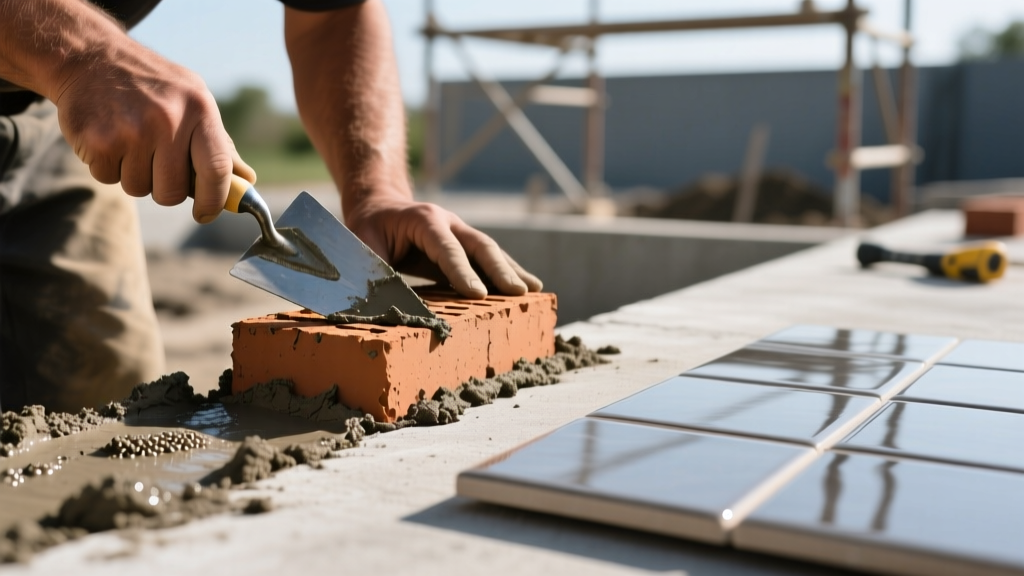
The Weakest Link: Joint and Grout Degradation
In both systems, the surface material will almost always outlast the material used to bind it together. Joint failure is the leading cause of hardscape degradation.
Brick Jointing Systems
For sand-set brick patios, polymeric sand is the standard. It hardens upon water activation to resist washout and weed growth. However, polymeric sand becomes brittle over time and will crack if the patio base settles. For mortared brick systems, Type N mortar is generally preferred for exterior patios as it offers higher flexibility and better weather resistance than the harder, more rigid Type S or Type M mortars, which can crack and damage the brick edges during thermal expansion.
Tile Grouting Systems
Standard cementitious grout (ANSI A118.6) is porous, stains easily, and degrades under constant moisture and freeze-thaw cycles. For exterior porcelain installations, upgrading to a high-performance epoxy grout (ANSI A118.3) or a single-component urethane grout (ANSI A118.14) is non-negotiable for long-term durability. These advanced grouts resist de-icing salts, oil stains, and efflorescence, extending the maintenance cycle from 5 years to 20+ years.
Environmental Stress Testing: De-icing Salts and Heat
If your patio is located in a climate that experiences winter snow and ice, or if it will be exposed to intense direct sunlight, material selection becomes highly specialized.
- De-icing Salts (Magnesium Chloride / Calcium Chloride): Chemical de-icers aggressively attack the mortar joints in brick patios and can cause surface scaling on lower-grade bricks. Porcelain pavers are entirely chemically inert and will not degrade when exposed to harsh ice-melting chemicals.
- Thermal Shock and Heat Retention: Dark-colored brick absorbs significant heat but dissipates it slowly, which can make barefoot walking uncomfortable in summer. Light-colored porcelain reflects more solar radiation. However, if a hot porcelain paver is suddenly cooled (e.g., by a heavy summer downpour), the thermal shock can cause micro-fractures if the tile was not manufactured to strict thermal shock testing standards (ISO 10545-9).
- Permeability Requirements: Many municipalities now mandate permeable hardscaping to manage stormwater runoff. Clay brick pavers laid on an open-graded aggregate base with wide joints easily meet EPA permeable pavement guidelines. Mortared porcelain tile systems are entirely impervious and require complex sub-surface drainage mat systems to comply with local runoff codes.
Lifecycle Cost and Replacement Matrix
Durability must be weighed against the initial capital expenditure and long-term maintenance. The following matrix projects costs over a 30-year lifecycle for a 400-square-foot patio installation.
| Cost Factor | Sand-Set Clay Brick Paver | Mortared 20mm Porcelain Paver |
|---|---|---|
| Material Cost (per sq. ft.) | $3.50 - $6.00 | $7.00 - $14.00 |
| Installation Labor (per sq. ft.) | $6.00 - $9.00 | $12.00 - $18.00 |
| Expected Lifespan | 25 - 40+ years | 40 - 50+ years |
| 10-Year Maintenance | $400 (Re-sanding joints, re-leveling) | $150 (Deep cleaning, grout touch-up) |
| Repairability | High (Individual pavers easily swapped) | Low (Requires grinding out grout, chipping tile) |
The Final Decision Framework
Use the following operational parameters to make your final material specification:
- The subgrade is expansive clay or prone to minor seasonal shifting (sand-set beds accommodate movement).
- Local zoning requires permeable paving for stormwater management.
- You want a traditional, modular aesthetic with high reparability (you can keep 5% extra pavers to swap out if one cracks or stains).
- The budget requires a lower upfront material and labor cost.
- The patio will support extreme point loads (e.g., heavy commercial planters, hot tubs, or vehicle traffic) requiring 35,000+ psi compressive strength.
- The environment involves heavy use of chemical de-icing salts or exposure to acidic spills (wine, grease, citrus).
- You require a perfectly level, mortared surface for ADA wheelchair compliance or smooth outdoor dining furniture placement.
- You are installing over an existing, structurally sound concrete slab and want to avoid the depth buildup of a sand-set brick base.
Both materials offer generational durability when specified and installed to their respective ASTM and ANSI standards. The decision ultimately hinges on your site's drainage capabilities, structural load requirements, and tolerance for long-term joint maintenance.
Written by
Elena RodriguezElena Rodriguez is a civil engineer and technical writer specializing in concrete technology, masonry systems, and ASTM/ACI compliance. She earned her B.S. in Civil Engineering from Texas A&M University and spent a decade at a materials testing laboratory, performing over 2,000 concrete compressive strength tests and masonry prism evaluations. Elena is an ACI-certified Field Testing Technician (Grade I) and a member of ASTM Committee C12 on Natural Building Stone. She currently consults on forensic engineering cases involving concrete failures and moisture intrusion. Based in San Antonio, TX, Elena is a proud member of the Society of Women Engineers (SWE) and coaches her daughter's FIRST Robotics team.
More from Elena Rodriguez
View all
Walls & Panels
Cost Analysis: Light Gauge Steel Framing Advantages and Disadvantages
Evaluate light gauge steel framing advantages and disadvantages through a strict cost analysis lens, comparing material, labor, and lifecycle expenses.
Aug 4, 2026

Walls & Panels
Gypsum Board Types: Exact Specifications, Thickness & Dimensions
Compare standard, Type X, and moisture-resistant gypsum board types. Get exact specifications, thicknesses, dimensions, and ASTM standards for your project.
Aug 4, 2026

Fire Resistance
Best Fire-Resistant Outdoor Decking Materials: 2026 Buyer Guide
Discover the best fire-resistant outdoor decking materials for 2026. Compare Class A PVC, aluminum, and hardwood options for WUI compliance and safety.
Aug 4, 2026