Black Granite Maintenance: The Ultimate Cleaning Playbook
Master black granite maintenance with our expert cleaning playbook. Learn how to seal, polish, and protect Absolute Black and Pearl granite surfaces.
The Material Science of Black Granite
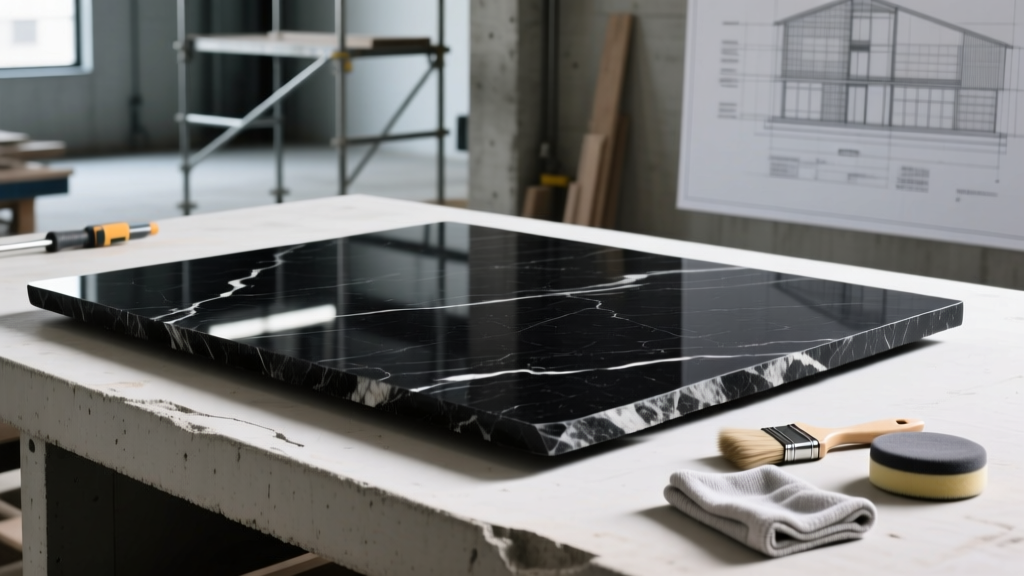
Black granite is not a single monolithic material; it is a commercial umbrella term covering several distinct igneous rocks, primarily gabbro, norite, and anorthosite. When homeowners and architects specify 'Absolute Black' or 'Black Pearl', they are selecting stones with vastly different mineral compositions, porosity levels, and maintenance requirements. Unlike lighter stones where stains hide within complex veining, black granite's uniform, dark canvas acts as a high-contrast magnifying glass for water spots, hard water mineral deposits, and sealer degradation.
Not all Absolute Black granite is naturally uniform. Some lower-grade slabs imported from specific global quarries are treated with carbon-based dyes or petroleum resins to mask natural gray mottling and fissures. Before applying any solvent-based cleaner or heavy-duty sealer, perform the Acetone Test: rub a white cotton cloth soaked in 100% pure acetone over an inconspicuous corner. If the cloth turns black or gray, your stone has been artificially dyed. Using alkaline strippers or aggressive solvents on doctored stone will dissolve the dye, resulting in permanent, patchy discoloration that requires professional diamond-honing to rectify.
Daily Cleaning Protocol: The pH-Neutral Mandate
The most common failure mode in black granite maintenance is the use of generic household surface cleaners. Products containing ammonia, vinegar, or citrus derivatives systematically degrade the siloxane bonds in impregnating sealers and dull the mechanical polish of the stone. According to the Natural Stone Institute, maintaining the structural integrity of the polish requires strict adherence to pH-neutral cleaning agents (pH 7.0).
Approved vs. Prohibited Cleaning Agents
| Category | Product / Ingredient | Impact on Black Granite |
|---|---|---|
| APPROVED | StoneTech Revitalizer, Weiman Granite Cleaner | Lifts oils without stripping siloxane sealers; leaves streak-free finish. |
| APPROVED | 50/50 Isopropyl Alcohol & Distilled Water | Excellent for rapid evaporation and eliminating fingerprint smudges. |
| PROHIBITED | Windex, Glass Plus (Ammonia-based) | Ammonia breaks down impregnating sealers, leading to rapid staining. |
| PROHIBITED | White Vinegar, Lemon Pledge (Acidic) | Acids etch calcium carbonate inclusions and dull the mirror polish. |
| PROHIBITED | Abrasive Sponges, Magic Erasers | Melamine foam acts as micro-sandpaper, creating permanent hazing. |
The Bi-Annual Sealing Strategy & Absorption Rates
A pervasive myth in the stone industry is that all black granites require frequent sealing. In reality, the need for an impregnating sealer is dictated by the stone's geological absorption rate. True Absolute Black (gabbro) is incredibly dense, often boasting an absorption rate of less than 0.05%. By contrast, Black Pearl or Impala Black can have absorption rates between 0.15% and 0.25%, making them significantly more vulnerable to oil penetration.
The 15-Minute Water Drop Test
Do not seal black granite on an arbitrary calendar schedule; over-sealing causes a permanent, cloudy haze that is notoriously difficult to remove from dark surfaces. Instead, perform this diagnostic test:
- Place a 3-inch puddle of distilled water on the most heavily used area of the countertop (typically near the sink or primary prep zone).
- Set a timer for 15 minutes.
- Wipe the water away and observe the stone. If a dark, damp ring remains and takes more than 5 minutes to evaporate back to the surrounding color, the stone's pores are exposed and require sealing.
- If the stone shows no color change, the existing factory or field-applied sealer is intact.
Finish-Specific Maintenance: Polished vs. Honed vs. Leathered
The mechanical finish applied to the slab at the fabrication shop dictates your daily maintenance playbook. Experts at MB Stone Care emphasize that altering the surface texture changes how the stone interacts with light, oils, and dust.
- Polished (Mirror Finish): Achieved through sequential diamond polishing up to 3000-grit. Maintenance Focus: Scratch and smudge prevention. Polished black granite shows micro-scratches from dragging ceramic plates or metal pots. Use felt-bottomed coasters and never cut directly on the surface. Clean with a 50/50 isopropyl alcohol solution to maintain the optical clarity of the reflection.
- Honed (Matte Finish): Stopped at 400-grit, leaving a smooth, non-reflective surface. Maintenance Focus: Oil stain prevention. Honed black granite is highly susceptible to 'shadowing'—dark, permanent blotches caused by cooking oils or butter absorbing into the open pores. Requires more frequent application of penetrating sealers and immediate blotting (not wiping) of spills.
- Leathered (Textured Finish): Treated with diamond-tipped brushes that etch away softer minerals, leaving a tactile, undulating surface. Maintenance Focus: Dust and debris extraction. The micro-valleys in leathered black granite trap flour, dust, and crumbs. Standard cloth wiping is ineffective; use a soft-bristled nylon brush or a vacuum with a hard-floor attachment to clean the texture before applying liquid cleaners.
Troubleshooting Matrix: Defects, Causes, and Exact Fixes
When black granite develops visual defects, misdiagnosis often leads to irreversible damage. Use this matrix to identify the root cause and apply the correct remediation protocol.
| Visual Symptom | Root Cause | Exact Remediation Protocol |
|---|---|---|
| Chalky White Rings | Hard water mineral deposits (calcium/magnesium) left after evaporation. | Gently agitate the area with #0000 extra-fine steel wool and a pH-neutral stone soap. Rinse with distilled water. Never use vinegar. |
| Cloudy Haze / Streaks | Improper sealer application (left to dry on surface) or use of wax-based cleaners. | Strip the surface using a dedicated stone sealer remover or pure acetone (if stone is verified un-dyed). Re-seal using the 10-minute dwell method. |
| Dark, Greasy Splotches | Lipid/oil penetration into the stone matrix, common around cooktops. | Create a poultice using baking soda and acetone (or mineral spirits). Apply 1/4-inch thick, cover with plastic wrap, poke holes, and let sit for 24 hours to draw out the lipid. |
| Micro-Scratches (Webbing) | Mechanical abrasion from sliding cookware or improper abrasive cleaning pads. | Surface-level webbing on polished stone requires professional re-honing and re-polishing with diamond pads. DIY scratch repair pens are ineffective on natural gabbro. |
Long-Term Preservation and Environmental Controls
Beyond daily wiping and bi-annual testing, the environmental conditions of the space housing black granite play a silent role in its longevity. In high-humidity environments or exterior applications, black granite is susceptible to sub-florescence—a condition where soluble salts migrate beneath the stone surface and crystallize, creating internal pressure that can cause spalling or flaking. Ensuring adequate ventilation and using dehumidifiers in enclosed spaces prevents moisture from being trapped beneath the slab.
By treating black granite not as a generic countertop material, but as a specific geological formation requiring tailored chemical and mechanical care, you preserve its optical depth and structural integrity for decades. Adhere strictly to pH-neutral chemistry, respect the absorption limits of your specific slab variant, and rely on diagnostic testing rather than arbitrary maintenance schedules.