Pink Marble Specifications: Compressive Strength & ASTM Ratings
Review pink marble performance specifications including ASTM compressive strength, water absorption rates, and ideal architectural applications.
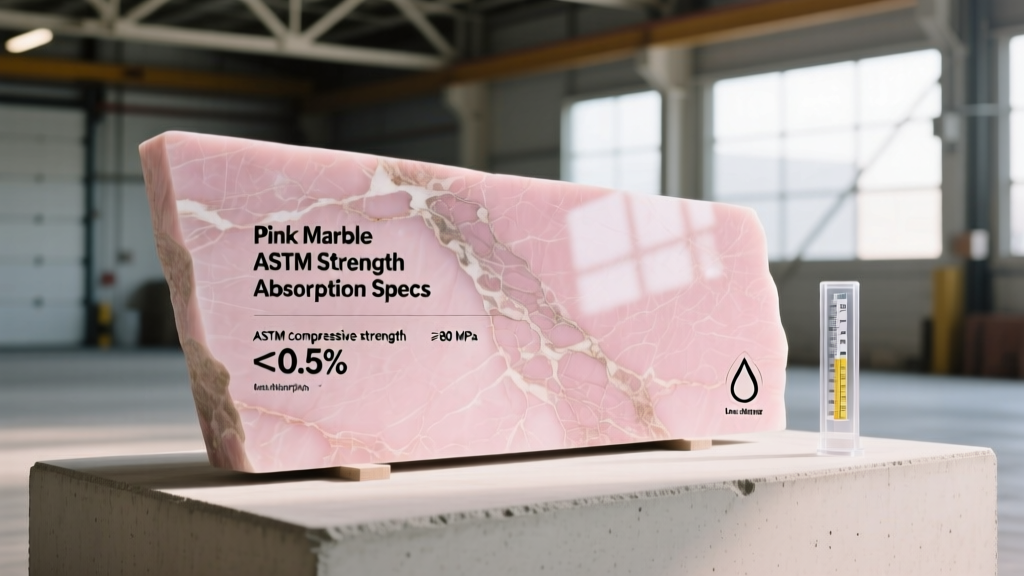
Architectural specification of pink marble requires navigating a complex intersection of geology, commercial nomenclature, and strict ASTM performance thresholds. Unlike monochromatic granites or uniform quartzites, pink marble encompasses a diverse spectrum of calcite and dolomite-rich stones that demand precise engineering data before being approved for structural cladding, heavy-traffic flooring, or wet-area surfacing. This guide details the exact performance ratings, failure modes, and specification frameworks required for integrating pink marble into modern construction projects.
The Geological Reality of Commercial Pink Marble
In the dimension stone industry, the term 'pink marble' is applied to two distinct geological formations, which drastically alters their performance specifications. Understanding this distinction is the first step in writing an accurate project specification.
- True Metamorphic Marble: Varieties such as Rosa Portogallo (Portugal) and Rouge de Rance (France) are genuine marbles formed through the metamorphism of limestone. These stones are primarily composed of calcite or dolomite and are governed by ASTM C503 (Standard Specification for Marble Building Stone).
- Crystalline Limestone (Commercial Marble): The famous Tennessee Pink Marble is geologically an Ordovician crystalline limestone from the Holston Formation. While it takes a high polish and is sold as marble, it must technically be evaluated against ASTM C568 (Limestone) thresholds for certain exterior applications, though it frequently meets or exceeds marble compressive standards.
Specifiers must request the petrographic analysis (ASTM C1721) from the quarry to confirm whether the supplied pink marble is calcitic or dolomitic, as dolomitic varieties offer superior resistance to acid etching—a critical factor for interior surfacing.
Core ASTM Performance Ratings for Pink Marble
The following data table represents the aggregate performance specifications for high-grade structural pink marble, averaged across premium metamorphic and dense crystalline varieties. These values serve as the baseline for approving material submittals.
| Physical Property | ASTM Test Method | Minimum Spec Requirement | Typical Pink Marble Range |
|---|---|---|---|
| Compressive Strength (Dry) | ASTM C170 | 7,500 psi | 13,000 – 19,500 psi |
| Flexural Strength (Dry) | ASTM C880 | 1,000 psi | 1,200 – 1,850 psi |
| Water Absorption | ASTM C97 | 0.20% max | 0.04% – 0.15% |
| Density (Specific Gravity) | ASTM C97 | 165 lbs/ft³ | 168 – 176 lbs/ft³ |
| Abrasion Resistance | ASTM C241 | 10 Ha min | 11 – 16 Ha |
Compressive and Flexural Strength Breakdown
While compressive strength (often exceeding 15,000 psi in dense Tennessee Pink) is more than adequate for load-bearing columns and heavy plinths, flexural strength is the governing metric for exterior cladding and large-format interior wall panels. Pink marble panels subjected to wind loads must possess a minimum flexural strength of 1,000 psi per ASTM C503. If the quarry's test batch shows high variance in flexural strength (a common issue in heavily veined Rosa varieties due to micro-fissures along the veining), specifiers must mandate fiberglass mesh backing or aluminum honeycomb composite reinforcement for panels exceeding 48 inches in height.
Water Absorption and the 0.20% Threshold
Water absorption dictates the stone's viability in freeze-thaw environments and wet interiors. High-quality pink marble typically tests between 0.04% and 0.15%. However, if a specific block tests near the 0.20% maximum threshold, it becomes highly susceptible to moisture migration, which can lead to efflorescence when used in exterior veneer applications over masonry backup.
⚠️ Critical Warning: Iron Oxidation and Rust Spotting
Many pink marbles derive their coloration from trace amounts of iron-bearing minerals like pyrite, limonite, or hematite. When water absorption exceeds 0.10% and the stone is exposed to constant moisture (such as in a shower pan or exterior cladding without proper weep holes), these minerals oxidize. This causes 'rust spotting'—brown halos that bleed through the pink surface. Specification Fix: For wet environments, mandate a maximum water absorption of 0.08% and require a breathable, non-yellowing silane-based impregnating sealer. Never use topical acrylic sealers, which trap moisture and accelerate sub-surface oxidation.
Application-Specific Performance Thresholds
Specifying pink marble requires adjusting the performance criteria based on the specific architectural application. The Natural Stone Institute provides framework guidelines that should be adapted as follows:
Heavy-Traffic Commercial Flooring
For airport terminals, hotel lobbies, or retail corridors, the abrasion resistance (ASTM C241) must be scrutinized. While pink marble averages 12 Ha, heavy foot traffic will eventually wear down a polished finish. Specifiers should mandate a honed or thermally textured finish (minimum 15 Ha) and specify a minimum thickness of 3/4 inch (20mm) for interior floors, transitioning to 1 1/4 inch (30mm) for exterior pavers.
Kitchen and Hospitality Countertops
Calcitic pink marble is highly reactive to acidic substances (citrus, wine, vinegar), resulting in immediate chemical etching that dulls the polish. If pink marble is specified for a commercial bar or kitchen island, the design documents must explicitly state that the client accepts natural patina, or the stone must be treated with an acid-resistant nano-coating (such as a fluoropolymer-based anti-etch treatment) post-fabrication. Alternatively, specify a dolomitic pink marble variant, which etches at a significantly slower rate.
Fabrication and Anchoring Specifications
The physical fabrication of pink marble introduces structural vulnerabilities that must be addressed in the shop drawings.
- Kerfing Limits: When using kerf-and-clip anchoring systems for exterior wall cladding, the kerf slot depth must not exceed 1/3 of the panel thickness. For a standard 30mm panel, the kerf should be 10mm deep, leaving sufficient unkerfed stone to resist shear forces during seismic events or high wind loads.
- Edge Profiling: Pink marble is prone to micro-chipping along sharp mitered edges due to its crystalline structure. Specify a minimum 1/16 inch (1.5mm) chamfer or a bullnose profile on all exposed exterior corners to prevent impact spalling.
- Adhesive Compatibility: Never use standard cementitious thinset or polyester-based adhesives for pink marble installation, as they can cause alkali-silica reactions or yellowing. Mandate 100% solids, high-modulus epoxy adhesives specifically formulated for natural stone, applied over a fully waterproofed and crack-isolated substrate.
Troubleshooting Common Pink Marble Failures
When pink marble installations fail, it is rarely due to the stone's inherent compressive weakness, but rather improper specification regarding its chemical and moisture tolerances. Below is a diagnostic matrix for common field failures.
| Failure Mode | Root Cause | Specification & Remediation Protocol |
|---|---|---|
| Sub-surface Rust Staining | Oxidation of pyrite inclusions due to moisture ingress from unsealed grout joints or substrate. | Specify silane-impregnating sealer. Remediate with a specialized poultice containing a reducing agent (e.g., thioglycolic acid), followed by re-sealing. |
| Panel Bowing (Hysteresis) | Thermal cycling and moisture differentials causing permanent crystalline deformation in thin exterior panels. | Mandate minimum 30mm thickness for exterior cladding. Use aluminum honeycomb backing for panels over 4 sq ft. Install open-drainage ventilated rain screen systems. |
| Alkali Efflorescence | Migration of soluble salts from Portland cement-based setting beds through the stone's capillary network. | Specify non-staining, polymer-modified setting mortars. Ensure substrate is fully cured and separated from the stone via a cleavage membrane. |
| Acid Etching (Dull Spots) | Chemical reaction between calcite matrix and acidic spills (pH < 7) on polished surfaces. | Specify honed finish for high-use areas, or mandate post-fabrication fluoropolymer anti-etch coating. Remediate via professional diamond-pad re-honing. |
Final Specification Directives
Integrating pink marble into a project requires moving beyond aesthetic selection and treating the material as a highly specific engineered component. By mandating rigorous ASTM C503 and C568 testing, enforcing strict water absorption limits to prevent iron oxidation, and specifying compatible epoxy adhesives and anchoring geometries, architects and engineers can ensure that pink marble installations achieve both their intended visual impact and their required structural lifespan. Always require the supplier to provide a minimum of three independent laboratory test reports from the specific quarry block designated for the project prior to final approval.