Stone Veneer Installer Near Me: 2026 Cost & Hiring Guide
Discover the true cost of hiring a stone veneer installer near me in 2026. Breakdown of local labor rates, hidden prep fees, and vetting checklists.

The True Cost of Hiring a Stone Veneer Installer Near Me
When homeowners search for a 'stone veneer installer near me,' they are typically met with vague national averages that fail to reflect local market realities. In 2026, the cost to install manufactured stone veneer (MSV) or natural stone veneer is heavily dictated by regional labor shortages, local masonry union rates, and the specific structural prep required for your home's exterior.
While material costs for MSV range from $4 to $12 per square foot, the labor component is where budgets frequently balloon. A qualified mason does not simply stick stone to a wall; they execute a multi-layer moisture management system that, if done incorrectly, leads to catastrophic wood rot and structural delamination.
2026 Quick Cost Summary: Installed Stone Veneer
- Manufactured Stone Veneer (MSV): $18 – $32 per sq. ft. (Total Installed)
- Natural Stone Veneer: $28 – $55+ per sq. ft. (Total Installed)
- Labor-Only Rate (MSV): $9 – $18 per sq. ft.
- Labor-Only Rate (Natural): $16 – $35 per sq. ft.
- Average Project Size: 300 sq. ft. (e.g., covering a standard 2-car garage face and entryway)
Labor Rate Breakdown: What Local Masons Actually Charge
Local masonry contractors typically price stone veneer installation in one of two ways: by the square foot or by an hourly/day rate. For straightforward, ground-level applications like a wainscot or a single-story fireplace surround, per-square-foot pricing is standard. For complex, multi-story exterior facades requiring extensive scaffolding and custom corner cuts, masons may shift to a time-and-materials (T&M) contract.
Regional Labor Cost Variations
Labor rates fluctuate significantly based on local demand, cost of living, and the density of skilled masons in your zip code. Below is a breakdown of average labor-only costs for MSV installation across major U.S. regions in 2026.
| Region | Labor Cost per Sq. Ft. (MSV) | Hourly Mason Rate | Market Dynamics |
|---|---|---|---|
| Northeast | $14 – $22 | $85 – $130 | High union presence; strict winter weather constraints. |
| Midwest | $10 – $16 | $65 – $95 | Moderate competition; seasonal rush in late summer. |
| South | $9 – $15 | $60 – $90 | Lower baseline costs; high humidity requires strict moisture prep. |
| West Coast | $16 – $25 | $95 – $150 | Seismic building codes require heavier lath and mechanical ties. |
Hidden Costs That Catch Homeowners Off Guard
The quote you receive for 'installation' rarely includes the ancillary work required to make the wall ready for stone. When vetting a stone veneer installer near you, ensure the following line items are explicitly addressed in the contract to avoid mid-project change orders.
1. Scaffolding and Site Access
For any work above 8 feet, OSHA regulations mandate proper scaffolding. Erecting and dismantling scaffolding for a two-story home exterior adds $1,500 to $3,500 to the project. If your property has steep grading or narrow side-yards that prevent standard scaffold setup, expect a premium for specialized staging or boom lifts.
2. Demolition and Surface Stripping
Stone veneer cannot be installed directly over painted brick, vinyl siding, or old stucco. Removing existing cladding costs $2 to $6 per square foot. If the underlying wood sheathing is rotted or compromised by previous water intrusion, plywood replacement will be billed at $65 to $95 per sheet (including labor).
3. The 'Surface Prep' Trap
This is where unlicensed or budget installers cut corners, leading to system failure. Proper prep requires a weather-resistant barrier (WRB), a weep screed, and metal lath. According to guidelines published by the Manufactured Stone Veneer Manufacturers Association (MVMA), a minimum 2.5 lb/sq yd galvanized metal lath must be mechanically fastened to the studs, not just the sheathing. Installers who skip the weep screed or use substandard felt paper will trap moisture, guaranteeing efflorescence and eventual delamination.
Warning: Never allow an installer to apply stone veneer directly to drywall, greenboard, or painted concrete block without a proper scratch coat and lath system. Interior applications still require a cement backer board and metal lath to support the immense weight (up to 15 lbs per sq. ft.).
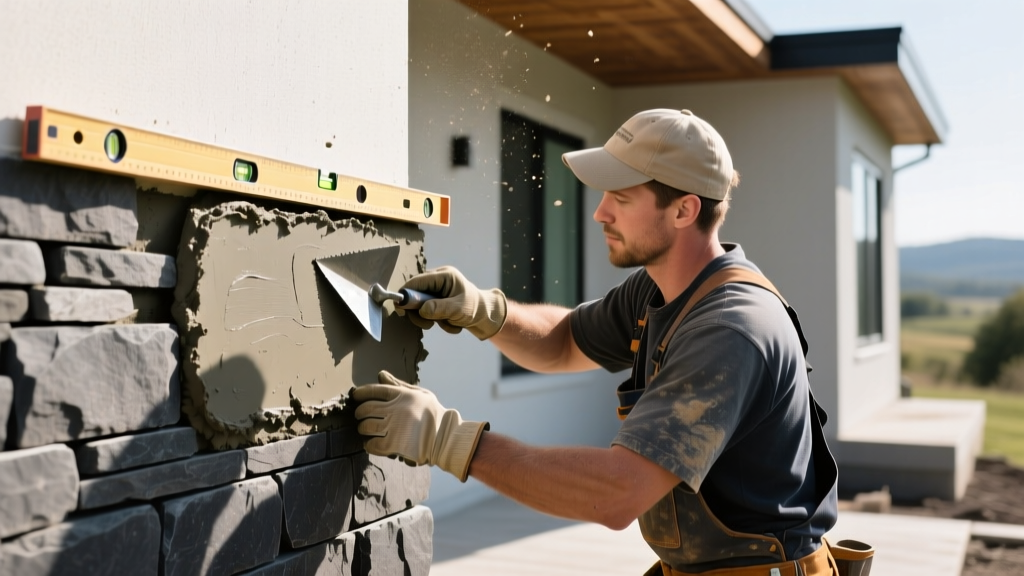
DIY vs. Professional Installation: A Financial Risk Matrix
While YouTube tutorials make stacked stone veneer look like a weekend DIY project, the financial risk of improper installation heavily skews toward hiring a professional. Below is a risk matrix comparing the two approaches.
Professional Installation
- Upfront Cost: High ($18-$32/sq ft)
- Warranty: 20-50 year manufacturer warranty (valid only if certified installer guidelines are followed)
- Moisture Management: Flashed weep screeds, proper WRB lapping, and Type S mortar mixing.
- Failure Risk: Low. Structural loads are calculated; seismic ties used where required.
DIY / Handyman Special
- Upfront Cost: Low (Materials only + $500 tools)
- Warranty: Voided immediately upon self-installation.
- Moisture Management: Often relies on mastic or construction adhesive (a critical failure point for exterior MSV).
- Failure Risk: High. 'Lip-lage' (stones falling off) and trapped moisture rotting the rim joist within 3-5 years.
How to Vet and Select the Right Local Contractor
Finding a 'stone veneer installer near me' is easy; finding one who adheres to OSHA masonry safety standards and ASTM C1670 specifications requires a targeted vetting process. Do not simply hire the general contractor with the lowest bid. Ask these three technical questions during the estimate walk-through:
- 'What specific mortar mix do you use for the scratch coat and the setting bed?'
Correct Answer: Type S mortar or a pre-blended polymer-modified veneer mortar. Type N is too weak for heavy natural stone; mastic/adhesive is strictly for interior, non-wet applications. - 'How do you handle the termination point at the ground or roofline?'
Correct Answer: They must install a corrosion-resistant weep screed at the base, maintaining a minimum 4-inch clearance from the soil grade (or 2 inches from paved surfaces) to prevent capillary water uptake and termite ingress. - 'Will you obtain the local building permit?'
Correct Answer: Yes. Exterior stone veneer adds significant dead load to the wall assembly and alters the drainage plane. Most municipalities require a permit and a final inspection by the local building department, as noted by the National Association of Home Builders (NAHB).
Frequently Asked Questions
How long does it take to install 500 square feet of stone veneer?
For a professional crew of two masons and one laborer, a 500 sq. ft. exterior project typically takes 5 to 8 days. This includes 1 day for demolition and prep, 1 day for lath and scratch coat (plus 24-48 hours of curing time), and 3-4 days for setting the stone and tooling the joints.
Do local installers provide the stone, or do I buy it myself?
Most established masonry contractors prefer to procure the materials through their commercial masonry supply yards. This allows them to apply their contractor discount (often 10-20% off retail) and ensures they are working with batches they trust. If you buy the stone yourself, the installer will not warranty the material against color fading or spalling.
Is it cheaper to install stone veneer in the winter?
While some installers offer a 5-10% off-season discount in late winter, masonry work requires specific temperature conditions. Mortar cannot be applied if temperatures are below 40°F (4°C) without expensive cold-weather enclosures and accelerating admixtures, which often negates any labor discount and increases the risk of weak, crumbly joints.
Written by
Elena RodriguezElena Rodriguez is a civil engineer and technical writer specializing in concrete technology, masonry systems, and ASTM/ACI compliance. She earned her B.S. in Civil Engineering from Texas A&M University and spent a decade at a materials testing laboratory, performing over 2,000 concrete compressive strength tests and masonry prism evaluations. Elena is an ACI-certified Field Testing Technician (Grade I) and a member of ASTM Committee C12 on Natural Building Stone. She currently consults on forensic engineering cases involving concrete failures and moisture intrusion. Based in San Antonio, TX, Elena is a proud member of the Society of Women Engineers (SWE) and coaches her daughter's FIRST Robotics team.
More from Elena Rodriguez
View all
Walls & Panels
Cost Analysis: Light Gauge Steel Framing Advantages and Disadvantages
Evaluate light gauge steel framing advantages and disadvantages through a strict cost analysis lens, comparing material, labor, and lifecycle expenses.
Aug 4, 2026

Walls & Panels
Gypsum Board Types: Exact Specifications, Thickness & Dimensions
Compare standard, Type X, and moisture-resistant gypsum board types. Get exact specifications, thicknesses, dimensions, and ASTM standards for your project.
Aug 4, 2026

Fire Resistance
Best Fire-Resistant Outdoor Decking Materials: 2026 Buyer Guide
Discover the best fire-resistant outdoor decking materials for 2026. Compare Class A PVC, aluminum, and hardwood options for WUI compliance and safety.
Aug 4, 2026