Stone Veneer Pool Wall Maintenance and Sealing Guide
Protect your backyard oasis. Learn expert maintenance, cleaning, and sealing techniques to prevent efflorescence and chemical damage on stone veneer pool walls.

The Unique Microclimate of Poolside Stone Veneer
A stone veneer pool wall exists in one of the most aggressive microclimates in residential construction. Unlike exterior facade walls that experience predictable wet-dry cycles from rainfall, poolside masonry is subjected to continuous chemical splashing, high UV radiation, saltwater crystallization, and fluctuating hydrostatic pressure. The mortar joints and the porous matrix of natural or manufactured stone act as a wick, drawing chlorinated or salt-laden water upward through capillary action. Without a rigorous, scientifically sound maintenance protocol, this constant moisture migration leads to rapid aesthetic degradation and structural spalling.
Identifying Common Poolside Veneer Failures
Before applying any treatments, you must accurately diagnose the type of deterioration occurring on your stone veneer pool wall. Misdiagnosis often leads to the application of sealers that trap moisture, accelerating the very damage you are trying to prevent.
Efflorescence vs. Subflorescence
Efflorescence is the white, powdery deposit of water-soluble salts on the surface of the stone. It is primarily a cosmetic issue caused by water evaporating and leaving salts behind. Subflorescence, however, occurs when these salts crystallize inside the pores of the stone veneer. As the salt crystals grow, they exert immense internal pressure (up to 3,000 psi), causing the face of the stone to pop off or spall. Saltwater pool systems are notorious for driving subflorescence because the sodium chloride solution is continuously wicked into the unsealed lower courses of the veneer.
Mortar Joint Degradation
Pool chemicals, particularly chlorine and bromine, attack the calcium hydroxide in Portland cement-based mortars. Over time, this chemical erosion reduces the mortar to a crumbly sand, compromising the lateral stability of the veneer. If your mortar joints recede more than 1/8 inch from the stone face, repointing with a polymer-modified, sulfate-resistant mortar is required before any sealing can occur.
The Approved Cleaning Protocol
The National Park Service guidelines on masonry cleaning emphasize the dangers of abrasive and harsh chemical cleaning. This is doubly true for pool environments where chemical runoff can alter the pool's water chemistry and damage filtration systems.
Forbidden Cleaning Agents
- Muriatic Acid (Hydrochloric Acid): Will instantly etch calcium-based stones (limestone, travertine, marble) and severely degrade mortar joints.
- Sodium Hypochlorite (Bleach): Leaves behind salt residues that drive subflorescence and will kill surrounding landscaping.
- Trisodium Phosphate (TSP): Can leave a filmy residue that interferes with the adhesion of penetrating sealers.
Step-by-Step Cleaning Procedure
- Pre-Wet the Surrounds: Saturate the pool deck and adjacent landscaping with fresh water to prevent chemical absorption and runoff damage.
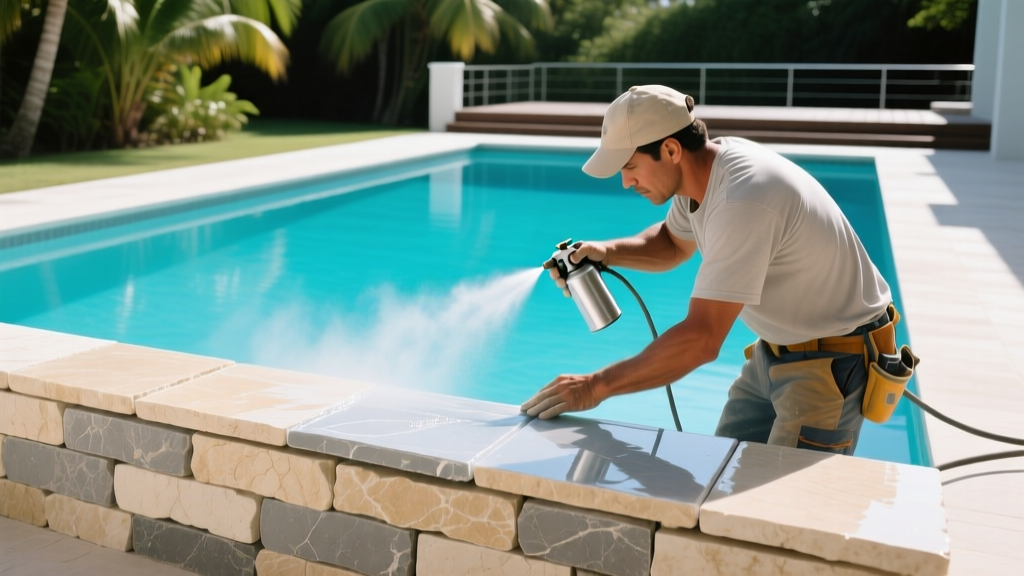
- Apply Alkaline Cleaner: Use a heavy-duty, non-acidic masonry cleaner (such as PROSOCO Sure Klean Restoration Cleaner) diluted to manufacturer specifications. Apply with a low-pressure pump sprayer.
- Dwell and Agitate: Allow a 5 to 10-minute dwell time. Agitate stubborn algae or efflorescence with a stiff nylon bristle brush. Never use wire brushes, which leave behind iron particles that will rust and stain the stone.
- Low-Pressure Rinse: Rinse using a pressure washer equipped with a 40-degree fan tip. Keep the pressure below 800 PSI and maintain a 12-inch standoff distance to avoid scouring the stone's natural patina.
- Neutralize and Dry: Allow the stone veneer pool wall to dry completely for a minimum of 48 to 72 hours. Moisture meters should read below 15% before proceeding to the sealing phase.
Sealer Matrix: Choosing the Right Protection
The Natural Stone Institute strongly advises against using film-forming sealers in exterior, wet environments. Film-forming sealers trap moisture vapor inside the masonry, leading to blistering, peeling, and accelerated freeze-thaw damage. You must use a breathable, penetrating sealer.
| Sealer Type | Mechanism | Vapor Permeability | Poolside Verdict |
|---|---|---|---|
| Silane/Siloxane | Penetrates deeply, reacts with silica to form a hydrophobic resin within the pores. | High (Breathable) | EXCELLENT. The only recommended choice for pool walls. Repels liquid water while allowing vapor to escape. |
| Acrylic (Film-Forming) | Sits on the surface, creating a physical plastic barrier. | Low (Traps Moisture) | FAIL. Will turn white, peel, and trap subflorescence-causing salts inside the stone. |
| Polyurethane | Forms a thick, durable surface coating. | Very Low | FAIL. Highly susceptible to UV yellowing and moisture entrapment in splash zones. |
For optimal results, apply a water-based silane/siloxane sealer using a low-pressure sprayer, back-rolling with a 3/8-inch nap roller to ensure even distribution and prevent pooling in the mortar joints. Two coats applied wet-on-wet (within 5 minutes of each other) ensures deep penetration without forming a surface film.
Seasonal Care and Winterization
In climates that experience freeze-thaw cycles, winterizing your stone veneer pool wall is non-negotiable. When water trapped in the stone's pores freezes, it expands by 9%, generating enough force to fracture the stone face.
According to the Sealant, Waterproofing & Restoration Institute (SWRI), the primary cause of winter masonry failure is not the cold itself, but the degree of saturation prior to the freeze. A properly sealed stone veneer that is kept dry will survive extreme cold; an unsealed, saturated veneer will spall in a single winter.
The Winterization Checklist
- Lower the Water Level: Drop the pool water level below the lowest course of the stone veneer to prevent ice damming against the masonry.
- Clear Weep Holes: Ensure all weep holes at the base of the veneer wall are clear of debris, allowing trapped moisture to drain before the first freeze.
- Inspect Flashing: Check the coping and capstone flashing. Any gaps in the sealant between the pool coping and the stone veneer will allow snowmelt to infiltrate the wall cavity.
- Avoid De-icing Salts: Never use calcium chloride or rock salt on the pool deck adjacent to the veneer. Splashing salt-laden meltwater will wick into the stone and cause severe springtime spalling.
Troubleshooting Decision Tree
Symptom-Based Action Plan
- Symptom: White, powdery residue on the surface.
- Action: Dry brush with a nylon brush. If persistent, apply a specialized efflorescence remover (e.g., PROSOCO Vana Trol). Do not use water to wash it off, as water re-dissolves the salts and drives them back into the stone.
- Symptom: Green or black slimy growth in mortar joints.
- Action: This is algae, not efflorescence. Treat with a quaternary ammonium-based algaecide. Avoid chlorine bleach, which leaves salt behind.
- Symptom: Stone face is flaking or peeling off in thin layers.
- Action: This is subflorescence/spalling. Stop all cleaning. The stone has been compromised by trapped salts. You must carefully remove the affected stones, clean the substrate, and reinstall using a Portland cement-free, polymer-modified thin-set mortar.
- Symptom: Water is no longer beading on the surface.
- Action: The silane/siloxane sealer has degraded (typically after 3 to 5 years in a pool environment). Clean the wall, allow to dry, and apply a fresh coat of penetrating sealer.
Maintaining a stone veneer pool wall requires shifting from reactive cleaning to proactive moisture management. By strictly avoiding acidic cleaners, utilizing breathable silane/siloxane sealers, and managing the unique chemical splash zone, you can preserve the structural integrity and aesthetic appeal of your masonry for decades.
Written by
Priya KapoorPriya Kapoor is a real estate market analyst and construction economics researcher with expertise in housing affordability, development feasibility, and infrastructure investment. She holds a Master of Regional Planning from Cornell University and previously worked as a senior analyst at CBRE's Investment Properties group, where she modeled returns for $4B in mixed-use development pipelines. Priya now runs an independent research practice advising developers, municipalities, and REITs on construction cost forecasting and market timing. She publishes the quarterly "BuildMat Market Pulse" report tracking material price indices across 12 commodity categories. Based in Austin, TX, Priya serves on the board of Habitat for Humanity Austin and is a marathon runner.
More from Priya Kapoor
View all
Construction Cost
Cost to Build a 1600 Sq Ft Home in 2026: Full Breakdown
Accurate 2026 cost to build a 1600 sq ft home—material, labor, and regional pricing breakdowns included. Plan your budget with real-time estimates.
Aug 11, 2026

Wood & Lumber
Name the Types of Wood for Pressure Treatment and Preservation
Learn how to name the types of wood best suited for pressure treatment. Compare species treatability, chemical retention levels, and 2026 preservation costs.
Aug 4, 2026

Stone & Masonry
Stone Veneer Suppliers Lindenhurst: 2026 Cost Analysis
Analyze 2026 stone veneer costs in Lindenhurst, NY. Compare local supplier pricing, delivery fees, and Suffolk County installation labor rates.
Aug 4, 2026