Cost to Build a House Versus Buying: A 2026 Value Analysis
Compare the true cost to build a house versus buying an existing home. We break down material costs, site prep, building science, and long-term value.
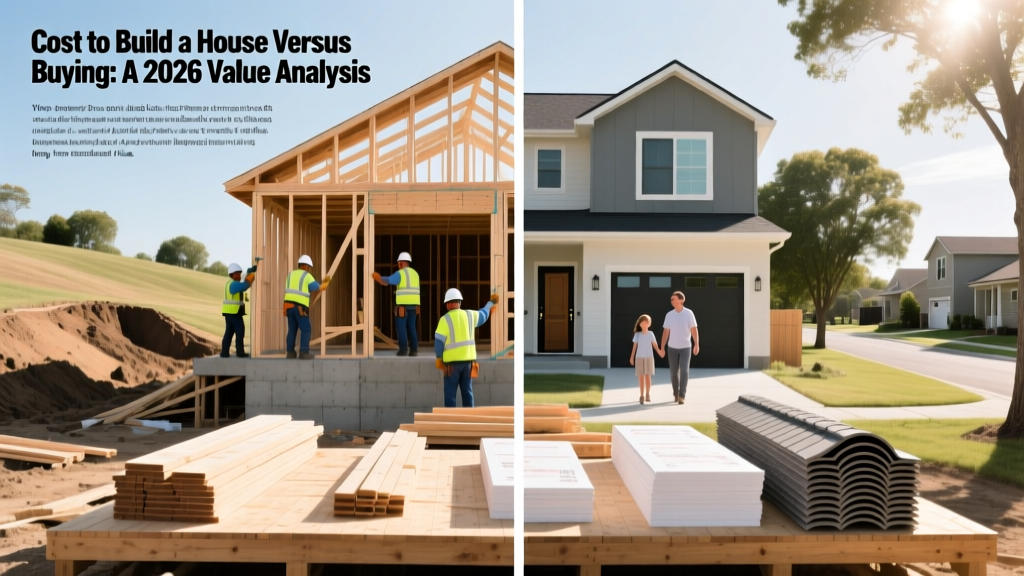
Evaluating the cost to build a house versus buying an existing property requires moving beyond the listing price and basic construction estimates. The financial reality hinges on site preparation, municipal impact fees, long-term maintenance capital expenditures (CapEx), and the underlying building science of the material envelope. While purchasing an existing home offers immediate occupancy and established neighborhood infrastructure, new construction provides control over material quality, energy efficiency, and modern structural warranties.
The Quick Verdict
On a pure price-per-square-foot basis, buying an existing home is typically 10% to 15% cheaper than building a comparable custom home. However, when factoring in the immediate CapEx required to update aging mechanicals and the ongoing utility premiums of legacy building materials, the 10-year total cost of ownership (TCO) gap narrows significantly, often favoring new construction in regions with strict 2024/2027 IECC energy codes.
The Hard Numbers: Breaking Down the Cost to Build a House Versus Buying
According to recent data tracked by the U.S. Census Bureau's New Residential Construction reports and industry analysis from the National Association of Home Builders (NAHB), the baseline costs diverge sharply based on soft costs and land acquisition. Below is a comparative breakdown for a standard 2,200-square-foot, 3-bedroom home in a mid-tier U.S. market.
| Cost Category | Buying Existing (Built ~2005) | Building New (Custom 2026) |
|---|---|---|
| Base Purchase / Hard Construction | $415,000 ($188/sq ft) | $374,000 ($170/sq ft) |
| Land Acquisition | Included | $85,000 - $150,000 |
| Soft Costs (Permits, Architect, Eng.) | $0 | $25,000 - $40,000 |
| Site Prep & Utility Hookups | $0 | $15,000 - $30,000 |
| Closing Costs / Agent Fees | $12,000 (2-3%) | $4,000 (Title/Legal) |
| Total Initial Capital Outlay | ~$427,000 | ~$503,000 - $609,000 |
Hidden Costs in New Construction: The Site and Soft Cost Gotchas
When analyzing the cost to build a house versus buying, prospective builders frequently underestimate site development. Raw land is rarely build-ready. You must budget for specific, non-negotiable site preparations:
- Geotechnical Soil Testing ($1,500 - $3,500): Required to determine load-bearing capacity. Expansive clay soils may require engineered pier-and-beam foundations or soil stabilization, adding $10,000+ to the foundation budget.
- Municipal Impact Fees ($5,000 - $20,000): Local governments charge these one-time fees to offset the strain a new home places on public infrastructure (schools, roads, water treatment). These vary wildly by zip code.
- Utility Taps and Trenching ($4,000 - $12,000): Running municipal water, sewer, and electric from the street to the homesite. If sewer is unavailable, a modern aerobic septic system will cost $15,000 to $25,000.
The Material Envelope: Legacy Construction vs. Modern Building Science
The most critical divergence between buying a 20-year-old home and building new lies in the material envelope. Existing homes were built under older International Residential Code (IRC) iterations, utilizing materials that are now considered baseline or obsolete. New construction allows you to specify advanced building science materials that drastically alter long-term value.
Sheathing and Moisture Management
A home built in 2005 likely utilizes standard oriented strand board (OSB) wrapped in housewrap (like Tyvek). While effective when installed perfectly, standard OSB is highly susceptible to edge swelling and rot if moisture breaches the cladding. In 2026, new builds frequently specify integrated water-resistive barrier (WRB) panels, such as the Huber ZIP System. This engineered wood sheathing features a factory-applied weather-resistant coating, eliminating the need for traditional housewrap and providing superior structural shear strength and moisture protection.
Insulation and Air Sealing
Legacy homes often rely on fiberglass batt insulation (R-13 to R-19 in walls). The flaw is not the material's R-value, but the installation; batts are easily compressed and leave gaps at electrical boxes and top plates, leading to massive thermal bridging and air infiltration. Modern custom builds utilize closed-cell spray polyurethane foam (ccSPF) or dense-pack cellulose combined with exterior continuous rigid foam insulation (like polyisocyanurate). This creates a near-hermetic thermal envelope, virtually eliminating drafts and preventing condensation within the wall cavity.
Fenestration (Windows and Doors)
Existing homes typically feature dual-pane, vinyl-framed windows with a U-factor of 0.30 to 0.35. New construction in demanding climate zones now specifies triple-pane, fiberglass-framed windows with argon or krypton gas fills and Low-E3 or Low-E4 coatings, achieving U-factors of 0.15 to 0.20. This material upgrade alone reduces heating and cooling loads by 15% to 20%.
Maintenance CapEx and Energy ROI Over 10 Years
To accurately compare the cost to build a house versus buying, you must project the 10-year maintenance CapEx. A 20-year-old existing home is entering the failure window for its primary mechanicals and exterior materials.
The 10-Year Maintenance Liability
If you buy an existing home, you should immediately escrow funds for the following inevitable replacements:
- HVAC System: $8,000 - $14,000 (Standard 16 SEER split system)
- Architectural Asphalt Roof: $12,000 - $18,000 (2,200 sq ft footprint)
- Water Heater: $2,500 - $4,000 (50-gallon hybrid heat pump model)
- Exterior Paint/Siding Repair: $4,000 - $8,000
Conversely, a new build comes with a 1-year workmanship warranty, a 2-year systems warranty, and a 10-year structural warranty (often backed by third-party insurers like 2-10 HBW), effectively reducing your Year 1-10 CapEx to near zero.
Energy Efficiency and the HERS Index
The Department of Energy's Home Energy Score program and the RESNET HERS Index provide standardized metrics for energy performance. A typical existing home built in the early 2000s scores a HERS rating of 100 to 120. A 2026 new build, constructed to the latest IECC standards with advanced air sealing, routinely scores between 45 and 55 (and can reach net-zero with solar integration). This 60-point delta translates to an average utility savings of $1,200 to $1,800 annually, yielding a 10-year savings of $12,000 to $18,000.
Financing Realities: Construction Loans vs. Traditional Mortgages
The capital structure required to fund the project heavily influences the overall cost. Buying an existing home utilizes a standard 30-year fixed or adjustable-rate mortgage, requiring as little as 3% to 5% down for qualified buyers.
Building requires a Construction-to-Permanent (C2P) loan. These are inherently more expensive and complex:
- Higher Down Payment: Lenders typically require 20% to 25% down because the collateral (the house) does not yet exist.
- Draw Schedule Inspections: Funds are not disbursed upfront. The builder submits draw requests at specific milestones (e.g., foundation poured, dried-in, drywall complete), requiring bank inspections and adding administrative friction.
- Interest Reserves: During the 9- to 12-month build phase, you pay interest-only on the drawn balance. Buyers must budget $15,000 to $25,000 just to cover the interest payments during construction before the loan converts to a standard mortgage.
Decision Matrix: When to Build vs. When to Buy
Use this framework to determine which path aligns with your financial and lifestyle parameters.
| Choose to BUY an Existing Home If... | Choose to BUILD a New Home If... |
|---|---|
| You need to relocate within 30 to 60 days. | You have a 12- to 18-month runway and can tolerate construction delays. |
| You have less than 20% saved for a down payment. | You have 20%+ down and cash reserves for site prep overages. |
| You prioritize mature landscaping and established neighborhood amenities. | You prioritize modern building science, smart-home wiring, and custom layouts. |
| You are comfortable managing DIY repairs and aging mechanicals. | You want a 10-year structural warranty and zero immediate CapEx. |
Ultimately, the cost to build a house versus buying is not just a comparison of initial outlays. It is a choice between accepting the compromised material envelope and deferred maintenance of legacy construction, or paying a premium upfront for site development and modern building science to secure a lower total cost of ownership over the next decade.
Written by
James ThorntonJames Thornton is a construction industry veteran with 25 years of hands-on experience in wood framing, lumber grading, and residential building codes. He started as a framing carpenter in rural Oregon, earned his ICC Residential Building Inspector certification, and eventually became a senior plan reviewer for the City of Portland Bureau of Development Services. James holds a B.S. in Wood Science & Technology from Oregon State University and is a certified lumber grader through the West Coast Lumber Inspection Bureau (WCLIB). He has inspected over 3,000 residential construction sites and authored the city's internal guide on advanced framing techniques (2x6 at 24" O.C.). James lives in Bend, OR, where he builds custom timber-frame cabins and competes in lumberjack sports.
More from James Thornton
View all
Insulation
Best Home Insulation Materials: Complete 2026 Guide
Compare top home insulation materials for 2026. Find R-values, installed costs per square foot, and best uses for fiberglass, spray foam, and mineral wool.
Aug 4, 2026

Sustainable Building
Certify Your Green Building Material for LEED and WELL
Step-by-step guide to certifying a green building material for LEED v5 and WELL v2. Master EPDs, HPDs, and VOC limits for 2026 project specifications.
Aug 4, 2026

Stone & Masonry
Veneer Stacked Stone Panels: Interior Design & Style Showcase
Discover how veneer stacked stone panels transform interiors. Explore modern design profiles, material pairings, and technical installation specs.
Aug 4, 2026