Cost to Build AR-15 vs Buy Pre-Built: 2026 Material Guide
Compare the cost to build AR-15 vs buy pre-built in 2026. We analyze receiver alloys, barrel steels, and exact component pricing to guide your decision.

The Metallurgy Divide: Forged Alloys and Barrel Steels
The decision to build or buy an AR-15 platform is fundamentally a question of material science and manufacturing economies. In 2026, the mass-market firearm industry has optimized CNC machining to a point where entry-level pre-built rifles often undercut the cost of sourcing individual components. However, building from scratch remains the only method to guarantee specific metallurgical standards, particularly regarding receiver alloys and barrel steels.
The lower receiver, the serialized core of the rifle, is predominantly manufactured from either 6061-T6 or 7075-T6 aluminum. 7075-T6, an alloy containing zinc and copper, boasts a tensile strength of roughly 83,000 psi. In contrast, 6061-T6, which is easier to machine and often used in billet lowers or budget cast receivers, yields approximately 45,000 psi. While 6061 is sufficient for standard semi-automatic fire, 7075-T6 forged lowers offer superior resistance to the shear forces generated at the takedown pins and buffer tube threads during sustained use.
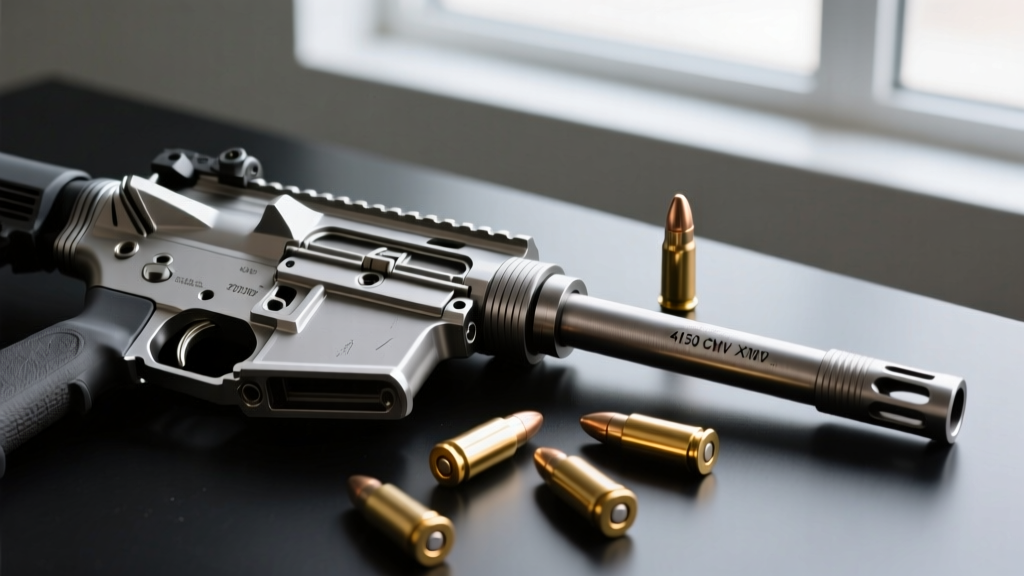
Material Insight: Barrel steel selection dictates the thermal lifecycle of your upper assembly. 4150 Chrome Moly Vanadium (CMV) steel, treated with a QPQ nitride finish, withstands the extreme heat and pressure of 5.56x45mm NATO cartridges far better than 416 Stainless Steel, which prioritizes intrinsic mechanical accuracy but degrades rapidly under rapid-fire thermal stress.
2026 Component Cost Matrix: The Custom Build
Building a mid-tier AR-15 requires sourcing components that meet military specification (Mil-Spec) or commercial equivalent standards. The following matrix outlines the 2026 pricing for high-quality, material-verified components. This build avoids ultra-budget parts that compromise on magnetic particle inspection (MPI) and high-pressure testing (HPT).
| Component | Material / Specification | 2026 Price Range |
|---|---|---|
| Stripped Lower Receiver | 7075-T6 Forged Aluminum (Hardcoat Anodized) | $110 - $140 |
| Lower Parts Kit (LPK) | Mil-Spec Steel/Polymer (Upgraded Trigger: +$100) | $70 - $180 |
| Buffer Tube Assembly | 7075-T6 Aluminum, H2 Buffer, Mil-Spec Spring | $80 - $120 |
| Stripped Upper Receiver | 7075-T6 Forged Aluminum, M4 Feed Ramps | $130 - $180 |
| Barrel (16-inch) | 4150 CMV Steel, Nitride, Mid-Length Gas | $170 - $240 |
| Bolt Carrier Group (BCG) | Carpenter 158 Bolt, 8620 Carrier, MPI/HPT | $140 - $190 |
| Handguard (Free-Float) | 6061-T6 Aluminum, M-LOK Interface | $160 - $250 |
| Gas System & Hardware | Stainless Gas Block, Melonited Tube, Charging Handle | $60 - $100 |
| Total Estimated Build Cost | Excluding Optic and Sights | $920 - $1,400 |
The Pre-Built Market: Economies of Scale
When comparing the cost to build AR-15 vs buy pre-built, manufacturers leverage bulk material purchasing and automated assembly lines to suppress costs. A large-scale manufacturer buying 7075-T6 aluminum forgings by the tens of thousands pays a fraction of the retail price per unit.
Entry-Level Pre-Builts ($600 - $850)
Rifles like the Ruger AR-556 or Smith & Wesson M&P15 Sport III dominate this tier. To hit these price points, manufacturers utilize 6061-T6 aluminum for lowers, M4 profile barrels (which suffer from harmonic inconsistencies), and carbine-length gas systems on 16-inch barrels. The carbine-length system increases bolt carrier velocity, accelerating wear on the cam pin and bolt lugs.
Mid-Tier Pre-Builts ($1,200 - $1,600)
Models from Bravo Company Manufacturing (BCM) or Daniel Defense utilize 7075-T6 forgings, 4150 CMV barrels, and properly tuned mid-length gas systems. At this tier, the cost to buy pre-built is often lower than sourcing the exact same components individually, making custom building purely an exercise in aesthetic or ergonomic customization rather than financial savings.
Hidden Tooling and Assembly Costs
First-time builders frequently overlook the capital expenditure required for proper assembly tools. Improper torque on the barrel nut or castle nut can lead to catastrophic failure or loss of zero. You must factor in the following tooling costs if you do not already own them:
- Armorers Wrench (Combo): $45 - $70 (Required for barrel nuts and castle nuts)
- Upper Receiver Vise Block: $30 - $60 (Prevents indexing pin shear)
- Headspace Gauges (Go/No-Go): $60 - $90 (Critical for verifying 5.56 NATO chamber tolerances)
- Torque Wrench (Inch-Pounds): $80 - $150 (Barrel nuts require 35-80 ft-lbs depending on the handguard system)
- AeroShell Grease 33MS: $15 (Molybdenum disulfide grease required for barrel nut threads to prevent galvanic corrosion between steel and aluminum)
Adding $225 to $385 in tooling to your first build drastically alters the break-even analysis compared to buying a pre-assembled rifle off the shelf.
Regulatory Considerations for 2026
When sourcing materials, builders must navigate the regulatory landscape. Following the ATF's Final Rule on the Definition of "Frame or Receiver," the legal landscape surrounding 80% lower receivers has shifted significantly. According to the ATF's published guidelines, partially completed receivers that can be readily completed to function as a firearm are now regulated similarly to serialized firearms when sold with jigs or critical tooling. For most builders in 2026, purchasing a standard stripped, serialized 7075-T6 lower receiver from a licensed FFL dealer remains the most legally straightforward and cost-effective path, avoiding the premium pricing and legal ambiguities of polymer 80% blanks.
The Decision Framework: Build or Buy?
When to Buy Pre-Built
If your primary objective is acquiring a reliable, entry-level defensive or sporting rifle on a strict budget, buy pre-built. The economies of scale allow manufacturers to offer a complete, test-fired, and warrantied rifle with 6061-T6 receivers and standard 4140 steel barrels for under $750. Replicating this price point with individual parts, shipping fees, and transfer taxes is mathematically impossible in the current market.
When to Build from Scratch
You should build if you require specific material optimizations that the mass market ignores. For example, if you need a 16-inch barrel with a mid-length gas system (to reduce recoil impulse and bolt wear) paired with a lightweight 6061-T6 free-float handguard and a specific two-stage trigger, building is mandatory. Furthermore, building guarantees that critical safety components, like the bolt carrier group, have undergone independent MPI and HPT testing, a quality control step that is frequently omitted in sub-$800 pre-built rifles to maintain profit margins. For deeper technical specifications on chamber pressures and material tolerances, refer to the SAAMI ANSI standards for 5.56mm and .223 Remington cartridges.
Written by
Elena RodriguezElena Rodriguez is a civil engineer and technical writer specializing in concrete technology, masonry systems, and ASTM/ACI compliance. She earned her B.S. in Civil Engineering from Texas A&M University and spent a decade at a materials testing laboratory, performing over 2,000 concrete compressive strength tests and masonry prism evaluations. Elena is an ACI-certified Field Testing Technician (Grade I) and a member of ASTM Committee C12 on Natural Building Stone. She currently consults on forensic engineering cases involving concrete failures and moisture intrusion. Based in San Antonio, TX, Elena is a proud member of the Society of Women Engineers (SWE) and coaches her daughter's FIRST Robotics team.
More from Elena Rodriguez
View all
Walls & Panels
Cost Analysis: Light Gauge Steel Framing Advantages and Disadvantages
Evaluate light gauge steel framing advantages and disadvantages through a strict cost analysis lens, comparing material, labor, and lifecycle expenses.
Aug 4, 2026

Walls & Panels
Gypsum Board Types: Exact Specifications, Thickness & Dimensions
Compare standard, Type X, and moisture-resistant gypsum board types. Get exact specifications, thicknesses, dimensions, and ASTM standards for your project.
Aug 4, 2026

Fire Resistance
Best Fire-Resistant Outdoor Decking Materials: 2026 Buyer Guide
Discover the best fire-resistant outdoor decking materials for 2026. Compare Class A PVC, aluminum, and hardwood options for WUI compliance and safety.
Aug 4, 2026