How to Install 24x24 Concrete Pavers: Base Prep and Laying Guide
Learn the exact base preparation, sand screeding, and laying techniques required to install heavy 24x24 concrete pavers without cracking or settling.
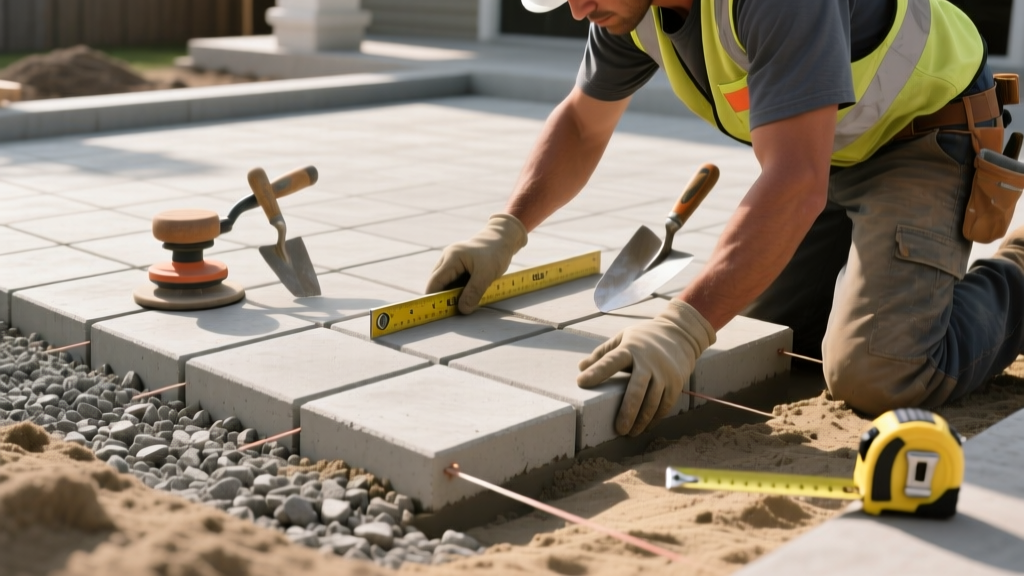
Large-format 24x24 concrete pavers deliver a seamless, modern aesthetic for patios, pool decks, and commercial plazas. However, their substantial size introduces unique structural and logistical challenges. A standard 24-inch by 24-inch paver with a 2 3/8-inch thickness weighs between 85 and 110 pounds. This mass means that point-load vulnerabilities, differential settlement, and subgrade failures are magnified compared to traditional 4x8 or 6x6 units. Proper installation requires strict adherence to compaction densities, precise bedding tolerances, and specialized handling equipment.
The Engineering Reality of Large-Format Pavers
Manufactured under ASTM C936 standards for solid concrete interlocking paving units, 24x24 pavers possess high compressive strength (typically exceeding 8,000 psi). Despite this strength, their large surface area makes them susceptible to rocking if the bedding layer is uneven. Unlike smaller pavers that can bridge minor subgrade depressions through interlock friction, a 24x24 unit will pivot on its center if the base lacks uniform support, leading to edge spalling and joint sand loss. The installation strategy must prioritize absolute planar uniformity over the entire project footprint.
Subgrade Excavation and the 95% Compaction Rule
The longevity of a large-format paver installation is dictated entirely by the subgrade and base aggregate. For pedestrian and light vehicular applications, a 6-inch to 8-inch base of crushed angular aggregate (such as Class II road base or 3/4-inch minus crushed stone) is mandatory.
Calculating Exact Excavation Depth
To achieve the correct final elevation, calculate your excavation depth using the following formula:
- Paver Thickness: 2.375 inches (standard for 24x24 units)
- Bedding Sand: 1.0 inch (uncompacted)
- Base Aggregate: 6.0 to 8.0 inches (compacted)
- Total Excavation Depth: 9.375 to 11.375 inches below the desired final finish grade.
Compact the native soil subgrade first, followed by the base aggregate in 2-inch to 4-inch lifts. Use a vibratory plate compactor delivering a minimum of 5,000 lbf of centrifugal force. According to NCMA Tech Spec 4, base materials must achieve a minimum 95% Standard Proctor density (ASTM D698) to prevent the heavy pavers from driving the base downward under load.
Bedding Sand Selection and Screeding Precision
Never use masonry sand or play sand for the bedding layer. These materials contain too many fine particles, which trap water and lead to frost heave or washouts. You must use coarse, washed concrete sand conforming to ASTM C33 specifications. The sand should be screeded to exactly 1 inch thick using rigid steel or aluminum screed rails. Do not over-screed or trowel the bedding sand, as this brings fines to the surface and creates a slippery, unstable plane for the heavy pavers.
| Material Layer | Specification | Thickness (Uncompacted) | Thickness (Compacted) |
|---|---|---|---|
| Subgrade (Native Soil) | Undisturbed or 95% Proctor | N/A | N/A |
| Base Aggregate | 3/4" Minus Crushed Stone | 8.0 inches | 6.0 - 7.0 inches |
| Bedding Sand | ASTM C33 Coarse Washed | 1.25 inches | 1.0 inch |
| Paver Unit | ASTM C936 Concrete | 2.375 inches | 2.375 inches |
Laying Techniques: Managing 100-Pound Units
Manual installation of 24x24 pavers by a single person is highly discouraged due to the risk of lower back injury and the high probability of chipping the paver edges during placement. For professional results, utilize a mechanical vacuum lifter (such as a Woods Power Grip or a portable battery-operated paver lifter) or a two-person manual paver carrying tool with padded clamps.
When lowering a 24x24 paver onto the bedding sand, drop it straight down. Do not slide it into place. Sliding displaces the screeded sand, creating a void beneath the adjacent paver and a high spot under the current one. Once the compactor runs over this area, the uneven support will cause the paver to crack diagonally under point loads.
Maintain a consistent joint width of 1/16-inch to 1/8-inch. Many modern 24x24 pavers feature built-in spacer bars or lugs on the sides. If your selected paver lacks these, use physical 1/8-inch plastic spacer tabs during installation, removing them just before sanding the joints to ensure uniform spacing across the entire grid.
Cutting 24x24 Pavers: Tool Requirements
Standard 10-inch masonry wet saws cannot cut a 24-inch paver in a single pass; the blade diameter lacks the depth and reach to clear the center of the unit. Attempting to flip the paver and cut from both sides often results in misaligned cuts and jagged edges. Rent or purchase a 14-inch or 16-inch bridge wet saw equipped with a continuous-rim diamond blade designed specifically for hard concrete. For curved cuts or notches, use a 9-inch angle grinder with a diamond masonry blade to score the top and bottom, then snap the waste piece with a heavy-duty masonry block splitter.
Edge Restraint and Polymeric Jointing
Because 24x24 pavers have fewer joints per square foot than smaller units, the lateral interlock is inherently weaker. Robust edge restraint is non-negotiable. Install a rigid, spike-anchored polyethylene edge restraint (such as PermaEdge) or pour a concrete curb directly against the perimeter pavers. Follow the guidelines outlined in NCMA Tech Spec 9 for edge restraint placement, ensuring spikes are driven into the base aggregate, not just the bedding sand.
For jointing, use a high-quality polymeric sand (e.g., Alliance Gator Maxx G2 or Techniseal Polymeric Sand). Sweep the sand into the 1/8-inch joints, vibrate the entire surface with a plate compactor fitted with a urethane protective pad to prevent scarring the paver faces, and then mist the surface with water to activate the polymers. The urethane pad is critical; running a bare steel or hard plastic compactor plate over large-format pavers will permanently scar and dull the finish.
2026 Cost Breakdown and Labor Realities
Large-format pavers command a premium not just in material costs, but in labor and equipment. The table below outlines current average costs for a professional 24x24 concrete paver installation.
| Cost Category | Estimated Range (Per Sq. Ft.) | Notes |
|---|---|---|
| 24x24 Paver Materials | $6.50 - $11.00 | Varies by finish (smooth vs. textured) and color. |
| Base & Bedding Materials | $2.00 - $3.50 | Includes crushed stone, ASTM C33 sand, and geotextile. |
| Edge Restraint & Poly Sand | $1.50 - $2.50 | High-end polymeric sand and heavy-duty restraints. |
| Professional Labor | $14.00 - $22.00 | Higher than standard pavers due to weight and equipment. |
| Total Installed Cost | $24.00 - $39.00 | Excludes major grading, drainage, or demolition work. |
Troubleshooting Common Installation Failures
- Rocking Pavers: Caused by uneven bedding sand or debris on the subgrade. Fix: Remove the paver, re-screed the ASTM C33 sand using a straight edge, and reset. Do not attempt to fix a rocking paver by pounding it down with the compactor; this will fracture the unit.
- Joint Sand Washout: Occurs when polymeric sand is over-watered during activation or applied in damp conditions. Fix: Rake out the failed sand to a depth of 1 inch, allow the joints to dry completely for 48 hours, and reapply polymeric sand following the manufacturer's exact misting instructions.
- Edge Spalling (Chipped Corners): Results from pavers being placed too tightly together without adequate joint spacing, causing them to grind against each other during thermal expansion. Fix: Replace the damaged pavers and ensure strict 1/8-inch spacing using physical spacers during the re-lay.