Concrete Pool vs Liner: Mix Design, Shell Costs, and Durability
Compare concrete pool vs liner structures. Explore shotcrete mix designs, admixtures, structural costs, and 2026 lifecycle pricing for inground pools.

The Structural Paradigm: Rigid Shell vs. Flexible Membrane
When evaluating a concrete pool vs liner for an inground installation, the decision extends far beyond surface aesthetics. It is fundamentally a choice between a monolithic, structurally independent concrete shell and a flexible, non-structural membrane dependent on secondary retaining walls. From a materials engineering perspective, the concrete shell acts as a self-supporting vessel capable of resisting hydrostatic pressure and soil loads, whereas a vinyl liner merely holds water, relying entirely on the structural integrity of polymer or steel wall panels and a compacted backfill.
| Structural Characteristic | Concrete Shell (Shotcrete/Gunite) | Vinyl Liner Pool |
|---|---|---|
| Load Bearing Capacity | High (Monolithic 4,000+ psi shell) | Low (Relies on backfill and wall panels) |
| Hydrostatic Pressure Resistance | Excellent (Mass and reinforcement resist uplift) | Poor (Requires sump pits and relief valves) |
| Soil Dependency | Low (Can bridge minor soil voids) | High (Expansive clay can bow polymer walls) |
| Shape Flexibility | Unlimited (Formed by rebar and pneumatic application) | Limited (Constrained by pre-manufactured wall panels) |
Concrete Pool Mix Designs: Shotcrete vs. Gunite
The structural superiority of a concrete pool is directly tied to its mix design and application method. According to the American Shotcrete Association, residential pool shells typically require a compressive strength of 4,000 psi at 28 days. Achieving this in a vertical and overhead application requires precise proportioning.
Dry-Mix Gunite
Gunite involves pre-mixing the dry cement and aggregate, which is then pneumatically conveyed through a hose. Water is introduced at the nozzle. The water-cement (w/c) ratio is strictly controlled by the nozzleman, typically targeting 0.40 to 0.45. This low w/c ratio yields high compressive strength (often exceeding 5,000 psi) but results in a higher rebound rate (10% to 15%). Rebound material must be aggressively swept away before it is encapsulated in subsequent layers, as trapped rebound creates weak planes and permeability pathways.
Wet-Mix Shotcrete
Wet-mix shotcrete involves batching all ingredients, including water, before pumping. The w/c ratio is locked in at the batch plant, usually between 0.45 and 0.50. Wet-mix offers lower rebound (5% to 8%) and higher application volumes per hour. To maintain workability without increasing the water content, high-range water reducers (superplasticizers) are mandatory in the mix design.
Admixtures and Watertightness: Engineering the Shell
A standard Portland cement mix is insufficient for a watertight pool shell. Modern mix designs incorporate specific admixtures to mitigate the unique stresses of pneumatically applied concrete. The American Concrete Institute (ACI) emphasizes the use of supplementary cementitious materials (SCMs) to reduce permeability.
- Silica Fume (Microsilica): Replacing 5% to 10% of the cement with silica fume dramatically reduces the size of capillary pores. This not only increases the 28-day compressive strength but significantly reduces rebound in dry-mix applications by increasing the cohesiveness of the mixture.
- Synthetic Microfibers: The addition of polypropylene microfibers (e.g., Fibermesh at 1.5 lbs per cubic yard) provides secondary reinforcement that controls plastic shrinkage cracking during the critical first 24 hours of curing.
- Crystalline Waterproofing: Admixtures like Xypex Admix C-Series react with the free lime and moisture in the concrete to form insoluble crystalline structures. If a micro-crack forms years later due to minor soil settlement, moisture entering the crack reactivates the crystals, effectively self-sealing the shell.
Rebar and Structural Reinforcement
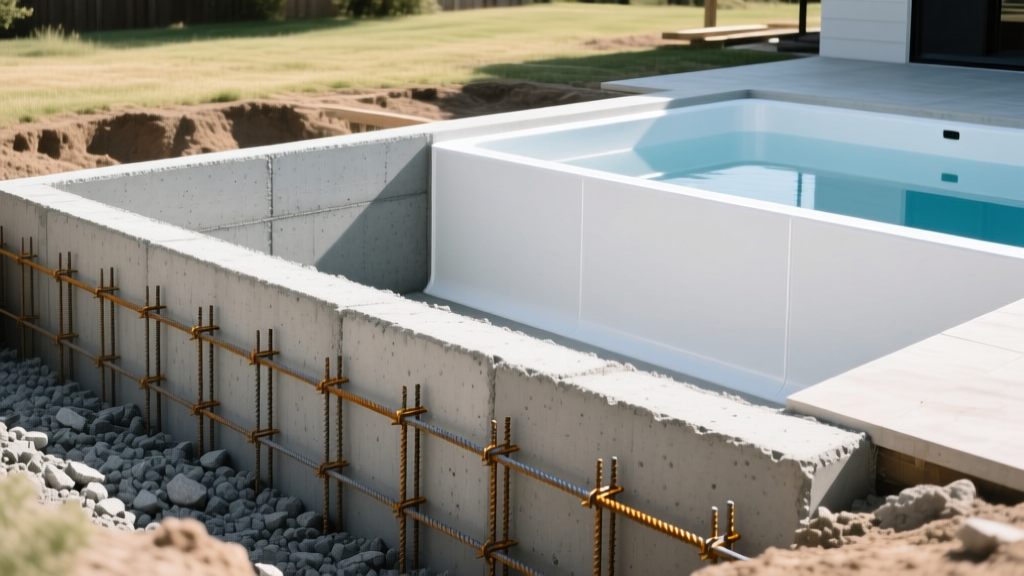
The concrete shell relies on a grid of Grade 60 steel rebar. Standard engineering for residential pools mandates #3 (3/8-inch) or #4 (1/2-inch) rebar spaced at 10 to 12 inches on center, both horizontally and vertically. The rebar must be tied and elevated using concrete dobies (chairs) to ensure it sits in the middle third of the shell thickness, providing a minimum of 2 inches of concrete cover to prevent corrosion.
Vinyl Liner Pools: The Hidden Structural Dependencies
When comparing a concrete pool vs liner, it is vital to understand what actually holds the water and the soil in a vinyl pool. The 20-mil to 30-mil vinyl membrane has zero structural rigidity. The structural work is performed by:
- Retaining Walls: Typically extruded polymer, galvanized steel, or aluminum panels. These are braced with diagonal steel struts anchored into the undisturbed soil.
- Simultaneous Backfilling: As the pool is filled with water, the exterior must be backfilled with clean, crushed gravel or flowable fill to balance the hydrostatic pressure. Failure to backfill simultaneously will result in the polymer walls bowing inward and collapsing under the water weight.
- The Floor Substrate: The pool floor is not structural concrete. It is typically a mixture of vermiculite and Portland cement (mixed at a 4:1 ratio) or a specialized pool grout, troweled smooth over the compacted earth. This substrate provides a smooth surface for the liner but cannot resist hydrostatic uplift.
Cost and Lifecycle Comparison Matrix (2026 Estimates)
While the initial installation cost of a vinyl liner pool is lower, the 20-year lifecycle cost often narrows the gap due to mandatory liner replacements and structural maintenance. The Pool & Hot Tub Alliance (PHTA) notes that proper maintenance heavily dictates the lifespan of both systems.
| Cost Category | Concrete Pool (Shotcrete/Gunite) | Vinyl Liner Pool |
|---|---|---|
| Initial Excavation & Shell Construction | $65,000 - $95,000 | $45,000 - $65,000 |
| Interior Finish (Plaster vs. Liner) | $8,000 - $15,000 (Pebble/Quartz) | $4,500 - $7,000 (Included in initial) |
| Lifespan of Interior Surface | 15 - 25 years | 7 - 10 years |
| 20-Year Interior Replacement Cost | $0 - $15,000 (1 replaster) | $9,000 - $14,000 (2 replacements) |
| Chemical & Maintenance Costs (Annual) | Higher (Requires acid washing, higher chlorine) | Lower (Non-porous surface resists algae) |
Decision Framework: When to Choose Concrete Over Liner
Use this site-specific framework to determine which structural system is appropriate for your project:
Decision: Choose Concrete. A concrete shell can be engineered with hydrostatic relief valves and a heavy enough mass to resist uplift. Vinyl liner floors will 'float' and wrinkle violently if groundwater rises beneath the vermiculite floor.
Decision: Choose Concrete. Expansive soils swell when wet and shrink when dry. A heavily reinforced concrete shell can bridge minor soil movements. Polymer walls in a liner pool are highly susceptible to bowing and track deformation under lateral clay pressure.
Decision: Choose Vinyl Liner. If the site has stable, well-draining soil and the client desires a standard rectangular or kidney shape with a lower upfront capital expenditure, a polymer-walled liner pool is the most cost-effective solution.
Frequently Asked Questions
Can you convert an existing vinyl liner pool into a concrete pool?
No. The structural systems are fundamentally incompatible. A vinyl liner pool relies on thin polymer or steel walls that cannot support the immense weight and lateral pressure of pneumatically applied concrete. Converting a pool requires complete demolition of the existing walls, excavation, and building a new rebar and concrete shell from scratch.
Does a shotcrete pool shell require curing?
Yes, curing is non-negotiable. Because shotcrete and gunite have low w/c ratios and high surface-area-to-volume ratios, they are highly susceptible to rapid moisture loss. The shell must be kept continuously wet for a minimum of 7 days using soaker hoses or sprinklers. Failure to wet-cure will result in map cracking and a significant reduction in the concrete's ultimate compressive strength.
How does aggregate size affect the concrete pool mix?
Aggregate size is strictly limited to a maximum of 3/8-inch (pea gravel) for pool applications. Larger aggregate increases the risk of hose blockages during pneumatic application and prevents the concrete from fully encapsulating the tightly spaced rebar grid. Properly graded 3/8-inch aggregate ensures a dense, homogenous matrix that minimizes voids behind the steel reinforcement.
Written by
Elena RodriguezElena Rodriguez is a civil engineer and technical writer specializing in concrete technology, masonry systems, and ASTM/ACI compliance. She earned her B.S. in Civil Engineering from Texas A&M University and spent a decade at a materials testing laboratory, performing over 2,000 concrete compressive strength tests and masonry prism evaluations. Elena is an ACI-certified Field Testing Technician (Grade I) and a member of ASTM Committee C12 on Natural Building Stone. She currently consults on forensic engineering cases involving concrete failures and moisture intrusion. Based in San Antonio, TX, Elena is a proud member of the Society of Women Engineers (SWE) and coaches her daughter's FIRST Robotics team.
More from Elena Rodriguez
View all
Walls & Panels
Cost Analysis: Light Gauge Steel Framing Advantages and Disadvantages
Evaluate light gauge steel framing advantages and disadvantages through a strict cost analysis lens, comparing material, labor, and lifecycle expenses.
Aug 4, 2026

Walls & Panels
Gypsum Board Types: Exact Specifications, Thickness & Dimensions
Compare standard, Type X, and moisture-resistant gypsum board types. Get exact specifications, thicknesses, dimensions, and ASTM standards for your project.
Aug 4, 2026

Fire Resistance
Best Fire-Resistant Outdoor Decking Materials: 2026 Buyer Guide
Discover the best fire-resistant outdoor decking materials for 2026. Compare Class A PVC, aluminum, and hardwood options for WUI compliance and safety.
Aug 4, 2026