Concrete vs Asphalt Cost: Driveway Paving Breakdown
Compare concrete vs asphalt cost for driveways. Explore current pricing, lifecycle maintenance, and ROI to choose the right paving material.

The True Cost of Paving: Beyond the Initial Quote
When evaluating paving materials for residential driveways, commercial parking lots, or rural access roads, the debate almost always centers on the upfront price tag. However, a true concrete vs asphalt cost analysis requires looking past the contractor's initial bid. The financial reality of paving is dictated by base preparation requirements, regional climate impacts, long-term maintenance schedules, and the ultimate lifespan of the surface. In 2026, material volatility and labor shortages have shifted the pricing landscape, making lifecycle cost analysis more critical than ever for property owners and developers.
- Asphalt Driveway: $8.00 - $14.00 per square foot (installed)
- Standard Concrete Driveway: $12.00 - $18.00 per square foot (installed)
- Decorative/Stamped Concrete: $18.00 - $28.00+ per square foot (installed)
Note: Prices assume a standard 2-car residential driveway (approx. 600 sq ft) with moderate site preparation. Extreme grading or demolition will increase costs.
Initial Installation: Concrete vs Asphalt Cost Matrix
The upfront cost difference between asphalt and concrete is primarily driven by material composition and curing times. Asphalt (bitumen mixed with aggregate) is a petroleum-based product, meaning its price fluctuates with global crude oil markets. Concrete (Portland cement, water, and aggregate) is generally more stable in price but requires more intensive labor for forming, finishing, and curing.
| Cost Factor | Asphalt (Standard) | Concrete (Standard Broom Finish) |
|---|---|---|
| Material Cost | $2.50 - $4.50 / sq ft | $4.00 - $7.00 / sq ft |
| Labor & Equipment | $3.50 - $6.00 / sq ft | $5.00 - $9.00 / sq ft |
| Base Prep (Aggregate) | $2.00 - $3.50 / sq ft | $2.50 - $4.00 / sq ft |
| Curing/Usability Time | 48 - 72 hours | 7 days (vehicles), 28 days (full cure) |
| Total Estimated Range | $8.00 - $14.00 / sq ft | $11.50 - $20.00 / sq ft |
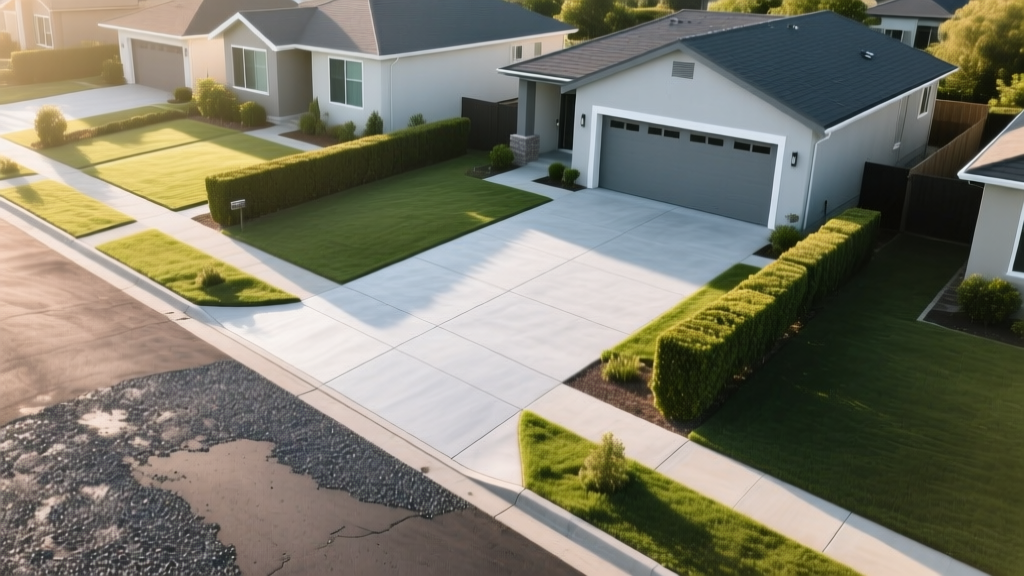
Long-Term Financial Impact: Maintenance and Lifespan
According to lifecycle cost analysis frameworks established by the Federal Highway Administration (FHWA), the lowest initial bid rarely equates to the lowest long-term cost. To accurately compare concrete vs asphalt cost, you must map out a 30-year maintenance ledger.
Asphalt Maintenance Realities
Asphalt is a flexible pavement. While this flexibility helps it survive minor ground heaving, it makes the surface highly susceptible to UV oxidation, water penetration, and chemical spills (like motor oil).
- Sealcoating: Required every 3 to 5 years. Cost: $0.15 to $0.30 per square foot. For a 600 sq ft driveway, expect to pay $90 to $180 per application.
- Crack Filling: Annual inspection and routing/filling of transverse cracks is mandatory to prevent base failure. Cost: $1.00 to $2.50 per linear foot.
- Overlay/Resurfacing: After 15 to 20 years, asphalt typically requires a 1.5-inch mill-and-overlay to restore structural integrity, costing $4.00 to $7.00 per square foot.
Concrete Upkeep and Repair
Concrete is a rigid pavement. When properly engineered with a 4,000 PSI mix design, 3/4-inch aggregate, and 5-7% air entrainment (critical for freeze-thaw climates), it requires significantly less routine maintenance. The American Concrete Institute (ACI) emphasizes that proper jointing and curing are the primary defenses against premature degradation.
- Sealing: Optional but recommended every 3 to 5 years to resist de-icing salts and staining. Cost: $0.50 to $1.00 per square foot (penetrating silane/siloxane sealers).
- Joint Resealing: Polyurethane joint sealant may need replacement every 10 to 15 years to prevent water from washing out the subbase. Cost: $2.00 to $4.00 per linear foot.
- Slab Replacement: If a panel fails due to root heave or severe spalling, individual panels can be saw-cut and replaced without disturbing the rest of the driveway.
Application Showcase: Where Each Material Wins
The decision between concrete and asphalt should not be based on cost alone; it must be matched to the specific physical and environmental demands of the application.
Choose Asphalt For:
- Extreme Cold Climates: Asphalt's flexibility allows it to withstand deep frost heaves without catastrophic cracking, provided the subbase is well-drained.
- Short-Term Ownership: If you plan to sell the property within 5 to 7 years, the lower upfront cost of asphalt yields a better immediate ROI without waiting for concrete's long-term payback.
- Rural or Long Driveways: For driveways exceeding 1,000 linear feet, the sheer volume of concrete required becomes cost-prohibitive for most residential budgets.
- Winter Snow Melting: The dark color of asphalt absorbs solar radiation, accelerating snow and ice melt compared to light-colored concrete.
Choose Concrete For:
- Heavy Static Loads: RVs, boat trailers, and dump trucks will cause asphalt to rut and depress over time, especially in summer heat. A 5-inch thick, 5,000 PSI concrete slab with #4 rebar handles these loads effortlessly.
- Hot, Sunny Climates: Asphalt softens and tracks in temperatures above 90°F. Concrete remains rigid and reflects UV rays, reducing the urban heat island effect.
- HOA and Aesthetic Requirements: Concrete offers endless finishes (exposed aggregate, stamped, stained) that comply with strict architectural review boards.
- Nighttime Visibility: The high albedo (reflectivity) of concrete reduces the need for high-intensity exterior lighting along pathways and driveways.
Hidden Costs That Derail Paving Budgets
Contractor bids often exclude site-specific anomalies that can inflate the final invoice by 20% to 40%. When comparing your concrete vs asphalt cost estimates, verify whether the following are included:
1. Demolition and Haul-Away
Removing an existing concrete driveway requires heavy machinery (skid steers with hydraulic breakers) and high disposal fees at local landfills. Expect demolition costs of $2.50 to $4.50 per square foot. Asphalt removal is generally 30% cheaper and is highly recyclable; many contractors will credit you for the Reclaimed Asphalt Pavement (RAP) value.
2. Subgrade Stabilization
If soil testing reveals expansive clay or high organic content (peat), standard base preparation will fail. You may need to over-excavate 12 to 18 inches and backfill with geotextile fabric and engineered fill. This can add $3.00 to $6.00 per square foot to the project, regardless of the surface material chosen.
3. Drainage and Grading
Both materials require a minimum slope of 1/8 inch per foot (approx. 2% grade) for proper water runoff. If your site is flat, the contractor must build up the base or install trench drains (costing $100 to $300 per linear foot) to prevent water from pooling and destroying the pavement edges.
The 15-Year ROI Decision Framework
To finalize your decision, apply this practical framework based on your project parameters:
The Break-Even Point: Industry data shows that the initial premium paid for concrete is typically recouped around year 12 to 15 when factoring in the avoided costs of asphalt sealcoating, crack filling, and mid-life resurfacing. If your timeline is shorter than 10 years, asphalt is the mathematically superior choice.
Furthermore, real estate appraisals increasingly recognize the value of rigid paving. A well-maintained, broom-finished or stamped concrete driveway can increase overall property valuation by 1% to 3%, often yielding a 100%+ return on the initial material premium at the time of sale. Conversely, a 15-year-old asphalt driveway in poor condition will frequently result in a buyer requesting a $5,000 to $10,000 escrow credit for replacement.
Final Specifications for Contractor Bids
Do not accept vague proposals. To ensure you are comparing apples to apples, require your contractors to specify the following in their bids:
- For Asphalt: Specify a Superpave PG 64-22 binder mix (or regional equivalent), a 2-inch compacted surface course over a 1-inch binder course, and a minimum 6-inch compacted aggregate base.
- For Concrete: Specify a minimum 4,000 PSI mix design, 4-inch slab thickness (5 inches for heavy loads), #3 or #4 rebar on 18-inch centers (or heavy-duty welded wire mesh), and control joints cut to 1/4 the slab depth every 10 feet.
By mandating these structural baselines, you eliminate the risk of contractors undercutting competitors by sacrificing the hidden structural elements that dictate the true lifespan of your pavement.
Written by
David NakamuraDavid Nakamura is a licensed architect (AIA) and construction technology writer focused on sustainable building methods, mass timber engineering, and high-performance building envelopes. He holds a Master of Architecture from the University of Washington and is a certified Passive House Consultant (CPHC). David spent eight years at the Seattle firm Mithun, where he led the design of three LEED Platinum projects, before founding his own practice specializing in net-zero residential design. He serves on the editorial advisory board of GreenBuilder Magazine and has authored peer-reviewed papers on cross-laminated timber (CLT) connections for the Journal of Structural Engineering. In his spare time, David teaches woodworking at Pratt Fine Arts Center and kayaks the Puget Sound.
More from David Nakamura
View all
Construction Cost
Labor Cost to Build a Deck Per Sq Ft: 2026 Installation Guide
Discover the exact labor cost to build a deck per sq ft in 2026. This installation guide breaks down contractor rates, complexity factors, and hidden fees.
Aug 4, 2026

Construction Cost
How Much Does It Cost to Build a 3 Bedroom House? Financing Guide
Learn exactly how much it costs to build a 3 bedroom house and explore 2026 financing options, construction loan types, and budget frameworks for your build.
Aug 4, 2026

Construction Cost
Cost to Build a Tennis Court: 2026 Guide
How much does it cost to build a tennis court in 2026? Breakdowns for asphalt, concrete, and synthetic surfaces plus fencing and lighting.
Jul 30, 2026