Different Types of Concrete Finishes: Mix Design Guide
Explore different types of concrete finishes and the specific mix designs, slump ranges, and aggregates required to achieve flawless textured surfaces.

The Intersection of Mix Design and Surface Finishes
The aesthetic and functional success of any concrete slab is dictated long before the finishing tools touch the surface. While contractors often focus on the mechanics of troweling or brooming, the underlying concrete mix design—specifically the water-cementitious ratio (w/cm), aggregate gradation, and admixture profile—determines whether a finish will execute flawlessly or fail through scaling, crazing, or delamination. Understanding how to tailor the batch ticket to the desired surface texture is the hallmark of advanced concrete placement.
When evaluating the different types of concrete finishes, it is critical to recognize that a mix optimized for a smooth, burnished interior floor will catastrophically fail if used for an exposed aggregate exterior patio. The following guide breaks down the technical mix requirements, execution timing, and structural variables for the most common architectural and structural concrete finishes.
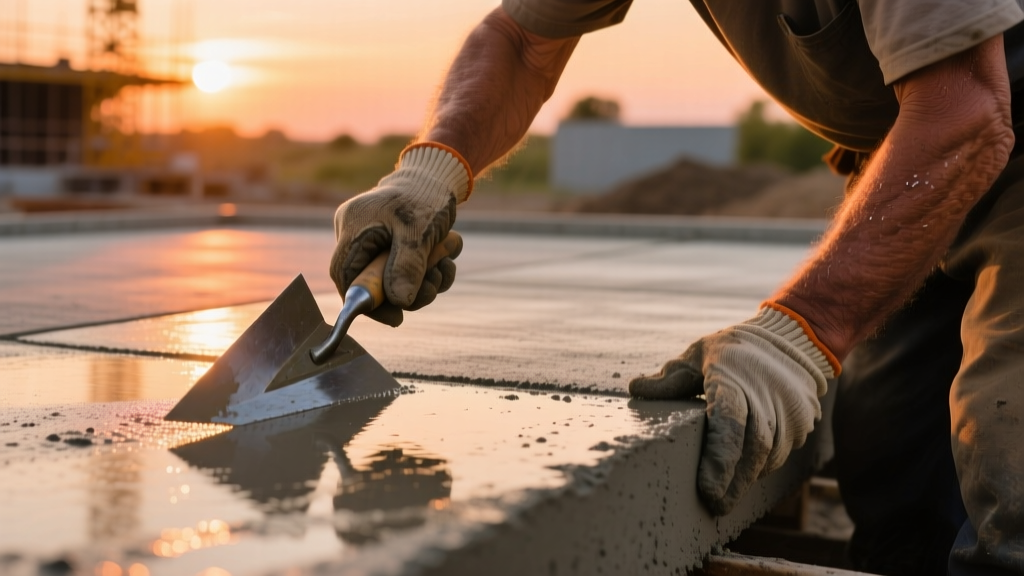
Breakdown of Different Types of Concrete Finishes
1. Broom Finish (Slip-Resistant Texture)
The broom finish is the standard for exterior flatwork, driveways, and municipal sidewalks due to its high coefficient of friction. Achieving uniform striations requires precise timing and a mix that resists excessive bleeding.
- Mix Specifications: Target a slump of 4 to 5 inches. The w/cm ratio should not exceed 0.45 to prevent surface crusting and subsequent scaling. Air entrainment of 5% to 8% is mandatory in freeze-thaw climates to provide microscopic relief valves for expanding water.
- Aggregate Profile: Maximum aggregate size of 3/4 inch. A well-graded sand fraction (fineness modulus of 2.6 to 3.0) ensures the paste is cohesive enough to hold the broom marks without tearing.
- Execution Timing: The broom must be pulled when the bleed water has completely evaporated and the concrete has stiffened enough to support the worker's weight with only a 1/4-inch indentation. Pulling too early causes the ridges to slump; pulling too late tears the surface paste, exposing fine aggregate and creating a dusting surface.
2. Smooth and Burnished Trowel Finish
Used for interior floors, warehouses, and architectural patios, a hard-troweled finish densifies the surface paste to create a smooth, low-porosity wearing course.
- Mix Specifications: Slump should be restricted to 3 to 4.5 inches. High-slump mixes (>6 inches) will trap excess water beneath the densified surface, leading to delamination and blistering. Specify a high cementitious content (minimum 500 lbs/cy) and consider supplementary cementitious materials like fly ash (Class F) or slag cement to improve workability without increasing water demand.
- Execution Protocol: Begin with a darby or bull float immediately after screeding to embed large aggregate. Follow with a Fresno trowel to bring paste to the surface. Final burnishing is done with a steel trowel (or a ride-on power trowel for large slabs) until the surface produces a distinct ringing sound, indicating maximum densification.
- Crucial Constraint: Never use a steel trowel on air-entrained concrete intended for exterior use. The steel traps the microscopic air bubbles at the surface, creating a weak layer that will inevitably scale during the first winter.
3. Exposed Aggregate Finish
This decorative finish removes the surface cement paste to reveal the natural beauty of the coarse aggregate, providing excellent slip resistance and a highly textured aesthetic.
- Mix Specifications: Slump of 4 to 6 inches. The mix must feature a visually appealing, uniformly graded coarse aggregate (often river gravel or crushed colored stone) with a maximum size of 3/4 inch to 1 inch.
- Chemical Retarders: To achieve a uniform exposure depth, a surface retarder (typically an ethylene glycol-based compound) is sprayed onto the freshly floated surface. This delays the hydration of the top 1/8 to 1/4 inch of paste without affecting the structural set of the slab below.
- Washing Phase: The surface is washed with a pressure washer (400 to 800 PSI) and a stiff-bristled broom the following morning. Washing too early dislodges the aggregate; washing too late leaves a hazy cement film that requires harsh acid etching to remove.
4. Stamped Concrete Finish
Stamping imprints patterns (such as ashlar slate or cobblestone) into the surface using polyurethane mats, requiring a mix that is plastic enough to accept the impression but stiff enough to hold the sharp edges of the pattern.
- Mix Specifications: Slump of 4 to 5 inches. The mix should include a mid-range water reducer (plasticizer) to achieve workability at a low w/cm ratio (0.40 to 0.45). High water content will cause the stamp mats to sink too deeply, blurring the joint lines and creating an uneven surface.
- Coloration: Integral liquid or powder pigments are added at the batch plant for base color. A dry-shake color hardener (applied at a rate of 0.6 to 0.75 lbs per square foot) is broadcast onto the surface and troweled in to provide a dense, abrasion-resistant, and highly pigmented wearing course.
- Release Agents: A secondary, contrasting antiquing release agent (powder or liquid) is broadcast over the surface before stamping to prevent the polyurethane mats from bonding to the concrete.
Mix Design Matrix: Matching Slump and Aggregate to Finish
Use the following matrix as a baseline when communicating with your ready-mix batch plant. Deviating from these parameters without specific admixture adjustments will compromise the finish integrity.
| Finish Type | Target Slump | Max Aggregate Size | Air Content (Freeze-Thaw) | Key Admixture Requirement |
|---|---|---|---|---|
| Broom | 4.0" - 5.0" | 3/4" | 5.0% - 8.0% | Air-Entraining Agent (AEA) |
| Smooth Trowel (Interior) | 3.0" - 4.5" | 3/4" | 0% - 2.0% | Water Reducer / Slag Cement |
| Exposed Aggregate | 4.0" - 6.0" | 3/4" - 1.0" | 5.0% - 7.0% | Surface Retarder (Post-placement) |
| Stamped | 4.0" - 5.0" | 3/4" | N/A (Rarely exterior) | Mid-Range Water Reducer |
According to the National Ready Mixed Concrete Association (NRMCA), adding water to the truck chute on-site to increase slump for easier finishing is the leading cause of surface defects. Every gallon of added water per cubic yard increases the w/cm ratio, reducing surface strength by up to 10% and drastically increasing the risk of plastic shrinkage cracking, craze cracking, and dusting. If the mix is too stiff, reject the load or use a high-range water reducer (superplasticizer) dosed strictly per ASTM C494 specifications.
Critical Admixtures for Finishing Success
Beyond basic water and cement, chemical admixtures are the primary tools for manipulating the setting time and workability of the paste to accommodate specific finishing techniques.
- Retarding Admixtures (ASTM C494 Type B): Essential for exposed aggregate and stamped concrete in high-temperature environments (above 85°F). Retarders delay the initial set by 1 to 3 hours, giving finishing crews adequate time to wash the surface or imprint mats without fighting a flash set.
- Accelerating Admixtures (ASTM C494 Type C): Calcium chloride or non-chloride accelerators are used in cold weather broom finishing to speed up the hydration process, reducing the window where the surface is vulnerable to freezing. Note: Calcium chloride must never be used in steel-troweled interior floors or reinforced concrete, as it promotes steel corrosion and exacerbates freeze-thaw scaling.
- Viscosity-Modifying Admixtures (VMAs): When designing high-slump mixes (6+ inches) for complex stamped or polished applications, VMAs increase the cohesiveness of the paste, preventing severe segregation and bleeding while maintaining high flowability.
Cost Implications and Labor Variables
The selection of a concrete finish directly impacts both material costs and labor hours. Highly textured or decorative finishes require specialized tools, secondary materials (color hardeners, release agents), and multi-day execution timelines.
| Finish Type | Material & Admixture Cost (per sq ft) | Labor & Finishing Cost (per sq ft) | Total Installed Range |
|---|---|---|---|
| Broom Finish | $0.15 - $0.25 | $2.50 - $4.00 | $6.00 - $9.00 / sq ft |
| Smooth Trowel | $0.10 - $0.20 | $3.00 - $5.00 | $5.00 - $8.00 / sq ft |
| Exposed Aggregate | $0.80 - $1.50 | $5.00 - $8.00 | $10.00 - $14.00 / sq ft |
| Stamped Concrete | $1.50 - $3.00 | $7.00 - $12.00 | $14.00 - $22.00 / sq ft |
Note: Pricing reflects national averages for standard 4-inch thick residential flatwork. Commercial specifications, thicker sections, or complex forming will increase costs accordingly.
Curing Protocols for Textured Surfaces
The curing method must be matched to the finish type to prevent surface desiccation and ensure the cementitious matrix reaches its design strength. The American Concrete Institute's Guide for Concrete Floor and Slab Construction outlines strict curing durations, but the methodology varies by texture.
For broom and smooth trowel finishes, wet curing using burlap or the application of a high-quality, wax-based curing compound (ASTM C309) is standard. Curing compounds must be applied immediately after final finishing once the surface sheen disappears.
For exposed aggregate and stamped concrete, liquid membrane-forming curing compounds are generally prohibited during the initial phase, as they will interfere with the washing process or the application of secondary sealers. Instead, these surfaces are typically covered with 4-mil polyethylene sheeting or specialized curing blankets for 48 to 72 hours. Once the concrete has cured and dried completely (usually 14 to 28 days), a solvent-based acrylic or polyurethane sealer is applied to enhance the color and provide UV and abrasion resistance.
By aligning the batch plant mix design with the specific mechanical and chemical requirements of the chosen finish, contractors can eliminate the most common causes of surface failure, ensuring a durable, architecturally precise result that meets both structural and aesthetic demands.
For further reading on long-term surface performance, the Portland Cement Association provides extensive data on how finishing techniques and mix proportions influence the freeze-thaw durability and abrasion resistance of architectural concrete over a 50-year lifecycle.
Written by
Elena RodriguezElena Rodriguez is a civil engineer and technical writer specializing in concrete technology, masonry systems, and ASTM/ACI compliance. She earned her B.S. in Civil Engineering from Texas A&M University and spent a decade at a materials testing laboratory, performing over 2,000 concrete compressive strength tests and masonry prism evaluations. Elena is an ACI-certified Field Testing Technician (Grade I) and a member of ASTM Committee C12 on Natural Building Stone. She currently consults on forensic engineering cases involving concrete failures and moisture intrusion. Based in San Antonio, TX, Elena is a proud member of the Society of Women Engineers (SWE) and coaches her daughter's FIRST Robotics team.
More from Elena Rodriguez
View all
Walls & Panels
Cost Analysis: Light Gauge Steel Framing Advantages and Disadvantages
Evaluate light gauge steel framing advantages and disadvantages through a strict cost analysis lens, comparing material, labor, and lifecycle expenses.
Aug 4, 2026

Walls & Panels
Gypsum Board Types: Exact Specifications, Thickness & Dimensions
Compare standard, Type X, and moisture-resistant gypsum board types. Get exact specifications, thicknesses, dimensions, and ASTM standards for your project.
Aug 4, 2026

Fire Resistance
Best Fire-Resistant Outdoor Decking Materials: 2026 Buyer Guide
Discover the best fire-resistant outdoor decking materials for 2026. Compare Class A PVC, aluminum, and hardwood options for WUI compliance and safety.
Aug 4, 2026